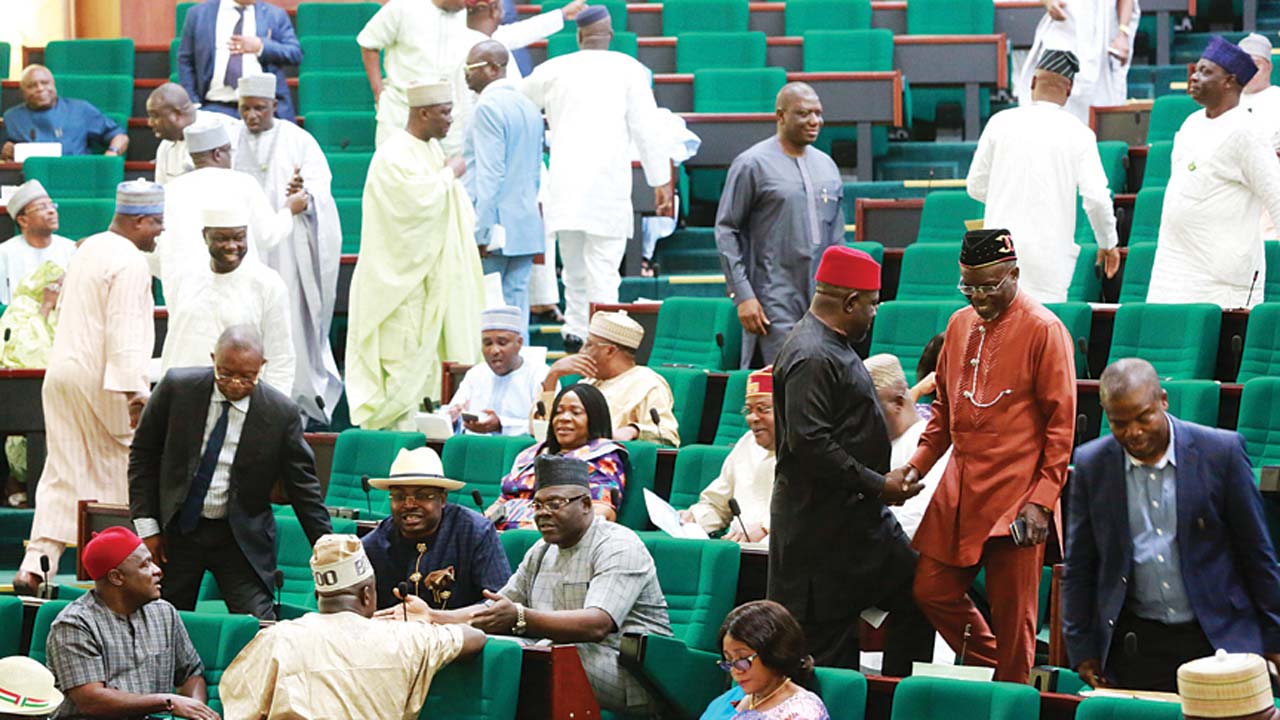
The House of Representatives on Thursday urged the Central Bank of Nigeria (CBN) to suspend the implementation of the cashless policy on deposits which took effect from Wednesday, 18 September, 2019 until appropriate and extensive consultative process is concluded.
Accordingly, the House mandated the Committee on Banking and Currency to interface with CBN to ascertain the propriety, relevance and the actual need for the implementation of that aspect of the cashless policy at this time considering the prevailing economic situation of the country and to report back to it within four weeks.
But analysts said it is not part of the role of lawmakers to issue such directive to the CBN.
“The National Assembly has the tendency of playing to the gallery and aligning with public sentiment,” said Taiwo Oyedele, head, tax and regulatory services, PwC.
He said it is not the role of the lawmakers to issue directives to the CBN. According to him, a better approach would have been to ask the CBN to provide data and explanation of possible impact of the policy and measures put in place to ensure desired outcomes.

The lower chamber of the National Assembly took these decisions Thursday during plenary, sequel to a motion on matter of urgent public importance moved by Benjamin Kalu (APC, Abia).
Kalu, while presenting the motion, said the House was against implementation of the policy as it would cause more hardships for Nigerians and negatively impact on micro, mini, small, and medium enterprises which he described as the engines of growth of the economy and employment generation.
These would throw “many of them out of business and sending more Nigerians into poverty, forcing more traders and micro investors to carry cash about with its attendant security challenges”, Kalu said.
“The House is aggrieved that while the impact of the cashless policy on withdrawals is still staring us all in our faces as well as other numerous burdensome charges by Nigerian Money Deposit Banks heavily impacting on businesses, the Central Bank of Nigeria deemed it necessary to impose the implementation of cashless policy on deposits without due consultations with all shades of stakeholder who will be impacted by the policy,” he said.
Meanwhile, the CBN has clarified that only the extra amount by which deposits and withdrawals exceed transaction thresholds for the implementation of cashless policy would attract charges.
Isaac Okoroafor, CBN’s director of corporate communications, made the clarification while featuring in an interview on Channels Television’s “Business Morning” programme on Thursday.

He explained that it was important for the CBN to reduce the use of cash so as to reap the benefits of cashless policy just like other countries.
The CBN had on Tuesday, in a circular to all Deposit Money Banks in the country, announced the commencement of its implementation of cashless policy which would impose charges on deposits in addition to already existing charges on withdrawals.
The charges, which took effect from Wednesday, September 18, will attract 3 percent processing fees for withdrawals and 2 percent processing fees for lodgments of amounts above N500,000 for individual accounts, while 5 percent processing fees for withdrawals and 3 percent processing fee for lodgments of amounts above N3,000, 000 would be charged for corporate accounts.
According to the circular, the charges on deposits would apply in Lagos, Ogun, Kano, Abia, Anambra, and Rivers States as well as the Federal Capital Territory, while nationwide implementation of the policy would take effect from March 31, 2020.
The CBN spokesperson pointed out that the apex bank’s decision to re-introduce the charges was in line with its overarching strategy of payment system vision 2020. “What it means is that our payment system should be organised in such a way as to make it safe and morally sound,” Okoroafor said.
The implementation of the cashless policy has, however, raised concerns among Nigerians and other key stakeholders in the nation’s financial industry.
Muda Yusuf, director-general of the Lagos Chamber of Commerce and Industry, said the implementation of the policy came at a time the country’s economy was in need of sustainable growth and development.
“The economy desires policies that are coherent consistent, coordinated, synchronised and transparent,” Yusuf said. “We need to boost the confidence of investors for such private capital flows to happen.”
Okoroafor, however, said the intention of the apex bank was not to inflict more hardship on the masses but to improve the accessibility of financial services in the country for Nigerian
“What we are doing is not to punish anybody, what we are doing is to make transactions easier for the ordinary man on the street and to also protect his account and business,” he said. “We are very glad that some people are seeing the reasons behind it and we urge Nigerians to please accept it.”
HOPE MOSES-ASHIKE, OLUWASEGUN OLAKOYENIKAN, Lagos, & JAMES KWEN, Abuja