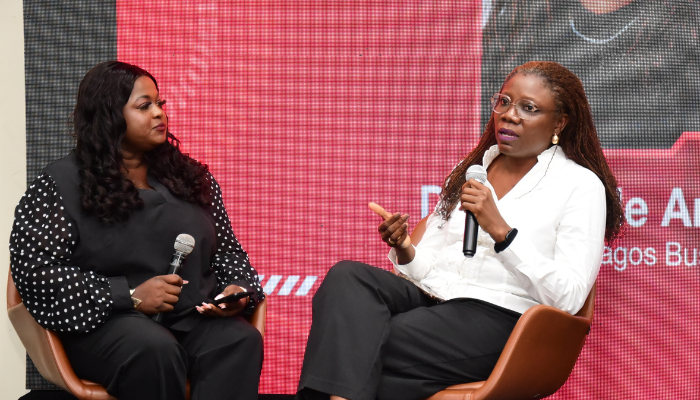
Artificial intelligence (AI) could provide transformative answers to some of Nigeria’s most pressing social deficits: education, healthcare, and poverty, if applied with foresight and inclusion, Yetunde Anibaba, senior lecturer in analysis of business problems and decision making at the Lagos Business School stated.
Speaking at a fireside chat during the BusinessDay AI Summit 2025 in Lagos on Friday, Anibaba argued that Nigeria must look beyond the hype around AI and ask how the technology can be directed toward solving the country’s problems.
Read also: Nigeria must build capacity, infrastructure, trust to shape its AI future – Experts
“We currently have about 18.2 million out-of-school children, roughly half of the global total. That makes Nigeria the epicenter of the world’s education crisis. AI won’t magically build schools or train teachers, but if we redefine education as helping people become more aware of their world and equipping them to solve problems, then AI tools can play a role, whether through personalized learning, language translation, or access to knowledge,” she said.

Anibaba also spotlighted Nigeria’s fragile healthcare system, where doctor shortages leave one physician serving an estimated 6,000 people, far below global standards. “Imagine how diagnostic AI or virtual consultation tools could extend access to underserved communities. If we fix education and health, we fix most of our social problems, because a healthy, educated person can create solutions for themselves and others,” she noted.
Poverty, she added, remains the third pillar of Nigeria’s entrenched social deficits, and here AI can enable smarter, data-driven interventions. “AI can help us map poverty in more granular ways and design targeted social policies. It’s about applying intelligence, not just technology,” she explained.
While emphasizing the opportunities, Anibaba also cautioned that AI comes with risks, including misinformation, bias, and job displacement. “Every technology has unintended consequences. Without frameworks to anticipate and mitigate them, Nigeria could face more harm than good,” she said.
She urged policymakers to adopt “anticipatory governance”, a proactive approach that prepares for long-term risks while enabling innovation. Regulation, she stressed, should “guide and protect without stifling” progress.
To build trust in AI adoption, Anibaba pointed to indigenous African leadership models rooted in collective responsibility, inclusion, and storytelling. “People must see the value of technology for themselves, not just be told to use it. Our traditional communal models can help bridge the trust gap,” she argued.

Read also: Efficiency, trade-offs are role of AI in the future of Journalism’
For Nigeria to truly harness AI, she averred that, digital exclusion must also be tackled, adding that, “If millions remain offline, they will remain excluded from the benefits of AI. Governance must therefore address not just the technology but also the human, cultural, and economic dimensions of adoption.”
“AI is just a tool. The real question is: what problems do we want it to solve, and who gets to decide?” Anibaba said.