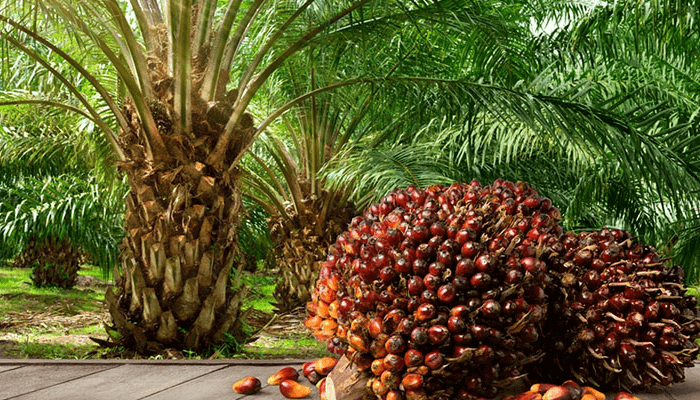
…Per hectare of palm replanting costs N2.3m
The average age of most palm trees in Nigeria is 60 years, and so are the smallholder farmers who harvest fruits to make the edible oil.
As the trees age, they are unable to absorb water or nutrients and are also vulnerable to deforestation, logging, drought, and invasive species, experts say.
The ages of farmers and trees are two critical challenges facing the nation’s palm oil, hindering the crop’s capacity to lead the non-oil exports sector.

“Most of the palm trees owned by smallholder farmers were planted during the 1960s, and the average age of the growers is 60 years,” said Alphonsus Inyang, president of the National Palm Produce Association of Nigeria (NPPAN), in a telephone response to questions.
Read also: Palm oil makers’ sustained gains pull N2.13trn investments
According to him, the economic lifespan of an oil palm tree is about 25 years–30 years, after which its production capacity begins to decline until it can no longer produce.
“Most of these old palm trees bear less fruits, and they are owned by smallholder farmers who produce 80 percent of our palm oil,” he explained.
He noted that the inability of farmers to access adequate and cheap long-term financing has made it difficult for farmers to replant old trees.

Inyang also said the industry is not yet attractive to the youth, which explains why it is yet to reach its potential.
“We need to start making palm oil production attractive to the youth through incentives because the investments in tree crops are very high, and most youths cannot afford it,” he said.
Africa’s most populous nation is the fifth largest producer of palm oil, accounting for two percent of global production.
The nation’s oil palm belt covers 24 states, including all nine states of the Niger Delta and the South-East part of the country.
Eighty percent of production comes from dispersed smallholders who harvest semi-wild plants and use manual processing techniques.
The country has the least yield per hectare among the top five palm oil producers, with an average yield of 2.5 million tons (MT) as against Indonesia’s 17MT and Malaysia’s 18.5MT per hectare, according to data from the Food and Agriculture Organisation (FAO).
Thailand, the third largest palm grower, has an average yield per hectare of 18.2MT, with Colombia having 16.5MT.
Read also: Old trees, weak reforms stall Nigeria’s palm oil growth
“We have one of the lowest yields per hectare, and this is because of the old trees in most palm oil producing regions,” said David Eghobamien, a palm oil farmer in Edo State.
The FAO data show that Nigeria’s oil palm fruit production has risen steadily since 2014.
It rose from 8.2 million MT in 2014 to 11.6 million MT in 2023, a 41 percent increase in nine years. This shows that the country is increasing its local production but at a slower rate, which experts attribute to low yields.
“Most of the palm trees have surpassed their economic lifespans and contribute very little now. Sadly, this is what you see in most of the farms owned by farmers,” said Eghobamien.
Hilary Uche Igwe, former president of the Oil Palm Growers Association, said the high cost of re-planting old trees and the long gestation of the commodity make replanting old trees difficult.
“It takes at least two years for the replanted palm trees to start fruiting. How do we survive before then?” he asked.
“This is why most of us have not started replanting most of the old trees we inherited from our parents,” he explained.
He noted that the lack of access to adequate and cheap financing by palm oil farmers has remained a major impediment that prevents investments in basic farm inputs needed to raise farm productivity.
“We have at most 150 stands per hectare of palm trees, and it costs an average of N15,000,” he said.
“Where will a smallholder farmer get N2.3million to replant old trees and wait for another three years to start reaping from it?” he asked.
Read also: Old trees, weak reforms stall Nigeria’s palm oil growth
Call for a dedicated fund
The unavailability of single-digit financing is often blamed for the nation’s inability to scale agribusiness to match continuous diversification rhetoric and boost productivity.
“We must have a dedicated fund for palm oil if we are truly serious about sustaining the current boom,” Inyang said.
He urged the government to put together a N1 trillion palm oil fund to support farmers, saying that it will enable the country to achieve its $1 trillion economy target.
“This will create 20 million direct jobs and over five million millionaires in rural communities.”