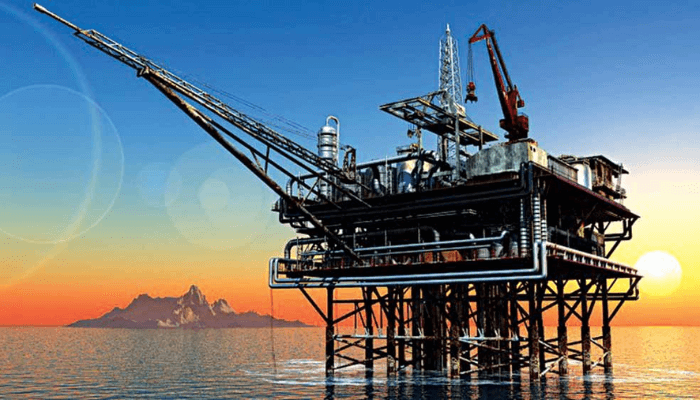
Nigeria’s deepwater oil production has plummeted to its lowest level in five years, underlining the growing structural and investment challenges facing Africa’s largest oil producer.
Latest industry data show the country’s deepwater output stood at 428,385 barrels per day (bpd) as of April 2025, a sharp decline from 629,558 bpd recorded in 2020, representing a 32 percent drop over the period.
This decline, occurring in what has traditionally been Nigeria’s most stable oil-producing zone, is triggering alarm among stakeholders and highlighting the urgent need for implementation of reforms to restore investor confidence and operational efficiency in the sector.
Read also: FG tasks NNPCL to boost oil production levels by 2026

A sector in decline
The deepwater segment, developed largely by international oil companies (IOCs) through complex offshore projects, has long provided a buffer against the more unstable onshore and shallow offshore regions plagued by insecurity and sabotage.
But the recent figures reveal that this once-dependable zone is now faltering.
Production figures from key operators – Shell, ExxonMobil, TotalEnergies, Chevron, and Eni – show an almost across-the-board reduction in output, with aging infrastructure and lack of new investments frequently cited as core reasons for the slump.
“No new investment has been made since the Egina project,” said the CEO of a Nigerian upstream company, who spoke on the condition of anonymity. “Delays in Final Investment Decisions (FIDs) for major projects like Bonga South West and ExxonMobil’s deepwater fields have hurt production and foreign investment inflows.”

Legal, regulatory hurdles
Industry analysts argue that the drop is not solely the result of aging oil rigs and field maturity, but also of regulatory inertia and slow implementation of reforms.
Ola Alokolaro, managing partner at Advocaat Law Practice, explained that “reforms are either under-implemented or too slow to reflect in real production gains.”
He pointed to maturing deepwater fields as a natural factor behind the decline but stressed that delayed FIDs are widening the supply gap.
“We must expedite amendments to our laws, resolve uncertainties surrounding Production Sharing Contracts (PSCs), and streamline regulatory approvals,” Alokolaro emphasised.
Indeed, one of the recurring complaints among oil majors is Nigeria’s sluggish bureaucratic processes that prolong project development timelines and inflate costs, making other jurisdictions like Guyana, Brazil, and Angola more attractive.
Read also: Oil to open higher as US strikes on Iran boost supply risk premium
Reforms: Promising on paper, awaiting action
There is some optimism that recent executive orders signed by the Nigerian government, which focus on cost reduction, tax incentives, and shortening contracting cycles, could be a turning point.
However, NJ Ayuk, executive chairman of the Africa Energy Chamber, offered a cautious perspective.
“These reforms are encouraging in theory,” Ayuk said. “But in oil and gas, especially in Nigeria, success is measured by execution. Unless these reforms are implemented with urgency and consistency, the benefits will remain hypothetical.”
Ayuk noted that most of Nigeria’s legacy deepwater fields are in decline, and only long-delayed mega projects can significantly lift output. “We need to get moving on project sanctions to prevent a continued slide in production.”
Field-specific analysis: Winners, losers
A granular look at field-level data from 2020 to April 2025 paints a more vivid picture of the crisis:
Bonga (Shell)
One of Nigeria’s flagship deepwater assets, Bonga’s output, has seen sharp fluctuations, from 117,506 bpd in 2020 to a low of 3,029 bpd in 2022, before bouncing back to 124,946 bpd in 2023.
While averaging around 127,600 bpd in 2025, Bonga has yet to break through its 2020 ceiling, indicating challenges in maintaining peak production.
Erha (ExxonMobil)
Erha has posted a worrying trajectory. From 64,419 bpd in 2020, production dipped to 60,268 bpd in 2022, peaked at 69,635 bpd in 2024, and declined again to 61,790 bpd by April 2025. The inconsistencies may reflect operational challenges and natural field depletion.
Usan (ExxonMobil)
Usan’s production has been notably erratic. From 37,192 bpd in 2020, output rose to 44,157 bpd in 2022 but fell sharply to 30,236 bpd in 2024. By March 2025, it had dipped further to 28,904 bpd, underscoring the lack of reliable recovery mechanisms or new wells.
Read also: Reps recover billions in debt from oil firms but public applause runs dry
Egina (TotalEnergies)
Once seen as the jewel in Nigeria’s deepwater crown, Egina’s output has been in freefall, from 154,027 bpd in 2020 to just 63,916 bpd by April 2025. The 58.5 percent plunge highlights the consequences of not replenishing reserves or conducting major reworks.
Agbami (Chevron)
Agbami has not been spared either. From 143,307 bpd in 2020, production dwindled to 95,782 bpd in 2024. Although 2025 data show a slight recovery, the field remains far from its historical highs.
Akpo (TotalEnergies)
Akpo’s fall has been steep, from 97,279 bpd in 2020 to 36,896 bpd in 2024. A marginal improvement has been observed in early 2025, but long-term sustainability appears questionable.
Abo (Eni)
In contrast to the general decline, Abo has demonstrated relative resilience. From 1,582 bpd in 2020, it rose steadily to maintain over 12,000 bpd in early 2025. While its scale is small, the consistency offers a rare bright spot.
Read also: Dangote, oil cartel and the inevitability of change
The cost of inaction
The plummeting figures are more than a statistical anomaly; they pose real threats to Nigeria’s economic stability. Deepwater oil revenues are crucial for budget planning, foreign exchange earnings and energy sector employment.
If Nigeria cannot reverse the trend, it risks losing its place among top African producers and missing out on billions in potential revenues.
As Brazil and Guyana continue to ramp up production and attract capital, Nigeria’s deepwater sector is at a crossroads. Either it accelerates the implementation of industry reforms, addresses infrastructure gaps, and offers clear investment incentives, or it continues its slow slide into irrelevance.
In the words of a senior oil executive, “The geology is not the problem; it’s governance. If Nigeria gets the rules right, the rigs will return.”
For now, however, the data tells a story of decline, one shaped by aging rigs, regulatory inertia, and a race against time.