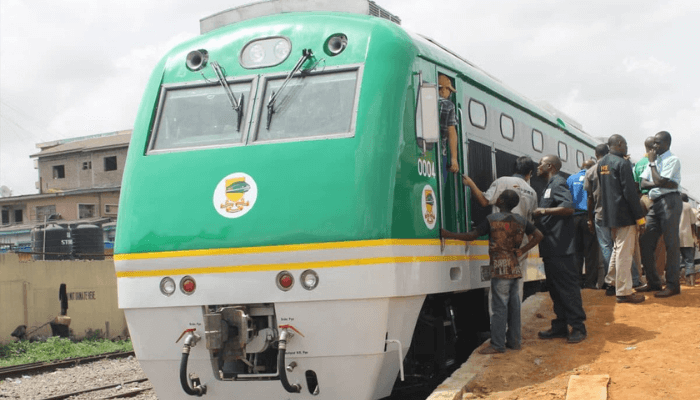
…NRC blames suspected track vandalism
The Nigerian Railway Corporation (NRC) has confirmed the derailment of Warri–Itakpe Train Service (WITS) on Saturday evening, just days after the route resumed operations following a temporary suspension.
In a statement signed by Kayode Opeifa, managing director and chief executive officer, the Corporation said the incident occurred at about 7:30 p.m. at Kilometer 212+8m, Agbor, involving two of the seven coaches on the train.
Preliminary investigations, according to the NRC, suggest that the derailment may have been caused by suspected track vandalism.

“The Management of the Nigerian Railway Corporation (NRC) wishes to inform the general public that a train derailment incident occurred yesterday at approximately 19:30 hours, involving two out of the seven coaches of our Warri-Itakpe Train Service (WITS) at Kilometer 212+8m, Agbor.
“Preliminary investigations indicate that the incident may have been caused by suspected track vandalism.
“We are pleased to confirm that all passengers on board were safely evacuated to Agbor, and everyone has been fully accounted for. No casualties or injuries were recorded.
“Our recovery team, supported by security personnel, has been at the site since last night carrying out recovery operations. These efforts are progressing steadily and are expected to be completed soon.
“As a precautionary measure, train services on the corridor have been temporarily suspended today to enable a comprehensive security and safety audit of the track and related infrastructure,” the statement read.

The NRC said its recovery team, supported by security personnel, had been at the site since Saturday night, carrying out recovery operations which are progressing steadily.
As a precautionary measure, the Corporation announced the temporary suspension of train services along the corridor to enable a comprehensive security and safety audit of the track and related infrastructure.
“We sincerely regret any inconvenience this may cause our valued passengers and the general public. Normal operations will resume as soon as it is verified safe to do so,” the statement added.
The derailment comes less than a week after the NRC resumed the Warri–Itakpe train service on October 29, 2025, following a temporary suspension to undertake critical repairs, maintenance, and system checks.
The Corporation had assured passengers at the time of its renewed commitment to providing safe, reliable, and efficient rail services across the country.
Meanwhile, the Nigerian Railway Corporation has raised fresh concerns over the increasing vandalisation of its electrical and signaling installations across key corridors, including Abuja, Lagos, Kaduna and Warri-Itakpe. The Corporation described the attacks as a major threat to safe and efficient train operations.
Confirming the arrest of two suspects in Kaduna, NRC said the individuals, Ibrahim Abdullahi (22) of Hayi, Rigasa, and Sani Ibrahim (24) of Layi Turaki, Rigasa, were apprehended by operatives of the Nigeria Police, Railway Command attached to the Abuja–Kaduna Train Service (AKTS) for vandalising cables at the Rigasa Train Station area.
The suspects were caught after a cable wire was discovered missing from one of NRC’s cranes stationed within the Rigasa facility on October 10, 2025. Acting on intelligence, a patrol team led by ASP Abdullahi Bwajin traced and arrested them.
During interrogation, they confessed to selling the stolen cable to a buyer identified as “Musa Major” for ₦90,000, with another accomplice, Abdulwahab Yakubu, currently at large.
The NRC commended the Railway Command for its swift action and assured that all perpetrators of such acts would face the full weight of the law.
Read also: NRC opens Abuja–Kaduna train platform for ticket payment
Opeifa, expressed deep concern over the recurring vandalisation incidents, describing railway electrical and signaling systems as Critical National Assets.
He warned that future offenders would be treated as economic saboteurs with severe legal consequences.
He also appealed to members of the public, especially residents of railway host communities, to collaborate with security agencies in safeguarding rail infrastructure.
“The railway system is a catalyst for community development and improved livelihoods. Protecting it is a collective responsibility,” Opeifa stated.