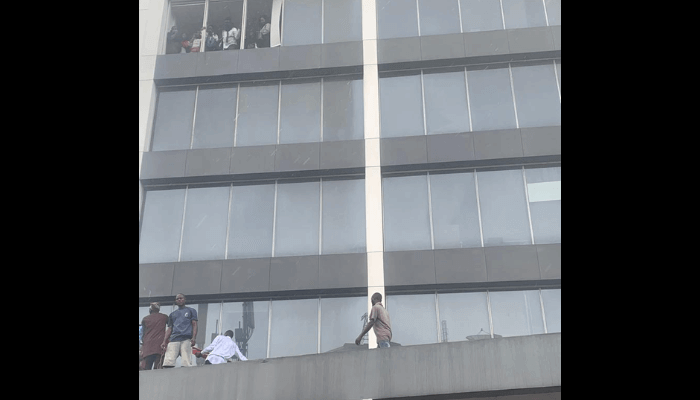
The Lagos State Fire and Rescue Service (LSFRS) has confirmed that casualty figures in the unfortunate fire incident at Afriland Towers on Broad Street, Lagos Island, has risen to 10, comprising adult males and females.
Margaret Adeseye, LSFRS Director, revealed this in an update report on the fire incident, saying, “further investigation with the Afriland team has revealed that 10 adult males including females were confirmed dead afterwards.”
The Federal Revenue Service (FIRS), one of the tenants in the building, is in deep pains, having lost its top management staff to the inferno, according to Dare Adekanmbi, the Special Adviser on Media to the FIRS chairman.
These staff include Ekelikhostse George, an Assistant Director; David Sunday-Jatto, Assistant Director; Nkem Onyemelukwe, Senior Manager, and Peter Ifaranmaye, Manager. Jatto’s case is said to be the most unfortunate as he was in the office on that day to hand over officially to his successor after his redeployment to another branch.

Read also: Afriland fire: NLC seeks thorough investigation
The tragic fire incident which also occurred in a neighbouring building on that fate day has sparked criticisms and condemnation of safety consciousness in the country, especially in high-rise buildings which, according to experts, is below par.
Both experts and cursory onlookers were confounded with the helplessness of the occupants of the Afriland Towers when the fire started and dark smoke engulfed the entire building, constraining escape and leading to the death of some of the occupants.
To avert future occurrences and stop losses of this magnitude in future, experts have put forward a number of measures that both the government and building owners need to put in place.
Above all things, it has become necessary in view of recuring fire incidents, for the government to take physical planning and building regulations seriously. Regulation, according to Hakeem Oguniran, CEO, Eximia Realty Company, is very important development.

He explained that it creates the framework for aligning the interests of the primary and secondary participants in the real estate value chain, and also sets the standards for compliance and instituting the penal regime for infractions and breaches.
“Regulation is important for establishing the institutional framework for the implementation of extant laws and subsequent reviews and amendments. It enforces compliance with ethical, professional and other industry standards and eliminates sharp practices and misconduct,” he explained further.
Francis Oledibe, a public affairs commentator, wants the government to build more fire stations, especially in high density neighbourhoods like Lagos Island, hoping that response in case of any emergency will be swifter and timelier, leading to the safety of life and property.
“We have seen cases where fire fighters come several hours after calling them and this is because they are not always near the scene of the incident or they are held up in traffic. These men are supposed to be the first responders but most times, they are not,” Oledibe lamented.
A structural engineer, who did not want to be named, told BusinessDay on phone that to prevent fire incidents in high-rise buildings, builders should employ a layered approach, including fire-resistant construction materials and compartmentation; active fire systems such as alarms, sprinklers, and extinguishers. Other ways to prevent the incidents are to mark clear evacuation routes, put in place comprehensive emergency plans and drills, regular maintenance of all systems, and community education on safety procedures.
“High-rise buildings present unique fire prevention and safety challenges, making it crucial for all stakeholders, including property developers, owners, and authorities, to prioritize protective measures. The private sector plays a significant role in this endeavour, as property developers and building owners need to implement robust safety practices to safeguard their assets and the well-being of their tenants,” the engineer advised.
The engineer advised further that governments in Nigeria should learn from UAE authorities who have introduced stringent building codes to enhance fire safety standards, reduce life risks, and minimize property loss in high-rise buildings.
These regulations, he explained, focus on using fire-resistant materials, improving fire detection and suppression systems, and ensuring that buildings have effective emergency evacuation plans, adding that, while these governmental measures are crucial steps toward mitigating fire risks, the collaboration of the private sector is equally vital.
“Property developers and building owners must proactively adhere to these regulations and adopt additional safety practices. This includes regular safety audits, investing in high-quality fire-resistant materials, implementing advanced fire alarm systems, and conducting routine tenant training on fire evacuation procedures. By doing so, they comply with the national building codes, create a safer environment for occupants, and reduce the likelihood of catastrophic damage.
Oledibe recommended that government should build accessible roads because, according to him, most times, the reason losses to fire incidents are of great magnitude is because roads to the scene of incidents are not accessible. “Government should build roads that could allow for free vehicular movements in case of emergency,” he said.