



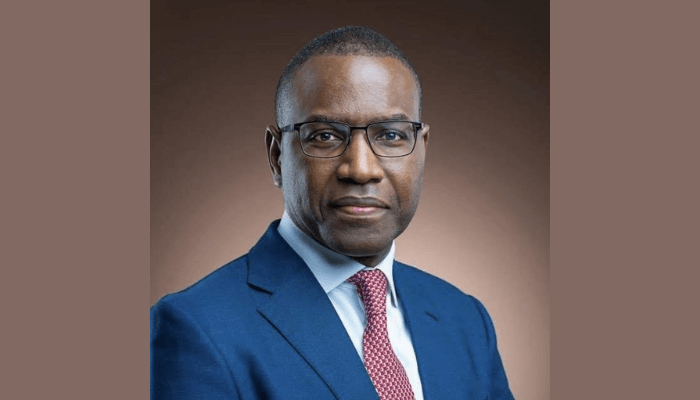
On the streets of Yeumbeul—a working-class neighborhood on the outskirts of Dakar—Amadou Hott’s journey to the frontlines of African finance began with a quiet obsession: solving math problems. Raised by a garbage truck driver and a housewife who believed fiercely in the power of education, Hott went on to study applied mathematics, build a career in international investment banking, and serve as Senegal’s economy minister and a vice president at the African Development Bank.
Now, as he vies for the presidency of the AfDB, Hott brings not just credentials, but conviction. He believes the continent stands at an inflection point: either seize the moment to become a global economic force—or risk being left behind in a fast-moving world shaped by green energy, artificial intelligence, and geopolitical realignments.
In this interview with Lolade Akinmurele, deputy editor at BusinessDay, Hott shares how his upbringing shaped his worldview, what the AfDB must do differently to serve a rising Africa, and why self-reliance—not donor dependency—must define the next chapter of the continent’s development. Excerpts.
What was it like growing up in Yeumbeul, solving mathematics while being raised by a truck driver and a housewife, studying applied mathematics, and becoming an economist and investment banker?

Growing up in Yeumbeul, one of the most disadvantaged neighborhoods of Dakar, Senegal, shaped everything I am today. My parents deeply believed in the power of education, the value of hard work, and the promise of possibility. This kind of story is not new in Africa—it has been told for generations and remains true today. It has fueled my passion for impact and ultimately led me to a 25-year career in finance, development, and public governance, all dedicated to Africa.
Today, I am running for the Office of President of the African Development Bank because I believe in Africa’s immense potential—especially when we invest in education, skills development, energy, and regional integration. If we get this right, we can unlock unprecedented opportunities, particularly for youth and women.
What’s your plan for Africa as a new global economy unfolds?
As a new global economy takes shape—driven by technological shifts, demographic trends, declining international aid, and evolving trade dynamics—Africa must not be a bystander. We must be builders, brokers, and bold leaders in this new era.
My plan is rooted in a simple but powerful truth: Africa is not lacking in potential; it is lacking in scaled, coordinated, integrated, and catalytic action. That’s where the African Development Bank must lead—with purpose and precision.

Africa holds 60% of the world’s uncultivated arable land, abundant energy resources, and a vast demographic asset. We must become a global hub for industrialization, adding value to our raw materials—especially critical minerals—at home, creating jobs for our youth, and exporting competitive products to the world. The Bank must aggressively finance smart value chains.
The African Continental Free Trade Area is a generational opportunity, but integration requires more than agreements; it needs roads, railways, digital infrastructure, energy corridors, and harmonized regulations. I will ensure the Bank doubles down on regional infrastructure and becomes the driver of connectivity—so that goods, people, data, and ideas can move freely across borders.
Africa’s youth are not a burden—they are our greatest competitive advantage. But we must invest in them through education, digital skills, entrepreneurship, and access to finance. The Bank must lead a continent-wide effort to align skills development with the jobs of the future and support countries in building inclusive innovation ecosystems.
Africa’s wealth must work for Africa. We must unlock domestic financial markets, attract private sector investment, and mobilize the trillions of dollars available across the continent. The Bank must act as a catalytic platform—connecting capital to projects and projects to impact.
Africa must not negotiate from the sidelines. We must be at the table, setting the agenda. Whether on trade, climate resilience, finance, or technology, the Bank must support member states in shaping a common African voice in global forums—backed by data, strategy, and solutions.
This moment calls for boldness, not business as usual. I am ready to lead the Bank as Africa’s engine in the new global economy—an institution that delivers at speed, at scale, and with impact. An institution that drives the continent’s self-reliance. That is my commitment. That is my plan.
In the face of trade tensions and dwindling aid from donors, how does Africa become self-reliant?
Geopolitics should not derail Africa’s development. If anything, they must push us to become even more strategic. Africa is standing before a formidable opportunity to chart its path, achieve self-reliance, and accelerate regional integration. That future cannot depend primarily on aid—aid must be catalytic, not the endgame.
We must increasingly rely on our own wealth, our private sector, our institutions, and our people. Self-reliance does not mean isolation. It means empowerment, ownership, and the ability to shape our destiny—engaging the world as equals.
To meet this moment, the African Development Bank must evolve into a faster, more innovative, and more self-reliant institution. One deeply rooted in the continent, capable of mobilizing domestic resources at scale, attracting private capital through effective public-private partnerships, and unleashing our youth’s entrepreneurial potential.
I see three strategic shifts the Bank must make to drive this transformation:
-
We must deploy financial innovation more aggressively—through hybrid capital platforms and guarantees—to strengthen the Bank’s capacity to invest and lend. We must gradually leverage the African Development Fund through market borrowings in a financially sustainable way, enabling more concessional lending to the 37 lowest-income countries on the continent.
-
We must unlock Africa’s capital. The continent holds over $2.5 trillion in assets among high-net-worth individuals and another $2 trillion with institutional investors. We must mobilize these resources through tailored vehicles. We must also help governments boost domestic revenue generation and support private sector growth and participation.
-
The Bank must become a trusted platform—connecting African capital with bankable projects, while ensuring those projects are prepared, implemented, and delivered with impact. Every dollar spent must unlock multiple dollars in third-party capital and create tangible social and economic value. This requires deploying top talent, ensuring quality procurement, and executing with discipline, accountability, and results.
Africa’s future will not be built on dependency, but on our own wealth, talent, and the ability to scale ideas into transformative action. The African Development Bank must be at the heart of that transformation.
This is not theoretical for me. I have done it before.
At UBA Capital (now United Capital) in Nigeria, I led one of the country’s most credible investment banks. I later created Senegal’s sovereign wealth fund, FONSIS, which became a pan-African benchmark by attracting both domestic and international capital into strategic sectors like health, agriculture, and infrastructure—all while keeping national priorities at the center.
As the Bank’s Vice President for Energy and Climate Change and as Senegal’s Minister of Economy and Planning, I have led large-scale reforms and financing efforts across the public and private sectors. I am motivated by that same mission today: to help Africa rise by its own means—and to lead the Bank in becoming the catalyst that makes that rise possible.
How will your experience as a public servant and private sector player influence your work as AfDB President?
Over the past 25 years, I’ve served Africa in leadership roles across both public and private sectors—at national, continental, and institutional levels. This journey has given me a 360-degree perspective on what drives success, what holds us back, and what it takes to turn vision into lasting impact.
I began my career in international finance, working in New York, London, Dubai, and Lagos. As CEO of UBA Capital in 2009, I led the transformation of the firm into one of Nigeria’s most credible investment banks. We executed landmark transactions, including the country’s largest corporate bond and West Africa’s first hybrid capital issuance.
This work allowed me to mobilize billions of dollars for African governments and private firms, and to create innovative tools for driving Africa’s transformation at scale. I also advised conglomerates like the Dangote Group on strategic investment decisions.
Driven by a desire to serve, I returned to Senegal to launch the sovereign wealth fund, FONSIS. Since its inception, the fund has attracted more than $10 for every dollar invested.
I was later appointed as the African Development Bank’s first Vice President for Energy and Climate Change. In under two years, we more than doubled the Bank’s private sector operations—proving what is possible when the Bank leads with ambition, scale, and speed.
As Senegal’s Minister of Economy and Planning, I led reforms to strengthen public-private partnerships, steered the country through one of its most difficult periods, and mobilized key development resources. I represented Africa at the G7 and G20 and co-chaired the Paris Summit for Financing African Economies in 2021.
These experiences have sharpened how I lead, build coalitions, and deliver results. They’ve also given me an operational understanding of the Bank and the reforms required to modernize it. I am ready to lead with clarity, credibility, and a steadfast commitment to inclusive, sustainable development for Africa.
By 2050, Africa’s working-age population will be 700 million. Will you encourage the idea of “exporting” emigration, as The Economist suggests?
By 2050, Africa’s working-age population will reach 700 million—an extraordinary opportunity, if we act boldly to transform this demographic trend into a dividend.
I do not believe Africa’s future should be built on exporting its talent out of necessity. Emigration must be a choice, not a development strategy. When our youth leave because they cannot find opportunity at home, that is not success—it is a sign that we must do more.
That said, I believe in mobility. African talent is already contributing to global industries—from tech and medicine to academia. But as AfDB President, my priority will be to create the conditions for our youth to thrive at home: through investment in skills, entrepreneurship, regional value chains, and a more integrated African market.
Let’s build a continent where young people want to stay—where they can innovate, lead, and prosper. And when they do choose to go abroad, it should be on their terms—with strong ties to the continent, allowing them to contribute wherever they are.
Africa doesn’t need to “export” its future. It needs to invest in it.
What happened at the Africa CEO Forum? The debate didn’t happen.
We were all looking forward to the debate. I was fully available and committed to participating, because I believe platforms like these are essential for shaping the future of our continent.
We had a meaningful discussion in Washington, D.C., last April, and I was eager for a follow-up in Africa—especially in front of key public and private sector leaders. Unfortunately, the debate did not take place as planned, but I remain open and eager to engage in meaningful dialogue whenever the opportunity arises.
Africa deserves robust, constructive conversations. I look forward to being part of many more.
If the next five years of your life were a chapter in a book, what would it be about?
This chapter would tell the story of how, through determined leadership and bold partnerships, we unlocked Africa’s vast potential—turning challenges into opportunities.
It would chronicle the modernization of the African Development Bank into a faster, more innovative institution, deeply connected to the people and private sector actors it serves. It would highlight how we invested in Africa’s greatest assets—its youth, women, entrepreneurs, and businesses—creating jobs, expanding markets, and building greener, more resilient economies.
It would show how we strengthened regional integration, making Africa more connected and globally competitive. Above all, it would be a chapter about hope, agency, and ownership—how Africa advanced its self-reliance, with the African Development Bank as a trusted partner, catalyst, and enabler of private sector growth.
And as the final pages unfold, I hope it will inspire the next generation to carry the mission forward—with renewed energy and unwavering vision.





