…Released Q2 2024 figures in November 2024
It has been 14 months since the National Bureau of Statistics (NBS) last released official unemployment data, underscoring persistent weaknesses in Nigeria’s labour-market reporting and leaving Africa’s most populous nation trailing peers, including Ghana, South Africa, Morocco, Egypt, and Angola on data timeliness.
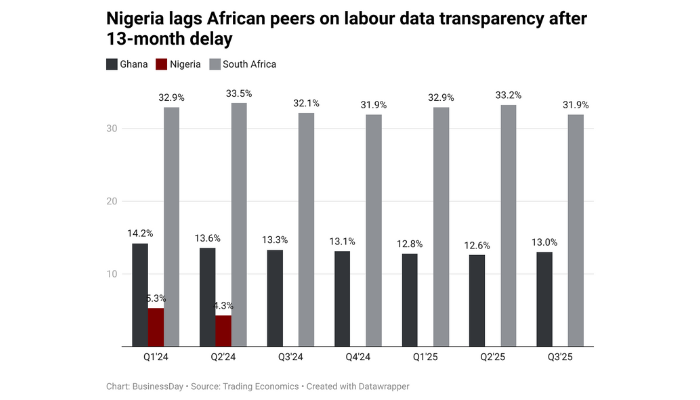
The country’s most recent unemployment figure – 4.3 percent for the second quarter (Q2) of 2024 – was published on November 25, 2024. No data has been released since then.
The delay follows a familiar pattern. In March 2023, BusinessDay reported that Nigeria had gone two years – between March 2021 and March 2023 – without publishing the critical macroeconomic data. The last report before that hiatus showed unemployment at 33.3 percent in the fourth quarter (Q4) of 2020.

Read also: Naira closes 2025 outside Africa’s top 10 worst currencies list
An official at the NBS, who requested anonymity, attributed the current delay to funding constraints.
“Some of these datasets are capital budget-funded, and this year the government has not released capital allocations, which explain the delay,” the official said. “The labour force survey is funded from the capital budget. Without funding, the NBS cannot carry out the exercise.”
Policy-making in the dark
Unemployment data is used in assessing economic performance, guide policy decisions, and hold governments accountable. Analysts say prolonged delays undermine economic planning and weaken Nigeria’s credibility.

“How do you design effective policy without up-to-date data?” asked Muda Yusuf, founder and CEO of the Centre for the Promotion of Private Enterprise. “Planning in both the public and private sectors suffers. Data quality is critical, and timeliness is a key component of quality data.”
Yusuf added that without current statistics, effective economic management, corporate strategy, and business decision-making become extremely difficult.
Methodology shifts and distorted signals
Following criticism over earlier delays, the apex statistical agency said in 2023 that it was working with the World Bank, the International Labour Organization, and other partners to improve the methodology of Nigeria’s labour force survey.
When the revised methodology was applied and data released in August 2023, the unemployment rate dropped significantly to 5.3 percent in Q4 2022 from 33.3 percent in Q4 2020. The change stemmed largely from a new definition of employment, which counts anyone who worked at least one hour per week for pay or profit, compared with the previous 40-hour threshold.
While the revised framework led to higher employment rates and lower unemployment figures, analysts argue it masks deeper structural problems. The rise in employment reflects survival-driven activities in the informal sector, as harsh operating conditions push young Nigerians into self-employment and informal work.
Read also: Cautious investors drag Africa’s private equity market to 5-year low
“One of Nigeria’s biggest challenges is that we plan and design programmes in the dark, and unemployment policy is no different,” said Olamide Adeyeye, country head of programmes at Jobberman Nigeria. “The absence of up-to-date data prevents effective programming.”
Adeyeye questioned whether existing interventions even address underemployment or the working poor. “I am not aware of any, largely because many interventions are neither properly documented nor published,” he said.
Patchy releases, missing quarters
In August 2023, the NBS released two unemployment reports at once—Q4 2022 (5.3 percent) and Q1 2023 (4.1 percent). Four months later, Q2 data showed unemployment rising to 4.2 percent following petrol subsidy removal and naira devaluation, which intensified inflationary pressures.
In 2024, unemployment figures were published for three quarters, rising to 5.0 percent and 5.3 percent before easing to 4.3 percent in Q3 2023, Q1 2024, and Q2 2024, respectively. Data for Q4, however, was never released.
Adeyeye warned that missing data leads to blind policymaking. “You end up addressing problems that do not exist while failing to tackle the real ones,” the firm said. “It becomes a trial-and-error policy that rarely delivers sustainable solutions.”
The latest labour report showed that self-employment accounted for 85.6 percent of total employment in Q2 2024, up from 84.0 percent in the previous quarter. The share of employees fell to 14.4 percent from 16.0 percent.
A recent Nigerian Economic Summit Group (NESG) report found that the formal sector accounted for just 7.0 percent of employment, with about 86 percent of Nigerians engaged in self-employment or unpaid work.
“This highlights the need for governments at all levels to create a more enabling business environment,” the report said. “A business-friendly climate would improve productivity, encourage formalisation, and boost tax revenue.”
Falling behind African peers
Nigeria’s data delays stand in contrast to several African peers.
Africa’s biggest economy, South Africa, released its Q3 2025 unemployment data in November, showing a decline to 31.9 percent from 33.2 percent in the previous quarter. Statistics South Africa published Q2 and Q1 data in August and May, respectively.
Ghana released its Q3 unemployment data – 13.0 percent – on December 18, while Q2 figures were published in August.
Angola’s unemployment rate, released earlier in December, fell quarter-on-quarter to 26.9 percent from 28.1 percent. Unemployment in Egypt and Morocco, both released last month, rose to 6.4 percent and 13.1 percent, from 6.1 percent and 12.8 percent, respectively.
“Countries that publish unemployment data on time show seriousness about job creation and labour-market reforms,” Adeyeye said.
Read also: AfDB sees Africa’s economy hitting $5.23trn by 2035 on AI boom
Wider data credibility concerns
Unemployment is not the only dataset Nigeria has delayed. The National Multidimensional Poverty Index (MPI) was last released in November 2022. Since then, the World Bank has published more recent poverty estimates, often sparking disputes with Nigerian authorities.
In its latest Nigeria Development Update, the World Bank estimated that 139 million Nigerians were living in poverty—an assessment the government rejected.
Similarly, capital importation data for Q1 this year was released only in August, showing a 67 percent year-on-year increase to $5.64 billion, driven mainly by portfolio inflows into the banking sector.
But updates to GDP and the Consumer Price Index have been more consistent. The country’s economy grew to 3.98 percent in Q3, down from 4.23 percent in Q2, while headline inflation slowed for an eighth consecutive month to 14.45 percent in November, from 16.1 percent in October, according to the NBS.
Still, confidence in official statistics remains fragile.
“The key issues are frequent methodology changes in core indicators such as inflation and unemployment, which do not always reflect lived realities,” said Abimbola Adewale, a Lagos-based analyst. “This has raised serious concerns about data credibility under the current NBS leadership.”