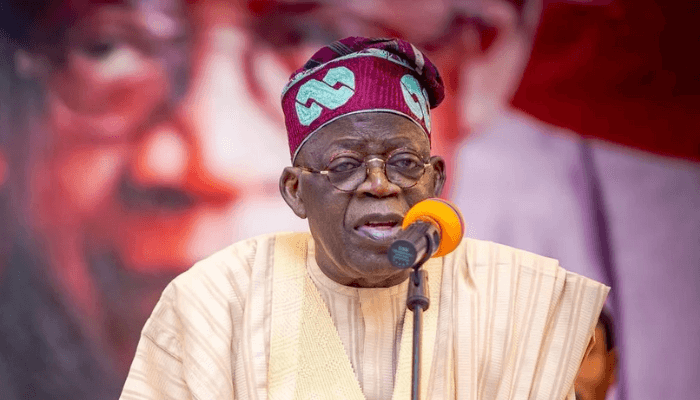
President Bola Tinubu has called on African nations to confront the escalating threat of climate change through innovation, strategic investment and stronger collaboration, warning that the continent’s future prosperity depends on urgent, united action.
Speaking at the inaugural Africa Infrastructure, Climate Change, and Green Investment Summit (AICIS) in Abuja, he urged Governments, private sector players, and global partners to scale climate finance, share knowledge, and deliver solutions tailored to Africa’s unique challenges.
He also reaffirmed Nigeria’s commitment to championing climate action, sustainable infrastructure, and green investment across Africa.
The summit brought together African heads of mission, Government representatives, industry leaders, policymakers, and international stakeholders to forge new partnerships aimed at tackling the continent’s pressing climate and development challenges.

Represented by Gagare Nadundu, Permanent Secretary for Political and Economic Affairs in the Office of the Secretary to the Government of the Federation, President Tinubu described the summit as a unique platform to engage, exchange ideas, and develop partnerships that would drive transformative change across the continent.
He said the presence of delegates from within and outside Africa reflected a shared commitment to advancing sustainable development, fostering resilient economies, and building a greener and more prosperous future for all.
In his keynote address, the President stressed that Africa stood at a defining moment, facing threats ranging from an infrastructure gap and resource constraints to the worsening effects of climate change.
He said climate change was not merely an environmental issue but also a profound economic and security challenge, citing unpredictable farming seasons, rising sea levels in coastal cities, and industries adapting to shifting realities.
According to him, Nigeria is implementing a robust climate action framework aligned with the Paris Agreement and Africa’s Agenda 2063, with investments in renewable energy, climate-smart agriculture, and clean technologies.

“The goal was to build resilience for communities, empower youth, and create green jobs, while urging African nations and global partners to scale climate finance, share knowledge, and develop innovative adaptation solutions that reflect Africa’s unique realities”, he emphasised.
On infrastructure, the President described it as the backbone of any thriving economy and noted that Nigeria was making unprecedented investments to bridge its infrastructure deficit through the Presidential Infrastructure Development Fund and the National Integrated Infrastructure Master Plan.
He explained that these projects were aimed at connecting communities, reducing poverty, and driving trade across borders.
He stressed that infrastructure must be sustainable, climate-smart, and accessible to all, and welcomed public-private partnerships, regional cooperation, and global expertise to deliver transformative projects.
President Tinubu called for unity in purpose, stating that as Africa’s most populous nation and largest economy, Nigeria is determined to drive regional integration, promote intra-African trade, and foster innovation, but cannot achieve these goals alone.
He urged all partners to work together for a greener, more resilient and prosperous continent.
Miriam Palmero, Ambassador of Cuba to Nigeria commended the focus on green investment, sharing details of Cuba’s “Tarea Vida” (Life Task) climate action plan, which protects coastlines, promotes renewable energy, and fosters sustainability.
She called for deeper cooperation between Africa and Cuba in technology exchange and clean energy, noting that Africa holds an essential part of the world’s future.
Pascaline Yakivu, Ambassador of the Democratic Republic of Congo to Nigeria, highlighted the country’s vast tropical rainforests, which account for nearly half of Africa’s total and play a vital role in global climate mitigation.
He noted, however, that conflicts in parts of the country had slowed key energy projects such as the Big Inga hydropower rehabilitation.
Paul Lombi, Ambassador of Zambia to Nigeria, noted that severe impact of climate change on the country’s energy security, citing crippling power shortages in 2023, and shared how Zambia uses the Gawu (apple green) tree, sourced from Nigeria and Niger as a natural fertiliser for climate-friendly farming.
Farouk Ahmed, Executive Director, Nigerian Midstream and Downstream Petroleum Regulatory Authority (NMDPRA), reaffirmed the agency’s role in aligning Nigeria’s energy sector with global sustainability goals.
He outlined ongoing initiatives, including prioritising natural gas as a transition fuel, supporting the Dangote Refinery’s LPG production, and modernising infrastructure through regulatory reforms and technology-driven transparency tools.
He said the agency was committed to reducing reliance on high-carbon fuels while expanding energy access for millions of Nigerians.
Chris Nkwonta, Chairman of the House of Representatives Committee on Climate Change, recalled the enactment of Nigeria’s Climate Change Act in 2021, which established the National Council on Climate Change to oversee emissions reduction, climate treaties, and adaptation strategies.
He assured that lawmakers would continue to work closely with relevant stakeholders to sustain the momentum on climate action.
Moses Owharo, Convener, expressed optimism that the discussions would yield actionable strategies to be implemented before the AICIS 2026 Global Summit.