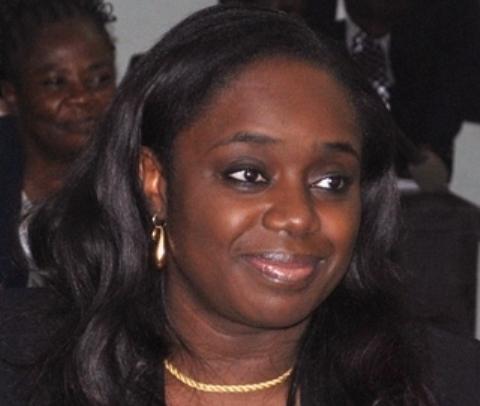
Kemi Adeosun the newly assigned finance minister resumed office yesterday, with a heavy burden of fixing Africa’s largest economy.
Receiving hand-over notes at a brief welcome event in her new Abuja office, Adeosun, a former banker and immediate past commissioner of finance in Ogun State, assured she would work in the interest of the country, but would need to meet and discuss with the departmental heads of her ministry before announcing any policy direction.
Adeosun is resuming office at a critical time of abysmally low government revenues and faces an uphill struggle to shore up Africa’s largest economy, which has been battered by a 40% fall in the price of oil.
As the head of the country’s economic management team, Adeosun’s immediate task is to develop and ensure the implementation of key fiscal policies that would complement the monetary polices of the Central Bank of Nigeria (CBN) in driving inclusive growth, creating jobs and lifting the present high poverty levels.

GDP growth has slowed for four consecutive quarters since last year, from 6.23 percent in second quarter 2015 to 2.35 percent in second quarter, 2015.
The International Monetary Fund (IMF) predicts it could slow to 4% this year, and the government may have to push through more unpopular cuts to subsidies and infrastructure investments, to plug the holes in its finances. Oil makes up around 60% of the government’s budget.
President Buhari’s government has just announced plans to expand spending for 2016 by over 80 percent to N8 trillion, the largest in the country’s history, in order to reflate the economy and spur growth.
But experts say Adeosun’s major challenge would be how to source funds for such a huge budget, considering the present low oil income and poor revenues from taxes.
“Medium-long term task of combo of Kemi Adeosun and Okey Enelamah in finance is structural transformation of economy for job creating growth,” Oby Ezekwesili, Nigeria’s former minster of education and former World Bank Vice President for Africa, tweeted yesterday.

Adeosun, who has been the finance commissioner for Ogun State since 2011, is a former managing director at Chapel Hill Denham, a Lagos-based investment bank, according to her LinkedIn LNKD -0.39% profile.
“Adeosun’s appointment to head the most important ministry during a time of economic crisis will stir some controversy. She is relatively inexperienced, especially compared to her immediate predecessor Ngozi Okonjo-Iweala, a political heavyweight,” says Malte Liewerscheidt, senior Africa analyst at Verisk Maplecroft.
“Adeosun has a strong background in the UK’s private financial sector but may struggle to navigate federal politics as the only post she previously held in Nigeria was Commissioner of Finance in Ogun State.”
Okechukwu Enelamah, head of the private equity company, African Capital Alliance, who had also been tipped to become finance minister, was sworn in as minister of trade and investment, though he was yet to resume duties as at press time yesterday.
Experts say Enalamah’s immediate agenda would be to redirect the focus of government revenue generation sources to the non-oil sector.
He would equally need to rehabilitate Nigeria’s reputation as a destination for foreign direct investment, which has been dented by the huge and high-profile fine handed to South African telecommunications operator MTN.
Enelamah would also be facing the challenge of revving up the country’s business environment, especially with the latest poor ranking of 169 on the World Bank Ease of Doing Business ratings.
Audu Ogbe, the new Minister of Agriculture who likewise resumed work yesterday, said he would be shouldering the burden of economic diversification, especially as the Federal Government looks to reduce the import bill of $22 billion yearly,with strategic direction away from oil.
Ogbe, accompanied by his Minister of State, Heineken Lokpobiri, and the new Permanent Secretary in the Ministry, Shedu Ahmed, said the Ministry would be intensifying efforts in research, marketing and self sufficiency.
“We must first be able to feed ourselves ,as $22 billion annual food import of the Federal Government is no more sustainable. We must also ensure certain interests outside our shores do not allow importation of things we could produce here, such as bananas and honey”
He said:”$400 million spent on tomato importation is unacceptable, in addition to $100 million spent on honey importation from other African countries.”
We would intensify efforts in improving seed quality to farmers and also ensure that we have improved quality of fertilizer for better agricultural yields”
He said a situation where we spend $1.3 billion on milk importation is also not acceptable.
“Uganda is already producing a greater percentage of the milk it consumes, I don’t see the reason why we cannot do same here.”
Swinging into action, Ogbe announced that he would be sending a memo to all the directors in the Ministry within a week detailing all the steps that the Federal Government is to take in its economic diversification process which would be deliberated upon to deliver set mandates.
Corroborating Ogbe’s views, Heineken Lokpobiri, new minister of state for Agriculture noted that dwindling oil resources mean “that we cannot afford to fail in our journey in agricultural transformation.”
According to him, “Nigeria has done it before in diversifying its revenue base through the agricultural sector, adding that it is more than prepared to do it better now, with the Federal Government’s support,and private sector collaboration.”
Onyinye Nwachukwu & Harrison Edeh