Art fairs are rarely — if ever — about art alone. Strip away the wall texts and polite conversations, and they reveal their true business: calibrating demand. They are about timing, confidence, and the delicate theatre of exchange — who buys, who hesitates, and who pretends not to notice price lists while noticing them very discreetly.
Between December 3 and 7, 2025, at the Art Pavilion of the International Conference Centre (ICC), the inaugural Abuja Art Fair stepped into this economy with notable caution. The question was not whether Abuja could host an art fair, but what kind of market it imagined itself to be.
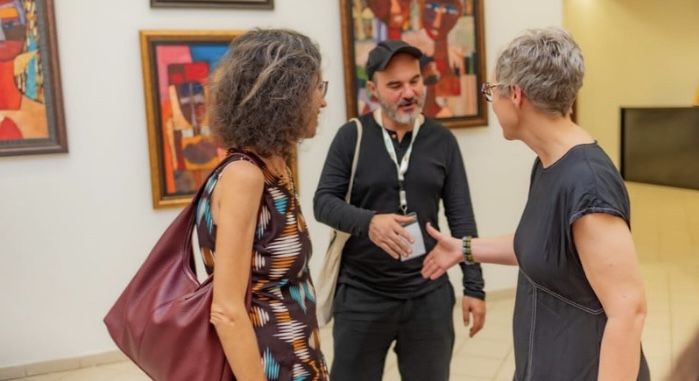
The setting seemed to encourage civility rather than urgency. Works were displayed generously, yet the atmosphere never acquired the transactional bustle familiar from Lagos or international art fairs. This restraint had its virtues though. It also had consequences. Without the productive tension of competition — between collectors, galleries, reputations — the fair sometimes felt less like a marketplace and more like a showroom awaiting activation.
Read also: Film, video censors board commits to responsible regulations

Abuja’s collector base, meanwhile, remains a subject of speculation rather than data. The city contains wealth, certainly, but wealth does not automatically translate into collecting. This helps explain why visitors to many art exhibitions — even in Lagos — often seem more inclined to discuss intention than to commit to acquisition. Price points, when revealed, are frequently greeted with thoughtful nods rather than decisive action. The Abuja Art Fair thus suggested a city still learning to see art not only as cultural capital, but also as an object of exchange.
This hesitation shaped the curatorial tone. Much of the work on display was competent, recognisable, and legible — art that reassures rather than provokes. Risk, after all, is difficult to price. Emerging artists were present, but often framed within familiar aesthetic languages, their radical edges gently sanded down for broader appeal. The result was accessibility without urgency, professionalism without friction.
Jeff Ajueshi’s long-standing role in Abuja’s art infrastructure loomed large. Through the Thought Pyramid Art Gallery and Art Centre, he has built continuity where little previously existed. Yet continuity can harden into consensus. The fair raised questions about gatekeeping — not in the crude sense of exclusion, but in the subtler one of taste formation. Whose work circulates? Who remains peripheral? Who is considered “sellable,” and on what terms?
Patronage played a stabilising role. Support from figures like Osahon Okunbo, through the Osahon Okunbo Foundation, ensured that the fair was well-produced and secure. This kind of backing is indispensable in Nigeria’s fragile art economy. But patronage also influences tempo. When the financial ground is already steady, there is less pressure to test the market’s appetite for risk. The fair felt buffered from failure — and, consequently, from urgency.
Comparisons with Lagos were inevitable, and instructive. Lagos’s art scene thrives on excess: too many openings, too much noise, inflated prices, speculative buying. Abuja offered the inverse — deliberation, moderation, and a preference for consensus. Neither model is inherently superior. But a market requires movement. The Abuja Art Fair occasionally seemed reluctant to provoke the very desire that drives collecting.

By the final day, the fair had proven its logistical competence and institutional seriousness. Deals may have been made, but discreetly. Visibility was achieved, but cautiously. What remained unclear was the fair’s appetite for shaping taste rather than reflecting it.
For Abuja to establish itself as more than an auxiliary stop on Nigeria’s art circuit, future editions will need to sharpen their market intelligence. This means clearer positioning, bolder pricing strategies, and a willingness to let artworks fail — commercially and critically. It means acknowledging that discomfort is not a flaw but a signal.
The inaugural Abuja Art Fair demonstrated that the city can host the mechanisms of an art market. Whether it is prepared to animate them — to allow desire, speculation, and dissent to surface — is the real test ahead. Until then, Abuja remains a city that looks carefully, prices politely, and waits.