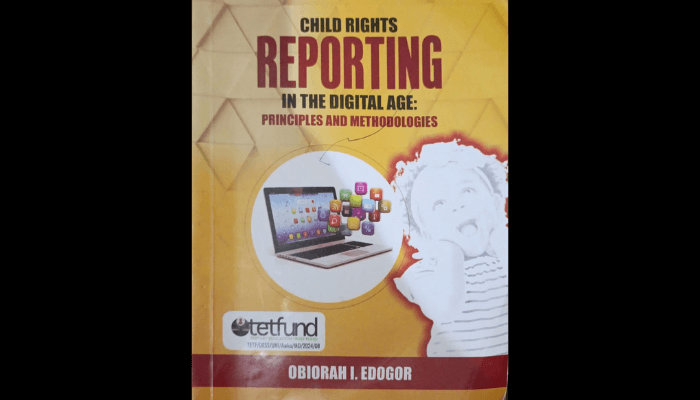
Obiorah Edogor (2025): Child Rights Reporting in the Digital Age—Principles and Methodologies. Awka: Fab Educational Books. ISBN: 978-978-7680-69-8
Child rights reporting is evolving, influenced by shifting digital landscapes, greater emphasis on child participation, and calls for more ethical journalism. Nonetheless, issues such as inadequate training, ethical complexities, and underrepresentation remain, underscoring the need for ongoing reform and investment in media and advocacy to realise and protect children’s rights.
This serves as the context for the publication and analysis of Obiorah Edogor’s (2025) work, “Child Rights Reporting in the Digital Age—Principles and Methodologies.”
UNICEF leads global efforts to address issues of child rights. It has moved into the media space, given the pivotal role of the media in creating awareness, setting agendas, and promoting accountability regarding issues surrounding children’s rights.
Professor Chinyere Stella Okunna, Deputy Vice Chancellor (Academic) of Paul University Awka, states in the foreword that Child Rights Reporting is a compulsory mass communication/journalism course in the unbundled mass communication/journalism curriculum. It results from the revision of the Minimum Academic Standards by a team of Nigerian and international scholars. The MacArthur Foundation funded this initiative.

Obiorah I. Edogor’s book, Child Rights Reporting in the Digital Age: Principles and Methodologies (2025), provides an in-depth, practical framework for journalists, communication scholars, and child advocates engaged in reporting on child rights amid rapidly evolving digital platforms. The work synthesises current challenges, international best practices, and methodological innovations essential for responsible and adequate coverage of children’s rights in a hyperconnected world.
Key Principles
1. Best Interests of the Child
• Reporting must be guided by the primary consideration of the child’s best interests, aligning with the United Nations Convention on the Rights of the Child (CRC).
• The “do not harm” principle is central; stories should protect rather than endanger children.
2. Respect for Children’s Dignity and Agency

• Children are described as subjects of rights, not just objects of sympathy or pity.
• Reporting should amplify children’s voices while safeguarding their privacy and well-being.
3. Accuracy, Sensitivity, and Balance
• Avoid sensationalism, stereotypes, or stigmatisation.
• Ensure fair and thorough contextualization of children’s issues, including background, causes, and consequences.
4. Privacy and Data Protection
• Special consideration is given to the collection, storage, and dissemination of children’s digital data.
• Journalists must secure proper consent, prioritise anonymity where required, and comply with emerging data protection codes.
Methodologies
Digital-First Approaches
• Use of online interviews, mobile reporting apps, and social networks for fact-finding, while observing ethical protocols.
• Scrutiny of user-generated content by verifiable means to counter misinformation.
Engagement and Participatory Journalism
• Approaches that include children’s direct perspectives through interviews, digital storytelling, and participatory media projects.
• Application of child-friendly interfaces and age-appropriate communication in digital reporting platforms.
Cross-Platform Analysis
• Triangulating information across social media, blogs, and legacy media to develop comprehensive narratives.
• Use of digital analytical tools to identify trending child rights themes, public sentiment, and misinformation.
Risk Assessment and Mitigation
• Proactive procedures to identify and manage risks posed to children in digital reporting, including strategies to avert digital harassment or retraumatization.
Thematic Highlights
• Digital Security: The text addresses the heightened risks of privacy breaches, cyberbullying, and online exploitation of children, and the responsibilities of reporters to minimise such threats.
• Inclusive Representation: Calls for more equitable media representation of marginalised groups (children with disabilities, girls, refugees) in digital spaces.
• Collaboration: Advocates multi-stakeholder partnerships involving journalists, educators, technologists, and child protection agencies.
• Continuous Learning: Encourages ongoing training for journalists to adapt to evolving digital tools and ethical standards.
Sample Best Practice Table
Principle Description Example
Best Interests Prioritize child safety above all else Omit identifying details for at-risk children.
Privacy & Data Protection Obtain consent and anonymize digital data Use coded names in digital investigative stories.
Child Participation Include children’s voices in stories Digital storytelling workshops
Digital Literacy Equip reporters with digital safety knowledge Fact-checking UGC before reporting
Relevance and Impact
Edogor’s work fills a critical gap in contemporary communication literature by marrying theoretical, legal, and practical reporting considerations in the digital context. The book is recommended for:
• Media practitioners,
• Students of journalism and mass communication,
• Child protection advocates,
• Policy makers who are interested in the intersection of children’s rights and digital technology.