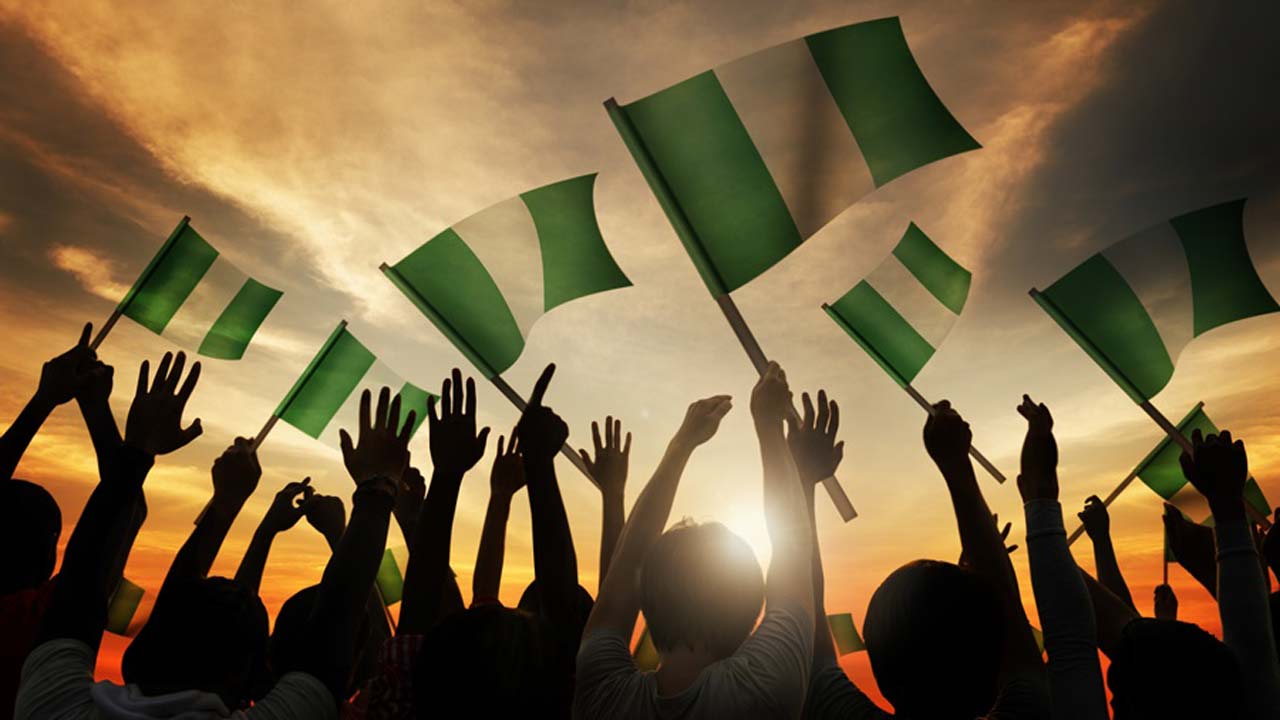
Spotlighting the socio-economic trajectory of the Nigerian state from independence till date, the downward slide and the divisive tendency prevalence in the country raise more questions about governance and its impact on the citizenry over the years.
Nigeria in the last 59 years has been in search for economic stability, while its people have lost all sense of decency for monetary values. Technological knowledge of the 21st Century has also made the people to give up ethical values to belong to a global village that has given birth to social imbalance. And in the search to attain social balance, the people create an unstable environment that is bedeviled with maladministration and maladjustment both for citizens and the nation at large.
October literally signifies freedom and deliverance for the Nigerian state from the colonial trade masters who ruled over its land and people. Unfortunately, the gains of that freedom were short-lived by actors who soon took the ruin of the nation state turning every gain to pain.
Economic woes

Nigeria is a middle-income, mixed economy and emerging market, with expanding manufacturing, financial, service, communications, technology and entertainment sectors. It is ranked as the 27th-largest economy in the world in terms of nominal GDP, and the 22nd-largest in terms of purchasing power parity.
However, in 2016, Nigeria suffered its worst economic woes in over two decades after seeing two consecutive quarters of negative growths, plunging the economy into its worst recession in decades. Unfortunately, the country’s economic growth has remained relatively stagnant following its 2017 recovery out of recession.
According to data from the National Bureau of Statistics (NBS), unemployment remains high; for instance, among the working-age group (15-64 years of age) unemployment has hit 23.1 percent accounting for a five percent increase from 2017, when it was at 18.1 percent.
The agriculture sector, though currently receiving government attention, has suffered from years of mismanagement, inconsistent and poorly conceived government policies, and the lack of basic infrastructure. Still, the sector accounts for over 41percent of GDP and two-thirds of employment. Nigeria is no longer a major exporter of cocoa, groundnuts (peanuts), rubber, and palm oil. Cocoa production, mostly from obsolete varieties and overage trees, is stagnant at around 180,000 tons annually; while it was about 300, 000 tons 25 years ago.
Insecurity

Despite notable military advances, and proclamations by the government that Boko Haram has been technically defeated, the group remains a threat to security in the northeast region. Abductions, suicide bombing and attacks on civilian targets by Boko Haram have persisted. At least, 1,200 people died and nearly 200,000 were displaced in the northeast in 2018. In June, at least 84 people were killed in double suicide bomb attacks attributed to Boko Haram at a mosque in Mubi, Adamawa State.
The northwest and north-central region of the country is currently battling with the menace of rustling and herders/farmers clashes. Decades old communal conflict between nomadic herdsmen and farmers around the Jos region of Plateau State intensified in 2018, spreading across the entire Middle Belt area of Benue and Nasarawa, further exacerbating the security situation in the country.
Recurring violence between herdsmen and farmers, as well as related cattle theft and banditry in many northern states, including Zamafara and Kaduna, posed serious threats to peace and security. Although the violence is increasingly described in religious terms, competing claims to land and other resources are at its core.
“Nigeria is on the precipice and dangerously reaching a tipping point where it may no longer be possible to hold danger at bay,” said former President Olusegun Obasanjo in a letter to President Muhammadu Buhari on the deteriorating security situation in Nigeria. His letter focuses on the Boko Haram and the ‘herdsmen/farmers crises’. According to Obasanjo, “When people are desperate and feel that they cannot have confidence in the ability of government to provide security for their lives and property, they will take recourse to anything and everything that can guarantee their security individually and collectively.”
Similarly, Agnes Callamard, a special United Nation (UN) Rapporteur in her preliminary statement at the end of a 12-day mission in Nigeria, said: “The overall situation that I encountered in Nigeria gives rise to extreme concern, with issues like poverty and climate change adding to the crisis.” She expressed the fears that if ignored, the ripple effects of unaccountability on such a large scale, had the potential to destabilise the sub-region if not the whole continent.
“Nigeria is confronting nationwide, regional and global pressures, such as population explosion, an increased number of people living in absolute poverty, climate change and desertification, and increasing proliferation of weapons. These are re-enforcing localised systems and country-wide patterns of violence, many of which are seemingly spinning out of control,” Callamard said in her report.
Any hope of national rebirth?
As much as the country continues to seek socio-political and economic boom, one cannot and should never rule out the option of a spiritual turnaround, as the current state of things in Nigeria cannot be said to be beyond redemption, hence the need for a national rebirth, a cleric said.
Reverend Olusola Idowu, pastor in charge of Ajayi Dahunsi Memorial Baptist Church, Ilasamaja, Lagos, disclosed to BDSUNDAY that there is hope of national rebirth for Nigeria. According to him, the Bible clearly states that a living dog is better than a dead lion and anyone living has hope. He cited the Book of Ecclesiastes 9:4.
He opined that there is hope for a national rebirth for Nigeria as long as there is still an entity known and addressed as Nigeria. He however, said: “We must remember that for a birth (or rebirth as the case may be) to take place, there must be conception and there must be midwives to take the delivery.
“In other words, for there to be a national rebirth in our nation, both the leaders and the followers must be involved. All hands must be on deck. First, we must all ‘desire’ a better future for this nation. At the moment, majority seems to have lost hope in this nation. We express this mainly through our desire to migrate and seek asylum in other countries.
“Second, we must ‘believe’ that a better Nigeria is achievable. The truth of life is that we are often driven in our actions by our belief system. Thirdly, we must be ‘sincere’ in our dealings. One major bane of our nation today is insincerity, both on the part of the leaders and followers. We all claim to desire a better nation but we are not sincere in our dealings. People want Nigeria to work but they are corrupt in their dealings. We cannot expect to have a rebirth until we are sincere in all our dealings.
“Fourthly, we must be ‘committed’ to building a better Nigeria. Politicians and analysts keep telling us what and what is wrong with our nation and what could be done to fix the nation, yet we seem to be taking one step forward and hundred steps backward. One wonders what exactly is our problem. I believe it is lack of commitment to finding lasting solution. Until we are all committed to doing the right thing and are willing to make necessary sacrifice the matter of national rebirth may remain elusive.
“Fifthly, we must be ‘selfless’. Another important virtue that will help us to achieve national rebirth is selflessness. This nation will experience great and positive turn around when all of us become selfless. When we start thinking of others. When we start considering the fact that every one of our action is capable of making life difficult or comfortable for others. Enough of talk. We must all be ready to walk our talk. Everyone seems to have an idea of what is good; our deficiency is only in the area of how to arrive at what is good. This is where religious, community and political leaders come in. Let us provide good leadership from home that will launch our dear country to a desired rebirth.”
SEYI JOHN SALAU