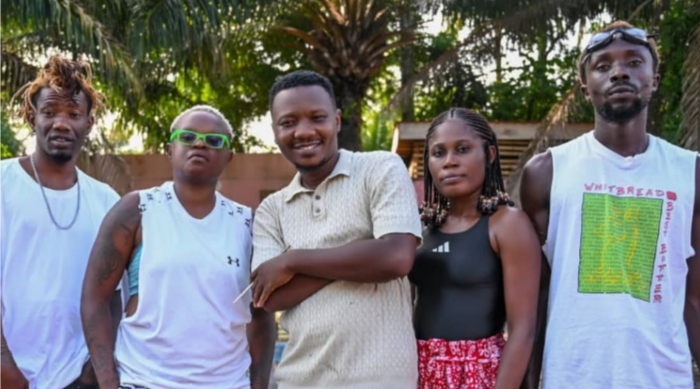
For two weeks (May 18-June1, 2025), the residents of Tarkwa Bay, an artificial Island in Lagos, had a set of unique visitors, who shared their space, their beach, their food, their laugher and pains as well.
The visitors, five in number, who could easily pass for normal residents or at most, tourists at the the laidback, yet serene island, were unique and charged with a burden to change recurring environmental conservation issues with their works.
They were five contemporary and multidisciplinary visual artists, including:
Elizabeth Chioma Ekpetorson, Olorunyemi Kolapo, Olúbùnmi Atere, Darlington A Chukwumezie and Josiah C. Josiah.
They were on the island on a two-week residency organised by Farmhouse Residency and curated by Adebimpe Owoyemi.

Call it holiday on the beach, art holiday or whatever name you fancy, the reality of their purpose on the island was met and evident with the breathtaking works they produced at the 2-female and three-male residency.
Well, credit goes to Farmhouse Residency that allowed them to freely express their artistic proficiencies across any medium or style of choice and even outside their primary medium, with found objects or materials of their choice.
Considering the freedom of expression,
Olúbùnmi Atere, a conceptual and ceramic artist, freed herself and tried her gifted hands in new medium.
Instead of clay, her cherished material, she used jute sack with found materials from the island to create a singular, yet masterpiece work for the residency, which she literally interpreted as ‘Encounter of Gazes’.
“A lot of transportation and business happen here. But there seems to be some contrasts where the kind of businesses that pass through this water do not really influence the people who stay here,” she explained.

“So, I thought the sack is a very good material to capture that journey, the journey between what is happening here and all the other places I extend to and what spirit remains with the people in the reality of that experience.
“So, with that sack I decided to make an eye to honour the spirituality of the place.
“I decided to create like an eye that captures the experience as a space of archive, a living archive that you can interact and come back to at different times to be something that might be participatory of the investigation,” she noted.
On her part, Elizabeth Chioma Ekpetorson, the second female artist participant in the residency, her works across the two weeks captured the old and abandoned Lighthouse on the island.
She regretted that the Lighthouse, which ordinarily should have been a must-see attraction for visitors, is hardly visited by anyone due to decades of abandonment.
It was from that point of neglect that she started her campaign against lack of maintenance culture on the island, and across the country, which is in line with the focus of the residency on environmental conservation issues.
Elizabeth sustained the campaign for maintenance culture with over 10 works, (all paintings), the highest in the residency.
But the male artists also lived up to expectations, amid sheer display of creative ingenuity.
For instance, Olorunyemi Kolapo, a science-inspired artist, all the way from Abuja, brought his innovative thinking to his work at the residency.
His paintings of African females on discarded satellite dish trays were breathtaking to say the least.
His untitled works were futuristic and about signal, identity and the beads.
“This morning, when I was looking at the work itself, I see it like the necklaces coming out as beauty.
“But the futuristic necklace is coming like a bondage. It reminds me of the slavery time. The reason for using the dish from there is basically because of signal,” he explained.
He is also not happy with how some cultural heritages like facial marks are being eroded.
But as much as he looks at the future, what African identity will be, he thinks that Africans as a people should make efforts to preserve their rich heritages despite westernisation and technology.
As well, Darlington A Chukwumezie and Josiah C. Josiah, the other two male artists, were exceptional in the delivery of their works at the residency respectively.
Josiah, a Federal Polytechnic Auchi trained visual artist, stayed true to using his works to archive experiences and emotions. He did the same for the residency, capturing and archiving his experiences on Tarkwa Bay, the emotions of residents and people he came across in his work across the two weeks.
His fulfilment is being able to meet, network with other artists and work together to raise awareness on environmental conservation issues through their works.
“My work here says it all, we cannot do without our environment, we need to preserve it, from the satchel water bags, pet bottles and other objects we freely throw into the gutters or the ocean shore, in the case of Tarkwa Bay,” he said.
He hopes to continue the network and exchanges from the residency after and outside Tarkwa Bay.
But the last and not the least is Darlington A Chukwumezie, a resident artist in Tarkwa Bay and the unofficial host of the team.
The multi- talented and self-thought artist was very much at home during the residency because the focus touches his heart as he has been campaigning on it privately on the island.
Chukwumezie, a recycle art master, presented an installation for the residency created from recycled materials and found objects all sourced from Tarkwa Bay, from floaters, doll babies, fishing net to others.
The skilled diver confessed waking up very early in the morning to ransack the beach shore for found objects pushed onshore by the waves and also dives deep to source some.
Though his work, in a globe shape, is not titled, he said his art is like a transporter. “It makes the viewer to have an interaction of their own inner self. So, I really want to show the idea of other people not to get into their own feeling through my art. I just want you to look at my art,” he said.
After the residency, he promised to continue the campaign for environmental conservation on the island.
“Most of the time when I go out to take my materials, I go with the kids from the community to show them why it is good to pick these objects and why it is bad to throw objects into the ocean. I will continue to teach them because I am seeing result too,” he said.
From the organiser’s perspective, Farmhouse Residency is excited on the successful outing, especially the quality of the works, which would be exhibited sometime this year.
Speaking on the residency, Adebimpe Owoyemi, curator of the residency, noted that the art residency programme was aimed at enhaning artists’ creativity, and enable them to develop new or existing techniques.
She was also happy that the artists were able to tackle issues relating to environmental conservation, human development, cultural and traditions preservation through their respective works at the residency.
On the choice of Tarkwa Bay and environmental conservation as the focus of the residency, Adebimpe noted that it was a timely theme as Tarkwa Island has been grappling with oil spillage caused by illegal bunkering, waste management, pollution, and other environmental issues that are threat to sustainable livelihood on the island.
She commended all the five artists for their focus and commitment during the residency, while assuring of a future one.