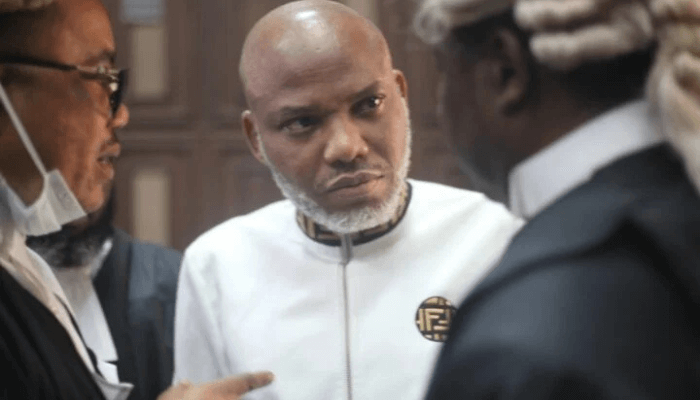
Kanu Agabi, the lead counsel for Nnamdi Kanu, leader of the proscribed Indigenous People of Biafra (IPOB), on Friday dismissed the prosecution’s claims that his client had threatened to unleash violence, describing them as nothing more than an empty boast.
Agabi told Justice James Omotosho of the Federal High Court in Abuja on Friday, presenting the defense’s argument in support of the no-case submission.
He criticised the prosecution for merely attempting to portray Kanu as a villain, without presenting substantial evidence.
He pointed out that none of the charges against Kanu had been proven, emphasising that the prosecution had failed to bring forward any witness who could testify that they were incited by Kanu’s broadcasts.

Agabi argued that Kanu’s statement about bringing the world to a standstill was merely boastful and not a criminal threat. He asserted that boasting alone should not lead to prosecution.
The lawyer also highlighted Kanu’s concern over the widespread insecurity in the country, insisting that his client had done nothing wrong.
Agabi stated that the defense had submitted evidence in a case where the Director General of the Department of State Services (DSS), Adeola Ajayi, and former Defence Minister, Theophilus Danjuma, were heard encouraging people to defend themselves from attacks.
He contended that the defendant’s statement was simply an urging for the public to protect themselves.
The defense attorney criticized the #ENDSARS report presented by the prosecution, claiming it was not properly verified.

He highlighted that his client, who had been in solitary confinement for over six years, was suffering from severe psychological effects. He pointed out that international law prohibits solitary confinement for more than 15 days.
Agabi further explained, “The prolonged confinement has taken a toll on his mental health. The case has been dragging on for a decade now.” He added that the passage of time had caused witnesses to lose their recollection of events, which is why many of the prosecution’s witnesses responded with phrases like “I can’t remember,” “I don’t know,” or “I have no idea” when questioned.
The defense attorney also criticized the death reports submitted by the prosecution, arguing they were presented without the attending doctors being available for cross-examination.
According to Agabi, the prosecution’s witnesses, when asked questions, repeatedly answered with variations of “I don’t remember,” “I don’t know,” or “I can’t recall” approximately 80 times during the proceedings.
Read also: Nnamdi Kanu behind 233 security deaths in #EndSARS protest – DSS
Agabi argued that the prosecution’s witnesses failed to provide credible evidence, as their repeated responses of “I can’t remember” or “I don’t know” did not meet the standard of proof beyond a reasonable doubt.
He pointed out that the defense raised 40 points in its address, but the prosecution failed to address 10 of them. He claimed the witnesses’ involvement was limited to obtaining statements, and that these statements were not properly investigated.
He emphasised that all the witnesses were from the DSS, which led to their inability to recall key details.
Agabi also requested the court not to give weight to additional evidence introduced after the trial began and criticized the repeated amendments to the charges, arguing that none of them specified individuals incited by the defendant.
He further challenged the proscription of IPOB, asserting it was invalid without the president’s approval, and urged the court to demand such approval if it existed.
He argued that the court lacked jurisdiction over the charge concerning the alleged unlawful transmitter, as the Court of Appeal had already ruled on the matter.
In response,Adegboyega Awomolo, SAN, the prosecuting attorney, disagreed with Agabi’s arguments. Awomolo, while presenting the prosecution’s counter to the no-case submission, urged the court to direct Kanu to enter his defense on the terrorism charge. He also requested that the court reject the defense’s no-case submission.
Awomolo explained that the prosecution had called five witnesses and presented various exhibits, including video and audio evidence. He argued that the prosecution’s reply had comprehensively addressed all the issues raised by the defense, rendering the no-case submission irrelevant.
The senior lawyer further stressed that the court’s responsibility at this stage was to assess whether there was enough evidence to establish a prima facie case, justifying Kanu being called to defend himself. He stated that the defense’s argument focused primarily on discrediting the witnesses, the records, and the evidence so far, which was not the proper approach at this point in the trial.
Awomolo also highlighted that, in the videos and audio recordings presented by the prosecution, Kanu had openly acknowledged his leadership role in IPOB, which he knew to be a proscribed organization. He pointed out that Kanu, in some of these recordings, admitted to making broadcasts that called for violence and destruction.
Awomolo criticised the defense’s argument that Kanu’s broadcasts were mere boasting and not criminal, asserting that the law prohibits statements that instill fear in the public. He argued that Kanu’s calls for violence and threats, including encouraging the killing of security personnel, were not just boasts but dangerous actions that led to the deaths of at least 170 security officers. Awomolo insisted that Kanu should explain his threats and the fear they caused, as boasting in such a context cannot be dismissed as harmless.
Awomolo also rejected the defense’s claim that Kanu had been in solitary confinement for 10 years, explaining that Kanu was granted bail in 2017 but had it revoked in 2022 after jumping bail. He accused the defense of causing delays in the trial for three years, denying that the prosecution was responsible for the prolonged case.
On the issue of IPOB’s proscription, Awomolo noted that the matter was before the Supreme Court and it would be inappropriate for the trial court to make a ruling on the legality of the proscription.
After hearing the arguments from both sides regarding the no-case submission, Justice Omotosho adjourned the case to October 10 for a ruling.