|
Getting your Trinity Audio player ready...
|
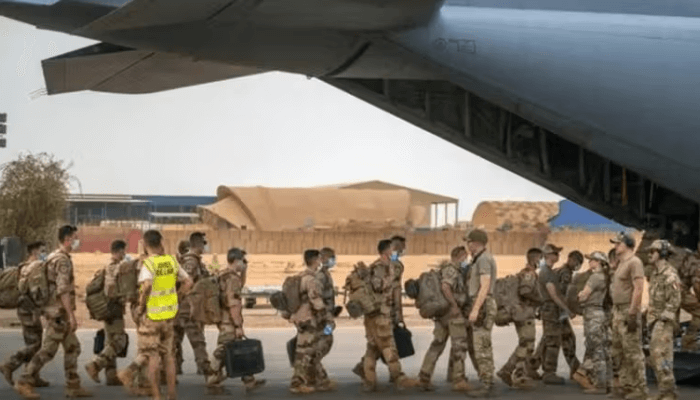
In a moment heavy with history and symbolism, France has officially ended its decades-long military presence in Senegal, closing the chapter on its last permanent base in West Africa.
On Thursday, Camp Geille in Ouakam, Dakar, was formally handed over to Senegalese authorities, drawing a quiet curtain on an era that began shortly after Senegal gained independence from France in 1960. The ceremony was attended by Senegal’s Chief of General Staff, General Mbaye Cissé, and Major General Pascal Ianni, head of French military command in Africa.
Read also: Flutterwave secures full license to empower businesses in Senegal
The final handover followed a phased departure that began in March 2025, with the restitution of the Marechal and Saint-Exupéry sites, the Contre-Amiral Protet installation in May, and the Rufisque post in early July. The withdrawal of roughly 350 French troops marks the end of France’s military footprint in Senegal and, more broadly, West Africa.

“This marks a new phase in our military relationship,” General Ianni said. “It reflects France’s decision to end permanent bases in West and Central Africa, and responds to the Senegalese authorities’ wish to no longer host foreign forces on their soil.”
Read also: ECOWAS, UNIDIR launch weapons management assessment in Senegal to tackle arms proliferation
General Mbaye Cissé, Senegal’s military chief, echoed that sentiment. “The withdrawal supports our new defence strategy,” he said. “Its primary goal is to affirm the autonomy of the Senegalese armed forces while contributing to peace in the subregion, in Africa, and globally.”
The exit agreement was finalised by a Franco-Senegalese joint committee on May 16 , in line with the 2012 defence cooperation pact between the two nations. But political momentum had already shifted earlier in the year. In February, talks began following a public call by President Bassirou Diomaye Faye for foreign troops to vacate Senegalese territory.
“Senegal is an independent and sovereign nation,” Faye declared last year. “Sovereignty does not accommodate the presence of foreign military bases.”

Read also: Senegal unveils 25-year economic and social development plan
His words resonated across a region increasingly sceptical of France’s long-standing military role. In recent years, public sentiment has turned sharply against what many view as a vestige of colonial influence and a symbol of dependency. France’s military withdrawals from Mali, Burkina Faso, Niger, Gabon, and Chad were all triggered by political tensions, coups, and accusations of neocolonial interference.
The shift has not been subtle. In Mali, the expulsion of France’s ambassador in 2022 ended a military partnership dating back to Operation Serval. That same year, France withdrew the 4,500-strong Operation Barkhane force from Mali and later exited Burkina Faso and Chad, following similar demands from transitional military-led governments. Operation Sabre, France’s counterterrorism deployment in Burkina Faso since 2009, was quietly wrapped up under a four-week withdrawal deadline.
Read also: ECOWAS, UNIDIR launch weapons management assessment in Senegal to tackle arms proliferation
Chad’s government, which hosted France’s final Central African base, accused Paris of meddling in its democracy, particularly after a botched attack on the presidential palace on January 8, 2025 worsened bilateral relations.
In Gabon, a coup in September 2023 that ousted Ali Bongo Ondimba led to a breakdown in ties and the termination of French military cooperation.
Now, with Senegal’s departure, the sweep of history appears complete. France’s longstanding military engagement in West Africa — once viewed as a stabilising force — has come to an end.
Paris has insisted this is not a retreat, but rather a “strategic recalibration.” It plans to maintain some presence in Djibouti and offer military training or technical assistance on a case-by-case basis — but the age of large permanent bases in Africa is over.
For Senegal, and for many in the region, the withdrawal symbolises a deeper turning point.
The move is seen as part of a generational and political shift toward sovereignty, redefined partnerships, and continental agency. Senegal’s new leadership has been unequivocal: the future lies in African-led solutions, not foreign boots on the ground.
The handover of Camp Geille was solemn but understated — perhaps deliberately so. There were no grand farewells, no declarations of victory. Just a quiet acknowledgement that a long chapter in Franco-African military history had closed.
And for many in Senegal, that is the most powerful statement of all.