|
Getting your Trinity Audio player ready...
|
The significant summery of the 25 years existence of the Niger Delta Development Commission (NDDC) seems to be that its projects have become the only ones that show that there is still government in the land for most communities.
The meaning may be that in most communities, it would either an NDDC road, the solar lights, the water, health centres, or schools that would stand to welcome any visitor, thus giving evidence that there was still a government in the land.
This was the crux of the speech by Samuel Ogbuku, the managing director of the Commission when he delivered an important address at the plenary session to mark the end of the 2th anniversary events that began in April 2025 but intensified in one week of activities closing on July 12, 2025.
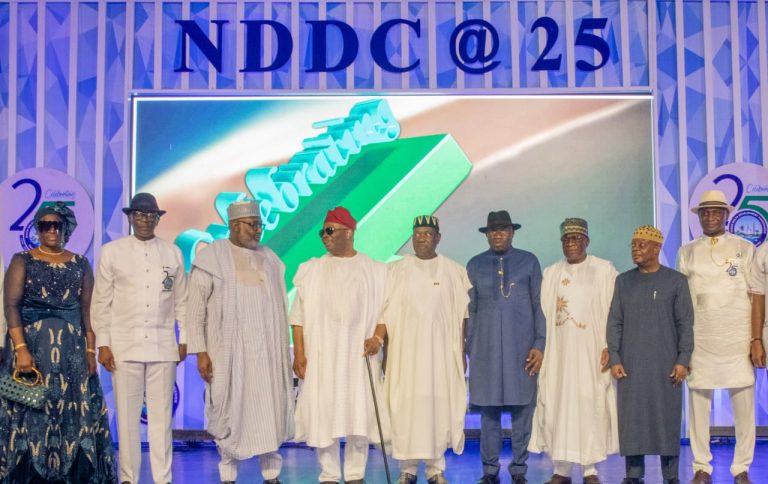
Ogbuku reiterated the Commission’s commitment to driving inclusive growth and economic diversification across the Niger Delta, with a renewed focus on agriculture, infrastructure, and youth empowerment.

Read also: NDDC prioritising projects to touch lives in Niger Delta – MD
Emphasizing the presence of NDDC projects in most communities in the oil region, the Bayelsa-born MD noted that this stark reality underscored the Commission’s responsibility to deliver impactful development and improve the quality of life for residents. He said the NDDC saw this development as a wake-up call.
To address the region’s long-standing developmental challenges, Ogbuku explained that the NDDC has initiated strategic partnerships with individual stakeholders, international oil companies (IOCs), and other key actors to build a sustainable future for the Niger Delta. He said this was to create a rallying platform to deliver more to the communities with the support of other development partners.
Ogbuku reaffirmed the Commission’s alignment with President Bola Tinubu’s Renewed Hope Agenda, assuring that he and his board members would use tangible infrastructure and social projects to reflect the administration’s commitment to regional development.
Ogbuku, who has continued to preach unalloyed loyalty and support to the present administration, said: “We are apostles of the Renewed Hope Agenda. Through visible, people-oriented projects, we will demonstrate what this administration is doing to transform the Niger Delta. All previously abandoned projects will be completed, and many more will be executed to meet the aspirations of our people.”

On his part, President Tinubu reaffirmed confidence in the leadership of the present managing director as well as the board. He talked about the need for stability of the oil region so the nation’s economy would be enhanced.
The President pointed to the strategic importance of the Niger Delta region to Nigeria’s economic future, describing it as the goose that lays the golden egg. He also called on the NDDC to accelerate the sustainable development of the oil-rich region.
Speaking at the anniversary plenary session which held in Port Harcourt, at the Obi Wali International Conference Centre, President Tinubu emphasized that no meaningful economic growth can be achieved without transforming the region that contributes the bulk of Nigeria’s foreign exchange earnings.
The President commended the NDDC leadership for their efforts to improve the Commission’s service delivery and encouraged them to sustain the momentum and continue working towards enhancing the region’s development.
His words: “Beyond infrastructural development, the NDDC must continue to prioritise human capital development, as it remains the primary index of progress. Projects and programmes that directly impact the lives of ordinary people in rural communities must be prioritised. In this regard, I commend the board and management for the ‘Light Up the Niger Delta’ initiative, which has not only reduced night crimes and enhanced security but has also extended trading hours and improved social life across the region.
“I also urge you to place special emphasis on empowering the youth and women of the region. The NDDC must constructively engage the youth, steering them away from violence and militancy towards entrepreneurship and other legitimate means of self-development.”
He added that his administration prioritises youth development, and that he encouraged the NDDC to collaborate with the Ministry of Youth Development to leverage the various initiatives available.
“Furthermore, there can be no sustainable development without peace, security of lives and property, and adherence to the rule of law. The NDDC must continue to work towards sustaining peace in the region”.
The President emphasized the importance of agriculture in the Niger Delta, noting the region’s vast potential beyond oil and gas. He encouraged the NDDC to invest in agricultural initiatives that would unlock and maximize the region’s agrarian resources for the benefit of both the region and the country.
While congratulating the Commission on the silver anniversary, he called on the people of the Niger Delta to continue to support his administration’s programmes and policies.
The high point of the event was the keynote address delivered by Ngozi Okonjo-Iweala, Director-General of the World Trade Organization (WTO).
Speaking on the theme of the anniversary, Okonjo-Iweala acknowledged that while the NDDC has made notable strides over the years, much work still lies ahead.
She emphasized that the 25th anniversary should go beyond ceremonial celebrations, serving instead as a strategic opportunity to reflect, review, and critically assess the Commission’s performance in fulfilling its mandate.
“The NDDC has achieved a lot, but there is still a great deal to be done,” she said, while urging the Commission to strengthen transparency, improve stakeholder engagement, and ensure that its interventions translate into lasting socio-economic benefits for the people of the Niger Delta.
The NDDC was established in 2000 by the Nigerian government to facilitate the development of the Niger Delta region. The NDDC 25th anniversary plenary session is a culmination of a week-long series of activities.
Key discussions at the plenary session revolved around the NDDC’s mandate to facilitate the rapid and sustainable development of the Niger Delta into a region that is economically prosperous, socially stable, and politically peaceful.
Speakers highlighted the Commission’s efforts in enhancing infrastructure, improving healthcare access, empowering communities through education and job creation, and fostering sustainable environmental management.