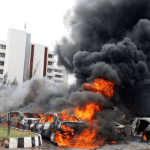
Survivors of deadly attacks in Benue State have shared heartbreaking accounts of how armed gunmen destroyed their communities, killing hundreds of people and burning homes to the ground.
The testimonies came during a town hall meeting in Makurdi, the state capital, organised by News Central TV to find solutions to the ongoing violence plaguing the region.
Joseph Kwagh, who survived the June 13 attacks on Yelewata and Daudu communities in Guma Local Government Area, told the audience he lost eight family members when gunmen invaded his village.
He described how the attackers came during heavy rain, shooting residents and setting houses on fire.

Jerry Ayem, another survivor, recounted the horrific moment when armed men broke into his family home around 10 pm, killing his mother and children.
“Around 10 pm, the Fulanis broke into our home, firing their guns. They smashed through our door. My mother and children were killed — they were hacked with machetes,” Ayem said.
His testimony left many in the audience visibly shaken.
David Ukeyima, who bore visible gunshot and machete wounds, described how attackers surrounded his home and set it ablaze to force the family out. His wife and three children were killed as they tried to escape the burning house.
Read Also: Our fertile farmlands have become killing fields – Benue farmers

‘This is ethnic cleansing’
Ier Jonathan-Ichaver, co-founder of Sesor, a non-governmental organisation, said the violence has gone far beyond simple disputes between farmers and cattle herders.
She accused the government of failing in its basic duty to protect citizens’ lives and warned that the attacks amount to ethnic cleansing.
“These attacks are genocidal. This is not just in Benue — it’s across the Middle Belt. What we are seeing is ethnic cleansing,” Jonathan-Ichaver said.
Her organisation has documented over 622 coordinated attacks in Benue since 2009, with more than 1,100 people killed in just the last two years.
She warned that more than two million people have been displaced in Benue alone, creating a “threat to national food security.”
“Section 14(2)(b) of the constitution says the primary purpose of government is the security and welfare of the people. Without justice, there can be no peace,” she added.
‘Attackers were foreign elements’
Denen Gbobgbon, president of the United Farmers Association in the Benue Valley, rejected the idea that the violence is simply about farmer-herder conflicts.
He accused some traditional leaders and officials in neighbouring Nasarawa State of helping foreign attackers from Mali and Niger who now claim ancestral farmlands in Benue.
“We don’t have real issues with herders. What we are facing is a coordinated genocidal attack by proscribed bandits,” Gbobgbon said.
He revealed that local communities had warned security agencies about the attackers’ presence since November 2024, but nothing was done to prevent the massacre.
“The Yelewata attack was not carried out by herders. These attackers were camped, prayed for, and we informed security agencies of their presence since November 2024 — yet nothing was done,” he said.
“Our ancestral lands have allegedly been sold to these groups, and some claim they were relocated on government orders. This must be investigated.”
Cattle breeders were also affected
Ibrahim Galma, secretary of Miyetti Allah Cattle Breeders Association (MACBAN) in Benue, acknowledged that both farmers and herders have suffered losses in the violence.
He said the crisis has evolved beyond its original causes into “full-blown criminality” involving criminal gangs.
“This is no longer a farmer-herder issue. It has been hijacked by criminal elements,” Galma said.
“The Fulani community has also been devastated in parts of Benue — we’ve lost access to farms in many areas.”
He praised efforts by state and federal authorities but called for more inclusive dialogue and support for all displaced communities.
The June massacre
The 13 June attacks on Yelewata and Daudu communities were among the deadliest in recent years, with over 200 people killed, including internally displaced persons and farmers.
The coordinated assault, blamed on suspected armed herders and bandits, is part of a pattern of violent incidents that have left hundreds dead and thousands displaced across Benue State.
President Bola Tinubu ordered security agencies to arrest the perpetrators and restore order following the massacre.
On 24 June, Inspector-General of Police Kayode Egbetokun announced the arrest of 28 suspects linked to the attack.