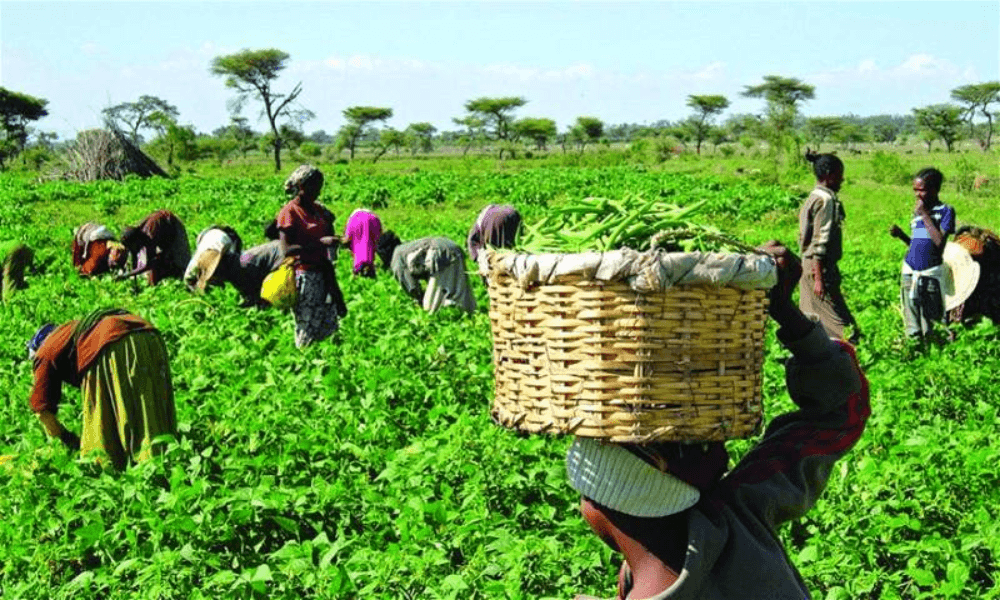
Agriculture experts say year-round or all-season farming has the capacity to scale Nigeria’s food output and reduce hunger in Africa’s most populous nation.
Worsening insecurity and extreme weather conditions pose a constant threat to food security in Nigeria- but so does rain-fed agriculture.
By moving beyond rain-fed agriculture and embracing all-year farming, Nigeria can unlock new levels of farm productivity, increase food availability and reduce reliance on imports, experts say.
Ibrahim Kabiru, national president of the All Farmers Association of Nigeria, said there is no real enabling environment for sustainable all-year-round agricultural production in the nation.

Read also: Why snail farming is Nigeria’s billion-naira goldmine
“We can’t keep relying on rain-fed agriculture to feed over 200 million people,” he noted.
Despite the push for increased local food production, dams across the country, which store water to enable farmers to cultivate all-year round, are still dysfunctional, and irrigation schemes are not working.
The situation has forced several farmers to spend a large chunk of their income on manual irrigation systems. Also, it has forced many who cannot afford manual irrigation to rely only on rain-fed farming.
This brings to the fore the recurring questions of the usefulness of the country’s several dams, which experts say will not only boost food production but also reduce Nigeria’s dependency on food imports.

“With functional dams and irrigation facilities, farmers across the country can grow food all year round,” Kabiru said.
“Farmers will be better served by improvement in the utilisation of existing dams than even building new ones,” he noted.
Nigeria has a total of 264 dams with a combined storage capacity of 33 billion cubic metres (BCM) of water for multipurpose uses. About 210 are owned by the federal government, 34 by the states, and 20 by private organisations, according to the Federal Ministry of Water Resources.
The purpose of dams is to boost water supply as well as provide reservoirs for flood control, irrigation farming, and hydroelectricity.
But the water hardly reaches the farms, as most of the dams across the country are being neglected by the government, experts say.
“Producing food all year round is a farmer’s delight. In Nigeria, most farmers rely on rain or the rainy season to start. While this is due to the soil topography, others are related to knowledge and skills of farmers. In Finland for example, despite the nature of weather conditions experienced during the year, the country has managed to maintain a stable production level for potatoes for local consumption and export within and outside the European Union. Israel has the most sophisticated use of technology in farming despite the nature of their farmland,” said Mamtus Nigeria, an agro-based platform.
Read also: Inside multi-billion naira pig farming business
It stressed the need for investment in acquiring farming knowledge and use of modern technology in agriculture.
“There are smart technologies such as drones, seed selectors, weather planners and rain guns, drip irrigation and sprinklers that help to boost farmers’ produce. Without prerequisite knowledge and skills most farmers are denied the benefit of these technologies, thereby impacting productivity.”