Nigeria is exporting more agricultural products this year than it has ever done. But the country still loses out on millions of scarce dollars and jobs as the majority of its agro-exports lack value addition, arriving foreign markets in raw or semi-processed forms.
In the first quarter (Q1) of 2025, exports accounted for over 57 percent of total trade, and just over eight percent of those exports were agricultural goods worth N1.7 trillion, the most Nigeria has made in a single quarter from them.
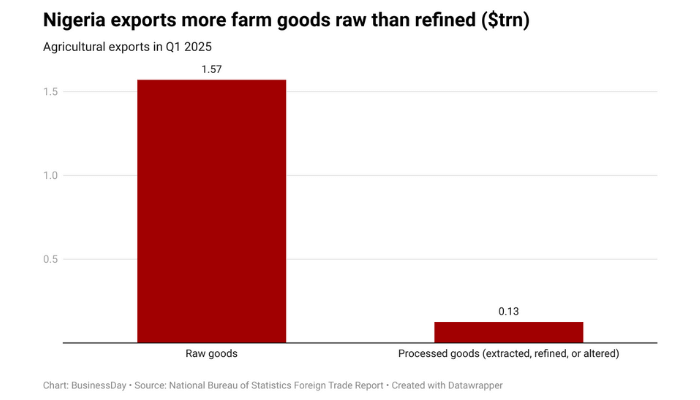
Yet, a closer look will show that the bulk of these were in their rawest form at the point of export, leaving Nigeria’s goal of industrial development for value addition in agro-exports stuck. This leads to missed opportunity for job creation and higher export earnings.
“If we look at what we are getting from the raw produce, and compare it to what the countries we export to are getting after they have been processed, it’s a lot of money,” Obiora Madu, director general of the African Centre for Supply Chain, told BusinessDay.

Read also: Agricultural renaissance has commenced Tinubu
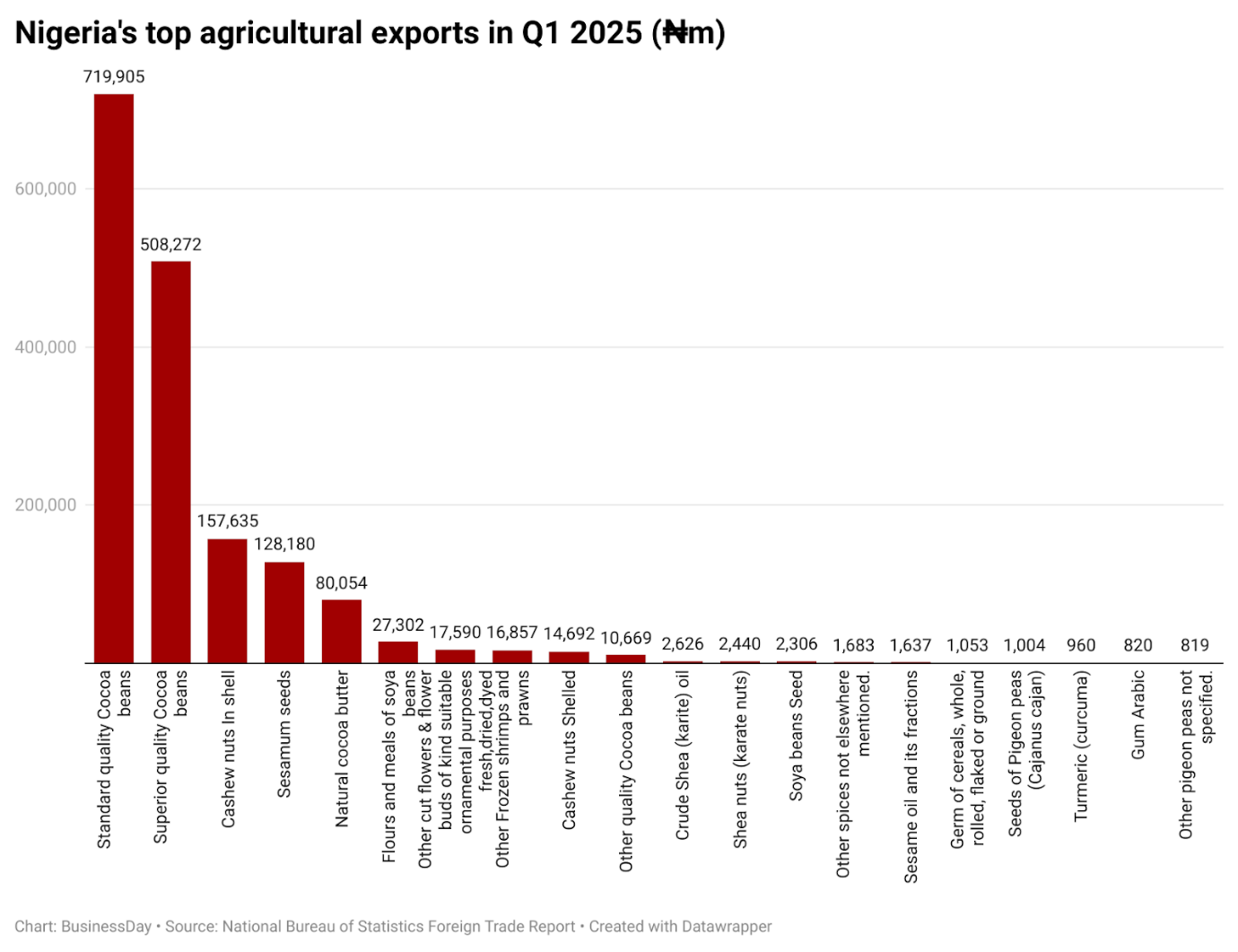
Between January and March, raw commodities accounted for over 92 percent of total agricultural exports, while processed goods made up just over seven percent. Cocoa remained export champion. Despite being the fourth largest cocoa producer, Nigeria still processes less than 13 percent of its cocoa locally, spending millions to buy back its derivatives from other cocoa producers.
In 2023, the country spent $33.94 million to import cocoa powder, according to the World Bank, 90 percent of which came from neighbouring Ghana, a cocoa producer.
Modelling Ivorian success
Côte d’Ivoire, the world’s largest cocoa producer, and world’s largest cocoa grinder, made huge strides with an aggressive approach to value addition.

This year, more than 50 percent of the country’s cocoa beans are processed domestically into butter, liquor, and powder, up from just 30 percent a few years ago.
The U.S. Foreign Agriculture Service’s latest overview of the country’s cocoa sector noted that it is dominated by the export of semi-finished products such as processed cocoa beans, cocoa butter, cocoa powder, and cocoa liquor–also known as chocolate liquor- which represent around 97 percent of exports.
But the country had been laying the groundwork for a while. Its differentiated Single Export Duty (DUS), introduced in 2017 until the end of 2024, played a key role in the export composition by exempting finished chocolate (zero percent tax) and applying reduced rates for powder, butter, and paste, while maintaining a high level for raw beans to encourage value-addition.
“Thanks to this mechanism, investments in processing have surged by 58 percent between 2020 and 2025,” the report noted.
Companies such as chocolate manufacturer CEMOI (Cémoi Group) support cooperatives in artisanal chocolate production and are seeking to develop an Ivorian market.
By 2030, the government wants to attain 100 percent first-stage processing and is collaborating with international partners to build new mega-facilities like the Transcao PK24 complex with an expandable 50,000-tonne capacity.
The economic logic is more money for more value. In the international market, raw cocoa sells for up to $9,000/ton, but processed cocoa products can fetch up to $13,000.
Read also: Farmers laud Tinubu, demand transparency in FG agricultural mechanisation programme
Kashim Shettima, Nigeria’s vice president, said at a meeting with the World Cocoa Foundation (WCF) in June that the government intends to revive Nigeria’s cocoa industry by boosting local grinding capacity, enhancing traceability and sustainability, and reducing reliance on raw bean exports.
But even as policy shifts gain momentum, quality control remains a major challenge in the Nigerian cocoa trade.
In June, the Ondo State government intercepted a truckload of adulterated cocoa beans, where dried cocoa placenta was mixed with beans to increase shipment weight.
The practice, driven by high prices and global demand, tarnishes Nigeria’s reputation in international markets.
The Ministry of Agriculture and Food Security has since stepped up enforcement, warning that such actions sabotage both the economy and the country’s trade image.
Recurring problem
It’s not just cocoa. Despite producing one-fifth of global cassava output and being the largest producer, Nigeria has continued to spend from its foreign exchange reserves to import large quantities of starch, flour, and ethanol, accounting for only two percent of processing market share.
Cassava is notably absent from Nigeria’s top agricultural exports, despite its abundance, due to its high-water content, perishability, and bulkiness, which make it unsuitable for long-distance trade without processing.
Meanwhile, Vietnam earned approximately $3.5 billion from processing and exporting Nigerian cashews in 2022, but Nigeria’s earnings from raw cashew exports were just around $250 million.
Countries like Malaysia, which transformed its agricultural sector through policies like the Industrial Master Plans (IMP) and Palm Oil Registration
and Licensing Authority (PORLA) regulations, have achieved over 80 percent local processing of its palm oil.
In contrast, Nigeria’s industrial policy, including the Nigeria Industrial Revolution Plan (NIRP), has struggled to achieve similar results due to implementation challenges and the continued dominance of raw material exports.
The Nigerian Export Promotion Council (NEPC) reports that the country loses approximately $1.2 billion annually in potential revenue from the cashew industry alone due to limited processing capacity.
Role of aggregators-for-export
The Raw Materials Research and Development Council (RMRDC), a research agency of the federal government, recently raised concerns over the growing dominance of large aggregators-for-export in Nigeria’s agricultural value chain, noting that their operations often favour raw commodity exports at the expense of local value addition.
“While the entities provide essential market access for smallholder farmers and contribute to the economy through significant export revenues, their practices often hinder local industrial development,” the Council noted in a report by N. Ike-Muonso, its director general, a natural resource economist.
“The dominance of these aggregators-for-export in the supply chain often drives up local prices, making it difficult for domestic processors to compete and thrive,” the agency said.
Read also: PMI: agriculture maintains the lead as economic activity expands for the sixth consecutive month
Closing the gap
The Nigerian government is now pushing for reforms, including a National Cocoa Management Board ,and policies to mandate local processing quotas.
The Senate recently passed the Raw Materials Processing and Local Production Protection bill, which mandates that all raw materials exported from Nigeria undergo at least 30 percent local processing.
The government will also charge a 15 percent levy on export value for violators, who also risk suspension or revocation of export licenses.
“Countries like Indonesia and Malaysia have successfully implemented similar policies,” the RMRDC noted, citing Indonesia’s raw material export restrictions, and Malaysia’s PORLA regulations which helped create a robust processing sector.
Internationally, the incentive exists. The UK’s Developing Countries Trading Scheme (DCTS) was to remove tariffs on goods such as cocoa butter and cocoa paste to support wider trade policy priorities and promote value addition in important non-oil export sectors.
Olayinka David-West, a professor and dean of Lagos Business School, Pan-Atlantic University, said that the gap in Nigeria’s processing power offers opportunities as it does challenges.
“The opportunity to drive industrial-scale production in Nigeria has never been more attractive,” she said. “[They] present significant opportunities for innovation and value addition through advanced agronomic practices, technology adoption, and infrastructure development.”