Nigeria’s plan to boost food self-sufficiency is faltering under the weight of skyrocketing farm input prices.
The rising cost of essential farm inputs, from fertilisers to high-quality seedlings, is threatening Nigeria’s ambitious plans to boost food productivity and achieve self-sufficiency.
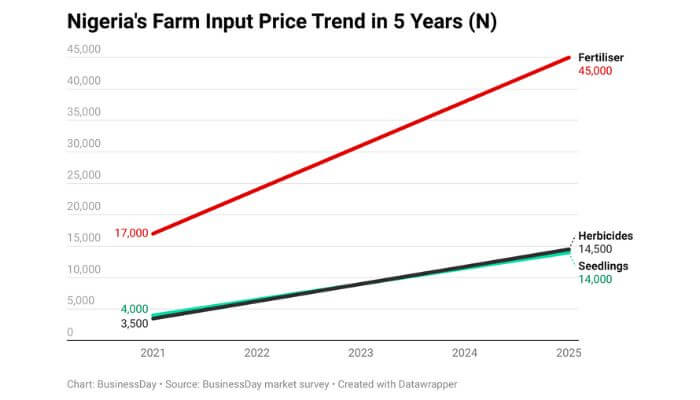
In the last five years, the cost of fertilisers in Nigeria has surged by over 100 percent from an average of N17,000 in 2021 to about N45,000 currently across the country.
The spike has coincided with soaring costs of other critical inputs such as herbicides and improved seeds, most of which are now out of reach for the average Nigerian farmer.

Ibrahim Kabiru, president of All Farmers Association of Nigeria (AFAN), said the rising cost of farm inputs is crippling the quest for food security as well as doubling prices.
Read also: Our fertile farmlands have become killing fields – Benue farmers
Kabiru explained that without addressing the rising cost of production—labour, inputs, and logistics—any efforts to curb food inflation will fall short.
“The average price of fertiliser today costs about N45,000, and this is why the prices of food items are rising. The higher the prices of farm inputs, the more we see a rise in food prices,” he said.
Over 60 percent of people in Nigeria are farmers who heavily rely on crude farming methods that cannot boost crop yields. While the country struggles with only 0.9 yield per hectare in beans production, countries like Egypt and Ethiopia consistently churn out an average of two and four tons annually, the Food and Agriculture Organisation (FAO) notes.

Experts in the agricultural sector link this challenge to several reasons, including poor access to quality seeds, insecurity, and climate change.
“We cannot subsidise food prices,” Kabiru noted. “But the federal government can sustainably subsidise the cost of farm inputs, especially fertilisers.”
For Kabiru, subsidising farm inputs promises high yields for farmers and lower food prices for consumers. “When the cost of production is low, then definitely prices of food commodities will fall.”
Despite having 36.9 million hectares of arable land suitable for the cultivation of rice, beans and others, Nigeria remains import-dependent, lagging behind its peers in terms of yield per hectare.
This shortfall in yield has led to a surge in food imports. In 2024, the country spent N2.79 trillion on imported foodstuffs, according to the National Bureau of Statistics (NBS). The country imported N1.7 trillion worth of food in the first three months of the year.
The data indicate that despite efforts to boost local production, Nigeria’s dependence on imports continues to rise across multiple sectors.
Abiodun Olorundero, managing partner at Prasinos Farms, emphasised the necessity for high-yielding seedlings that not only assure the nation of food security through a boost in yield, but can also afford farmers sustainable revenue.
“Smaller countries are producing more than we are because of their yield per hectare. Now, the reason our yield is low compared to other African peers is due to farmers’ inability to access quality seedlings and fertilisers,” he noted.
“The truth is, fertilisers boost the quantity of yield, and when farmers cannot afford it, they are forced to rely on archaic methods that cannot boost our yield.”
Research has shown that farms, where adequate fertilisers are applied, experience faster growth and produce healthier crops which then translates into higher yield.
Olorundero further said that a farmer with the capacity to cultivate about 20 hectares of land is now forced to cut down to about five hectares just because of inability to afford the cost of fertilisers, pesticides and high-quality seedlings.
“The impact of the unexplainable surge in farm input is enormous. Food prices have invariably been affected and there is a growing shortage in food supply,” the agribusiness man said.
Femi Oke, president of AFAN, Lagos Chapter, reiterated that the rise in acquiring farm inputs is preventing Africa’s most populous nation from achieving food security. He affirmed that the rising cost of pesticides is weighing on farmers.
Reade also: Kogi First Lady begins distribution of agro inputs, equipment to farmers
In 2024, prices of fresh tomatoes doubled owing to the Tuta Absoluta outbreak that ravaged a wide range of tomato farms in the key producing states. Farmers reported losing billions of naira to the pest.
Globally, approximately 20 percent–40 percent of agricultural produce is lost annually due to pest and pathogen infestations.
In a previous interview with BusinessDay, Shuaibu Bulama, a representative of the Federal Ministry of Agriculture, had stressed that the price of insecticides had risen above the purchasing power of farmers.
When farmers cannot afford to purchase pesticides, there will always be disease infestation, he said.
China Peters, a Benue State farmer, noted that several farmers are trapped in poverty. “We’ve been forced to return to subsistence farming. Without fertilisers or pesticides, yields remain low and food insecurity deepens.”
“A lot of farmers do not have the resources to purchase farm inputs, hence they depend on subsistence farming, which is why yield per hectare is low compared to other African countries,” he said.