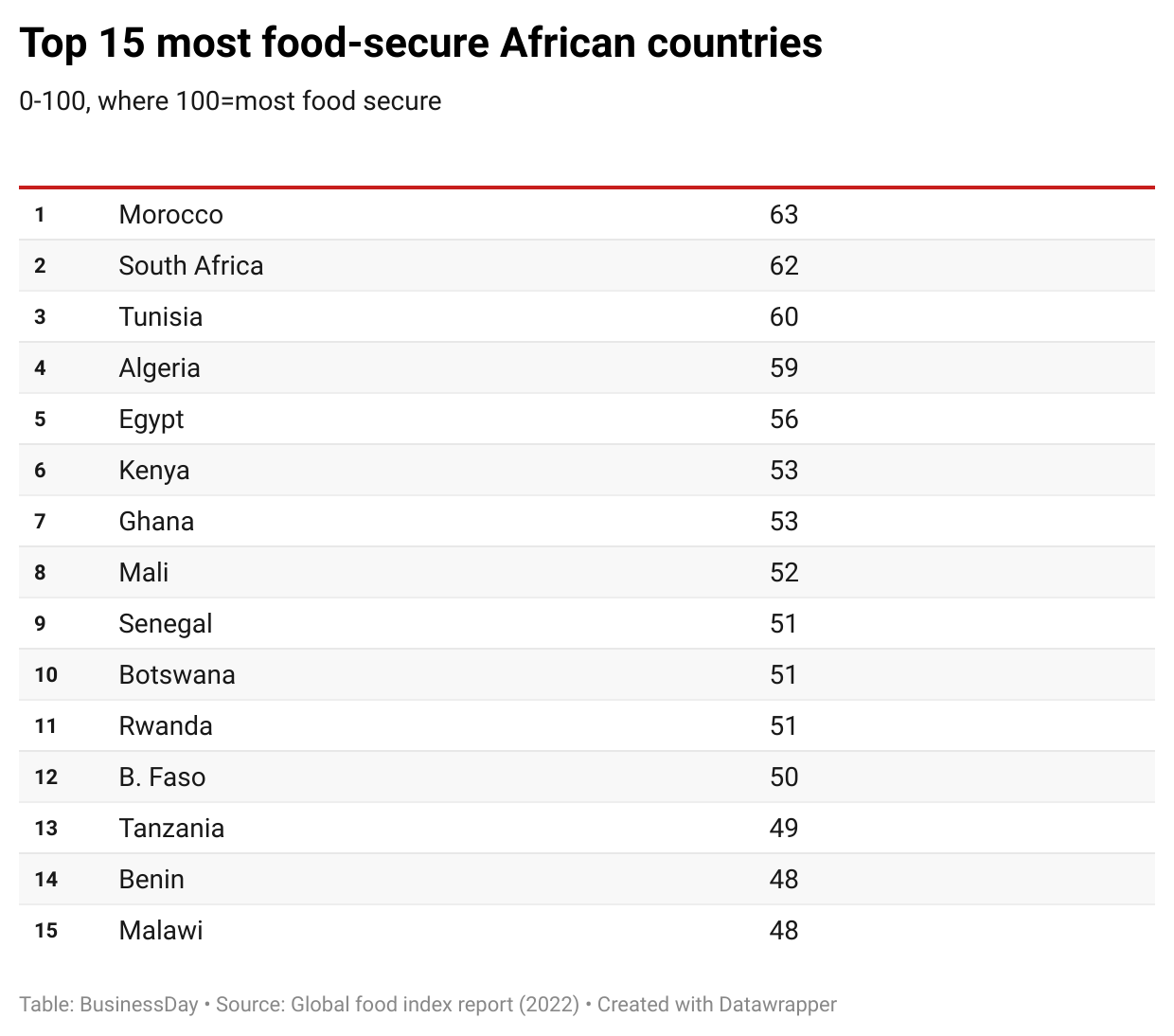
Tanzania has emerged as a rare African success story on food security, achieving 128% sufficiency in 2024 and exporting surplus food across the region, just three years after battling a national food crisis. Here’s how the transformation happened.
Tanzania, an East-African country with a population of 66.7 million people has set a new benchmark in food security, raising hope that the fight against rising hunger and malnutrition in Africa is achievable.
The country is now a model for food security on the continent, achieving 128 percent of food sufficiency in 2024 and exporting surplus to neighbouring countries.
Tanzania’s success of moving from a country plagued with high production shortfall to food security holds lessons for Nigeria, a country grappling with its own agricultural challenges.

Tanzania, with 44 million hectares of arable land—of which only 10.8 million are cultivated and 29.1 million are suitable for irrigation—now produces enough food to feed its 60 million citizens and still exports surplus to neighboring countries. It has also become a regional leader in processing and exporting cashew nuts, a rare feat among African nations.
In contrast, Nigeria, despite having over 70 million hectares of arable land and cultivating 30 million, uses only 5 percent (1.5 million hectares) for irrigation. As a result, it remains one of Africa’s most food-insecure nations.
According to the FAO, 40 percent of Nigerians lack reliable access to food, and 33.1 million people are projected to be food insecure by 2025.
“A food-secure Nigeria is possible, just like Tanzania has shown,” said Adebayo Adeleke, founder of Supply Chain Africa. “But it won’t happen without serious work,” he stated.
“We need to bridge infrastructure gaps, fix supply chains, invest in storage, add value to our produce, and fully embrace mechanisation,” he added.

Tanzania’s agricultural gains are credited to deliberate policy choices—not chance.
“We expanded irrigation, subsidised critical inputs, trained young farmers, and invested heavily in research,” said Hussaine Bashe, Tanzania’s Minister of Agriculture, while presenting their agricultural annual scorecard.
But experts warn that Nigeria must first address rural insecurity.
“Nigeria can do the same,” said Ibrahim Kabiru, President of the All Farmers Association of Nigeria (AFAN). “But not until we deal with insecurity so farmers can access their land safely,” he noted.
Analysts say with the right reforms—subsidised seeds, youth-focused programs, investment in irrigation and storage—Nigeria can replicate Tanzania’s success.
Tanzania’s journey to sufficiency
Just a few years ago, Tanzania was in the grip of a food crisis. Between 2020 and 2021, 30–40 percent of the population in some regions faced severe food insecurity.
According to the Integrated Food Security Phase Classification (IPC), over 2 million people among the 13 percent of their total population surveyed—lacked reliable access to food.
But by 2024, Tanzania had not only reversed the crisis, it became self-sufficient in staple crops like maize, wheat, and edible oil. The FAO now cites the country as a regional success story.
The turnaround began in late 2021, when the government launched a sweeping reform package in partnership with the African Development Bank (AfDB) and other institutions. The initiative supported 1.7 million rural farmers, targeting key staples such as maize, rice, and wheat.
“We unlocked the twin challenge of low production and productivity by involving youth-led agricultural systems, supporting them with irrigation, research, and input subsidies,” said Bashe.
In 2022, the government designated up to 100,000 hectares for sunflower and oil palm to reduce dependence on imported edible oils.
At the same time, it streamlined export rules, subsidised inputs, built processing plants, and tackled post-harvest losses.
In the 2023/2024 season, Agricultural exports surged to $3.54 billion, up from $2.33 billion the previous year. At the same time, cereal output jumped from 11.4 million to 18.9 million tons.
Cash crop production increased from 1.22 million to 1.49 million tons, while the output of roots and tubers grew from 11.1 million to 15.7 million tons.
Tanzania’s story proves that with the right mix of policy, investment, and innovation, recovery from food insecurity is possible.

Why Nigeria’s food insecurity persists
A recent survey by Basil Abia, co-founder of Veriv Africa, and his research team reveals alarming trends in Nigeria’s agricultural sector.
According to the findings, 54 percent of farmers lack access to finance, 21.3 percent are affected by communal conflict, and 12.7 percent suffer post-harvest losses. Many also face mounting challenges from floods, droughts, and other climate-related crises.
“The numbers are scary,” Abia said. “58.5 percent of Nigerians face food insecurity, and only 5 percent of agricultural activity in Nigeria involves irrigation. That’s why food insecurity persists—we can’t keep relying on rain-fed agriculture,” he noted.
Beyond the challenges in production, experts say weak infrastructure after harvest is worsening the crisis.
“Food security is not just about farming,” said Adebayo Adeleke, founder of Supply Chain Africa. “What happens after harvest is even more important,” he added.
“There’s a lot of waste—huge quantities of fresh food rot in trucks because our supply chains are broken. Farmers can’t afford their own produce a few months after harvest, and consumers can’t sustain bulk purchases either,” Adeleke explained.
The situation reflects a wider regional crisis. The World Bank’s 2025 Food Security Report warns that 50 million people are projected to face severe food insecurity in Western and Central Africa, driven primarily by conflict and climate change.
Measures in boosting productivity
Experts believe Nigeria can overcome its food insecurity crisis by adopting proven strategies from countries like Tanzania.
Adebayo Adeleke, founder of Supply Chain Africa, emphasized the importance of political commitment and coordinated efforts.
“Food security in Nigeria is achievable—it’s been done in many countries,” he said.
“Just like Tanzania, we need strong political will, investment in value addition for staple crops, and better post-harvest storage to reduce waste,” he added.
He also stressed the need for a robust supply chain and collaboration across stakeholders to strengthen food systems.
Youth involvement is another critical factor. In Tanzania, young people were grouped into cooperatives to ease access to finance—an approach Nigerian experts say could be replicated.
“Sixty percent of Nigerian youths are not engaged in agriculture,” said John Alamu, CEO of Johnvents. “We need more of them to see farming as a viable business.”
“We must build systems that make agriculture appealing—not just as a side hustle, but as a serious, profitable enterprise,” added Peter Adekanye, CEO of Oyemond Agro.
With the right reforms, analysts say, Nigeria could unlock its vast agricultural potential and achieve sustainable food security.