




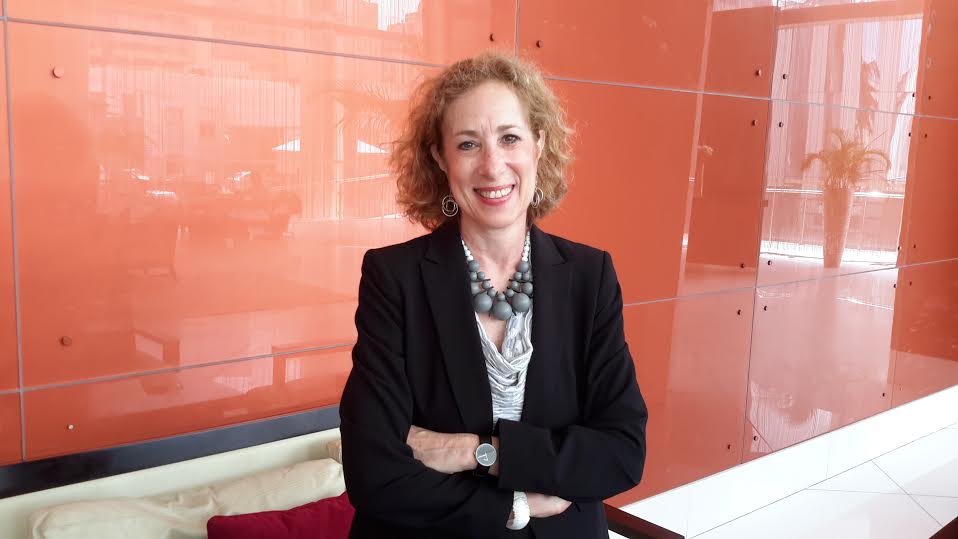
Indeed there are female high fliers, breaking the glass ceiling and daring to set the pace for other women to follow. One of such an inspiration is my ‘date’ for this week. Her name is Nancy Wildfeir-Field and she is the President of GBCHealth. GBCHealth is a coalition of companies and organizations committed to investing their resources to make a healthier world… for their employees, for the communities in which they work and for the world at large.
Nancy Wildfeir-Field joined GBCHealth as its new President at the end of May this year. Nancy has extensive international experience in both global health and the private sector, having most recently served as Director, Global Partnerships for BSR (Business for Social Responsibility) where she oversaw the highly regarded HERproject.
Previously, she managed health-related partnerships for USAID in the Caribbean and Eastern Europe, served as Managing Director for The Prince of Wales International Business Leaders Forum (IBLF), held joint management responsibility for the health issues group at Burson-Marsteller, managed project implementation strategy for the UK Ministry of Health and served as communications director for one of the UK’s largest medical associations.
“Nancy’s rich and diverse experience will allow her to drive GBCHealth forward as the world’s foremost expert on business engagement in global health,’ said Ray Chambers, Co-Chair of the GBCHealth Board. “With fewer than 600 days remaining to achieve the MDGs and a need to protect hard-won health progress beyond 2015, Nancy’s leadership in harnessing business resources for global health goals will be vitally important. The Board is excited to have her on the team.”
“Nancy’s rich and diverse experience will allow her to drive GBCHealth forward as the world’s foremost expert on business engagement in global health,’ said Ray Chambers, Co-Chair of the GBCHealth Board. “With fewer than 600 days remaining to achieve the MDGs and a need to protect hard-won health progress beyond 2015, Nancy’s leadership in harnessing business resources for global health goals will be vitally important. The Board is excited to have her on the team.”
Added Aigboje Aig-Imoukhuede, Co-Chair of the GBCHealth Board, “Nancy’s appointment comes with the Board’s full support and endorsement. We know Nancy will work effectively with GBCHealth’s network of partners to deepen and accelerate the private sector’s impact on the most pressing health issues of our time.”
Meeting Nancy was quite interesting as she was recently in Nigeria for a few days attending the Corporate Alliance on Malaria in Africa (CAMA) annual technical forum themed: The Road to 2020: Mobilising private Sector in Nigeria’s Fight Against Malaria.
Meeting Nancy was quite interesting as she was recently in Nigeria for a few days attending the Corporate Alliance on Malaria in Africa (CAMA) annual technical forum themed: The Road to 2020: Mobilising private Sector in Nigeria’s Fight Against Malaria.
I managed to catch up with her for a few minutes and it was an enlightening discourse. Sharing with me on GBCHealth’s active participation at the forum, Nacy says “as an organisation, we have consistently worked with the business community on various issues. It started from HIV/AIDS and has now grown into two other areas including tuberculosis and malaria. The statistics have changed, TB is much more in control and malaria incidence is much higher around the world. Part of our goal is to address other areas like maternal and child health, and how we can help to accomplish the MDG goals 4 & 5 in collaboration with the business community”
“Malaria is one of those areas that is really a cross cutting issue and if we can tackle some of the malaria incidences in a number of countries, Nigeria being one of them, then we can have a very significant impact and as such we can quickly save children’s lives and help impact the economy immensely.” She said. That’s not all there is to the economic implication of malaria. Hear Nancy tell you more. According to her, “Malaria has a health and economic impact and Nigeria is one of the countries with a high disease burden so therefore, we will be assisting to help Nigeria mobilize the health sector to help proffer solution around moving to malaria elimination agenda because this will help in terms of national results which will eventually aid global impact.”
Speaking on the feasibility of pre-elimination of malaria by 2020, Nancy has this to say “It is very ambitious and though I am not a health expert however, I have been working in the health sector for a number of years…it is an ambitious target but I also know that ambitious targets can be reached with commitment and collaboration because partnership is very key. Government cannot do it alone, private businesses and NGOs cannot do it alone, we have to work together to come up with integrated solutions across borders and regions.” Says Nancy.
It is established that this might not be an easy task though achievable however, the challenges are there. Nancy sheds light on some “There are a number of challenges we need to address. An integrated solution is absolutely key; it can’t be just about treatment and prevention, we need some new tools, resistance is increasingly an issue around the world so how do you address that? How do you ensure from a treatment point of view that the affected person is actually completing his treatment? This is where education and provision of proper control comes in.”
“I believe the challenges like having the tools for the right treatment at the right consistency can be a challenge, another challenge is adequate funding because finance is one of the big challenges, adequate funding to ensure we have all in place in a consistent way.” Nancy narrates.
“I believe the challenges like having the tools for the right treatment at the right consistency can be a challenge, another challenge is adequate funding because finance is one of the big challenges, adequate funding to ensure we have all in place in a consistent way.” Nancy narrates.
GBCHealth works more on coalition builders, “we work to share information and resources across different organisations. There is an enormous investment being made in terms of community programs being established, in terms of new product development across different areas.” She reveals but that is not all, Nancy ads “In some cases, I think through community programs or philanthropic programs, there are investments being made and we as an organisation are working to create a new mechanism that will enable business community from an initial perspective, able to start aggregating funding which enables smaller and large donors to come together and look at really focusing on impact, results and its rewards. It is important that the resource is there and that an enabling environment is also put in place to ensure each of the sectors can contribute appropriately.”
There are reports showing that funds have been released at various levels to help fight malaria. There have been questions on the efficacy of the disbursing process and the spending, a crucial cause for worry you would say and Nancy has her views on this. Again, she speaks. “The new mechanism we are working on in collaboration with a number of different partners is that we are designing a way that hopefully begins to identify such challenges. To ensure that the funding that is being committed and being contributed to different projects is used for its purpose is important and we do that by setting some clear indicators and parameters.”
“we are putting in place some parameters that looks at the long term impact so as an example, if we look at malaria, take the bed nets for instance, there has been stories around bed nets being misused or misappropriated for different sources, how do you work with the implementing organisation to ensure and monitor that the bed nets are being used in the appropriate way? In longer terms you can device means to find out if the items disbursed are achieving the anticipated results. If for instance you can monitor and discover that the nets are being used, it can help with your findings and if the results aren’t okay, we can check to find out what the issues are and what we need to be thinking about is what is needed to tackle the issue.” Nancy reveals.
She continues “Another area of importance to look at is the integration of global service, are we just addressing malaria or addressing other issues? In the case of children for instance, if we are improving their nutritional intake, we must also improve their ability to fight the disease as opposed to leaving the children who are weak and this can eventually lead to death.”
The interview came to an end after Nancy gave her words of admonition to the business community saying “One of the key messages for the business community about why it is important for the business community to step up is that we have been focusing on the maternal and child health issue but malaria is rampant in Nigeria and what does that mean in terms of productivity of the workforce? It starts from your workplace and then you go further to look at the impact on the community. I believe it is a clear business case because if you want to improve your productivity, then you need to get malaria under control, it will reduce absenteeism, you will have a healthier and happier workplace, you will then have a healthier and happier community and you will have a better customer base so I think from the business perspective there is a clear case here and there are figures that shows this is true.”
Kemi Ajumobi
