



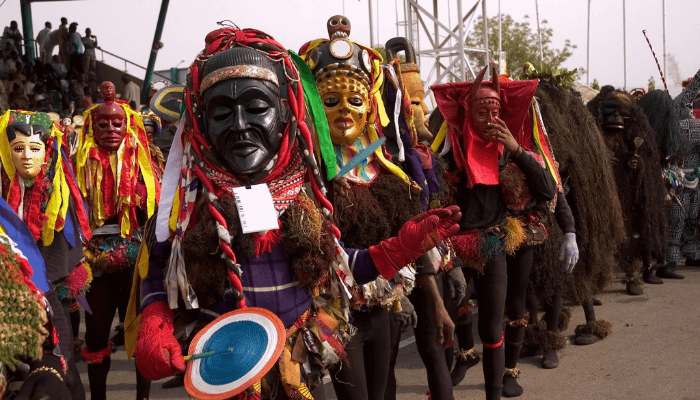
In every culture, certain institutions occupy the realm of the untouchable. They are shrouded in mystery, steeped in symbolism, and guarded by an unspoken reverence. Among the Igbo, the mmanwu – masquerade – is such an institution. It is not just performative folklore or ancestral nostalgia; it is a metaphysical reality, an embodied presence of the ancestors, believed to mediate between the spiritual and the temporal realms. Traditionally, masquerades are feared, respected, and honoured as spiritual agents entrusted with the moral compass of the community. But as Friedrich Nietzsche once warned, “He who fights with monsters should be careful lest he thereby becomes a monster.” What we have witnessed in Nsukka on 22 June 2025 – spirits in handcuffs – is the ultimate cultural irony: those masked as spirits of old descending into the profane realm of lawlessness, only to be unmasked by agents of the law they once transcended.
According to a statement released by the Enugu State Police Command, three members of the Oryiokpa masquerade group were arrested on 23 June, 2025, for physically assaulting residents during what should have been a sacred cultural celebration. A viral video had earlier surfaced, showing these so-called “ancestral emissaries” descending into raw street brutality. One victim, it was confirmed, sustained serious bodily harm and is receiving treatment. They resisted arrest at first, but unlike the true mystics of the spirit realm, they could neither vanish into thin air nor conjure a cloud of ancestral dust to escape. No. The supposed spirits were bundled into a police van by mere mortals – a security apparatchik they ought, in their sacred essence, to transcend. And therein lies the tragedy. They could not disappear because there was nowhere spiritual left in them to return to. This underscores the tragedy of self-demystification!
This public arrest of masqueraders, those believed to be incarnations of the dead, is not just symbolic; it is a cultural rupture. For masquerades to be subdued by the law of the living is to acknowledge their loss of spiritual potency. If indeed the Oryiokpa masquerades were true reincarnations of the ancestors, as tradition demands, they would not have been so vulnerable. They would have activated some esoteric abracadabra, perhaps melted seamlessly into the spiritual realm from whence they cometh, escaping the reach of mortal hands. But they did not. Why? Because they had long ceased to function as spiritual entities. They had been hollowed out by miseducation, unchecked youthful delinquency, commercialization of the sacred, and a lack of ritual discipline. The masquerade did not lose its power in the moment of arrest; it had already lost it through years of self-inflicted demystification. And in stripping itself of mystery, it became fair game for ridicule, handcuffs, and court summons.
This aligns with the Ezikeọba proverbial wisdom: “Ma nọyer n’ihe, ọ ga ne-eshi eene, eene.” (A masquerade – spirit – that tarries too long in the land of the living, begins to smell human.) The Oryiokpa masquerade had overstayed, not just temporally, but symbolically. It had become so familiar, so mundane, so desacralized, that it was now perceived not as ancestral force but as youthful nuisance. Herein lies a tradition in crisis, transiting from spiritual agency to street hooliganism.

Traditionally, the mmanwu serves clear spiritual, judicial, and moral purposes – enforcing taboos, mediating disputes, commemorating the dead, and symbolizing divine presence. Cultural traditions thrive on discipline, ritual, knowledge, and sacred meaning. Oryiokpa masquerade in the good old days, for instance, is governed by ritual protocols, spiritual initiations, and elder-led oversight. In those days, unveiling a masquerade in public space was a taboo that could provoke communal sanction. But in contemporary times, modernity has uprooted this order. In Nsukka as in many other Igbo communities today, masquerade performance has been handed over to uninformed youths, many of whom see it as an avenue for violence, extortion, or youthful mischief. The female folks are chased and assaulted; traders are taxed; innocent passersby are whipped or harassed – all in the name of masquerading. Such has been the toxic character of contemporary masquerading that if an ancestor were to return to Ideke Arumona today, one wonders if he would recognize himself in Oryiokpa or if he would recoil in shame!
How did we get here? Much of the blame lies in the generational disconnect between tradition and its so-called torchbearers today. The elders, who once oversaw the rites and disciplined the errant masqueraders have either died, been silenced, or have retreated into disillusioned resignation. In their place, a new breed of Gen Zs has taken over, not out of a deep reverence for the tradition, but out of boredom, bravado, a thirst for spectacle, and perhaps most importantly the craze for ‘cultural revival’. Most of the so-called cultural custodians are, ironically, the same youths, who publicly dismiss ‘Church’ as a ‘scam,’ not out of any strong theological conviction, but out of sheer rebellion against order. The catchphrase – ‘no gree for anybody’ – normally suffices as their battle-cry for driving this protest. No doubt, the church, for all its challenges, at least, makes conscious and sustained efforts to instill discipline, values, structure, and moral direction. But in turning their backs on it without understanding either its values or its cultural roots they now parade in costumes, these modern-day masqueraders drift into a nihilistic performance of identity – all costume, no substance.
This breakdown of ritual discipline is not just a spiritual issue; it’s a sociological one. As Émile Durkheim postulated, when collective beliefs lose their normative power, anomie – normlessness – sets in. What we saw in Nsukka on 23rd June was not tradition at play. It was anomie in masquerade. It was not the dance of spirits, but the rampage of misguided humans donning ancestral costumes. The foregoing quite vividly paints the stinging irony of justice when spirits embrace the thorny chest of the law. The self-demystification is complete when the sacred becomes ordinary and the ordinary becomes criminal. Imagine Oryiokpa – supposed spirits – in handcuffs and scuffled like hoodlums and street urchins!
The image of masqueraders in police custody is not just visually jarring; it is cosmologically absurd. And yet, it is a fitting indictment of cultural hypocrisy. For too long, society has tolerated criminality under the pretext of tradition. For too long, communities have cowered in fear or silence when masked thugs – not true masqueraders – inflicted harm during festivals. This arrest should thus serve as a historical milestone – the moment when even “spirits” became answerable to the law. Commissioner of Police, CP Mamman Bitrus Giwa, said it best: “Masquerade celebrations are a sacred and symbolic aspect of our culture. But the actions of those who exploited the occasion to commit criminal acts are unacceptable.” His words signal a growing recognition that the state must now serve as the arbiter between sacred tradition and civil order. The masquerade must no longer be a cloak for criminality.
It must be noted, however, that the arrest was made possible through the cooperation of community members. This is significant. It signals a paradigm shift. The silence that once protected erring masqueraders is breaking. The complicity of communal elders, who often rationalize such acts as ‘cultural revival’ or ‘boys just being boys,’ is now being challenged. But more must be done. Communities must reclaim the lore and discipline of masquerade. They must restore initiation rites, reintroduce ethical education, and reestablish the spiritual backbone of the tradition. Masquerade societies must cease to be playgrounds for the uninitiated and return to being sanctuaries of sacred conduct. For as long as we allow masquerade to be hijacked by the mundane, turning sacred regalia into sweaty costumes and sacred space into a battleground, we risk losing the very soul of our tradition. And when that soul is lost, what remains is cultural costume with no conscience. The masquerade, once feared, revered, and cloaked in mystery, has become a laughingstock and object of public opprobrium.

Herein lies the challenge of restoring the sacred and redeeming the mask. The Oryiokpa Nska masquerade incident is not just a local embarrassment; it is a cultural tragedy with national significance. It calls us to reflect deeply on the state of our traditions, the hollowness of our symbols, and the urgent need for cultural renaissance. Arresting masqueraders may seem absurd on the surface – like arresting spirits – but when the sacred becomes savage, the law has no choice but to intervene. To rephrase the words of St. Paul in 2 Timothy 3:5, these masqueraders had “a form of godliness, but denied the power thereof.” They wore the mask; yes, but they lacked the mystery. They invoked the ancestors, but channeled the instincts of the lawless. They spoke the language of tradition but walked the path of deviance.
The way forward requires difficult conversations. Elders must rise from silence; restore the sacred; and reclaim guardianship of tradition. Cleanse the masquerade of its current profanities; rebuild community structures to educate; initiate and regulate the practice. Communities must define clear codes of conduct for masquerade festivals and enforce them without fear or favour. Churches must engage, not just condemn. And the youths must ask themselves: is it culture we are reviving or chaos we are chorusing and glorifying? Let masquerade regain its power not through fear and force, but through discipline and dignity.
Until then, let this incident stand as both proverb and prophecy – that any spirit that forgets its source and descends into lawlessness will not only be unmasked but will also be arrested, arraigned, and prosecuted like any ordinary miscreant. May this not be the cultural epitaph of Mkpunano, Nru, and Ihenowere, and indeed the entire Nska Asadu Ideke Arumona! For in the end, ma nọyer n’ihe… ọ ga ne-eshi eene, eene – and a masquerade that begins to smell human can no longer claim to be spirit. Kpo!
.Prof Agbedo is of the University of Nigeria, Nsukka, a Fellow of Royal Dutch Institute, and Public Affairs Analyst.





