|
Getting your Trinity Audio player ready...
|
As the Fourth Industrial Revolution (4IR) reshapes economies and job markets around the world, Nigeria risks being left behind if it fails to act with urgency.
While global leaders invest heavily in robotics and emerging technologies, Nigeria’s education system remains largely unprepared to equip students with the skills needed for the future of work.
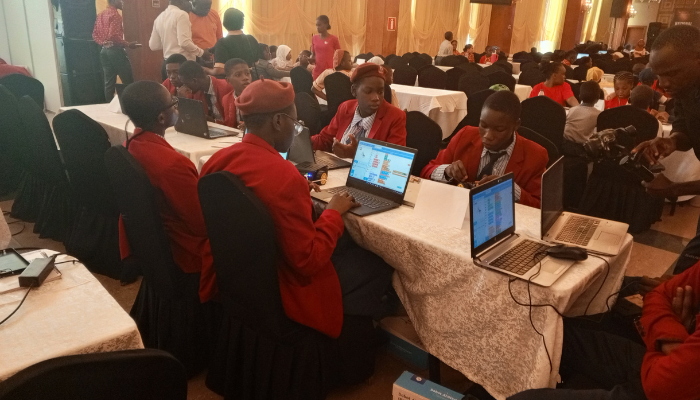
Experts warn that without a deliberate strategy to integrate robotics education, the country may miss a critical opportunity to harness its youthful population for technological innovation and economic growth.
Olusola Ayoola, chief executive officer/founder of Robotics, and Artificial Intelligence Nigeria (RAIN), expressed worries that the education system in Nigeria lacks structures for robotics.

He emphasised that Nigeria must move away from the culture where people boast of being able to change motherboards, to a culture where they are able to remove the sensor and replace it.
“I must say true robotics training teaches us how to build from scratch. So the future of robots is inextricably linked to the future of our robotics education. We can’t have advanced robotics without having advanced training in robotics.
Read also: Lagos to train teachers, adjunct-instructors on robotics education
“There is no particular structure on what these young ones must learn, so most them have to learn on their own,” he said.
Ayoola decried the fact that many companies in Nigeria hardly are supporting education and beyond that, neither are these firms absorbing the talents from the schools.

He emphasised that many Nigerian youth, even those who do not want to come back, would want to stay in Nigeria and work remotely for foreign companies. But he reiterated that this is not very good for the industry in Nigeria.
Similarly, Abiodun Gbenga-Ilori, director of Innovation and Technology Management Office (ITMO) and project lead of Innovation to Market (I2M) at the University of Lagos, said that Nigeria must be deliberate to maximise the fourth industrial revolution opportunities.
“In recent years, we have had many of our youths making strides and taking advantage of opportunities that come with the 4IR. Such youths upskilled themselves and gained employment working for foreign companies in capacities like Data Scientists, Cloud Engineers, and Software Developers while residing in the country.
“They contribute to the foreign earnings of the country. You can imagine what the case would be if concerted efforts were deployed to harness the potential of the country toward positioning it for the 4IR,” she said.
According to the Global Innovation Index (GII), Nigeria lags, ranking 122 out of 137 economies due to many factors such as a lack of proper know-how on how to innovate hindering birthing innovations in the country.
Gbenga-Ilori stressed that due to ease of getting access to money from the sale of crude oil, the country has failed to harness opportunities the fourth industrial revolution (4IR) offers.
“The 4IR requires significant human development and some other factors and hence deliberate steps must be taken. India as a country readily pivoted well and we can see the result in where their economy stands in the world,” she noted.
Ayoola buttressed his views that robotics is becoming the order of the day, but maintained that Nigeria must decide whether to be part of revolution or not.
“As the world stands at the threshold of a technological revolution, we Nigerians must look at ourselves eyeball to eyeball and ask a critical question. Do we want to be passive consumers of foreign innovation or active players in this technological revolution?
“It’s a choice to make, because often we are confused between our national drive for industrial automation and our drive for robotics,” he stressed.
Experts argue that Nigeria and other sub-Saharan Africa is the world’s youngest region today with more than 60 percent of its population under the age of 25.
By 2030, they say, the continent will be home to more than one-quarter of the world’s total under-25 population, growing the size of its workforce by more than the rest of the world.
However, World Economic Forum data reveals that African countries, especially Nigeria is very vulnerable to job displacements occasioned by AI and automation.
According to the report Ethiopia and Nigeria maintain large proportions of workers in lower-skilled jobs, which are more susceptible to automation.
In light of Africa’s vulnerability to extensive job displacement possibly occasioned by AI and automation, urgent steps need to be taken to implement a bottom-up revision of curricula in schools across Nigeria.
More than ever before, industry participation and input is needed in re-shaping learning and instruction in educational institutions to make ready a workforce for the rapidly changing workplaces of the 21st century.