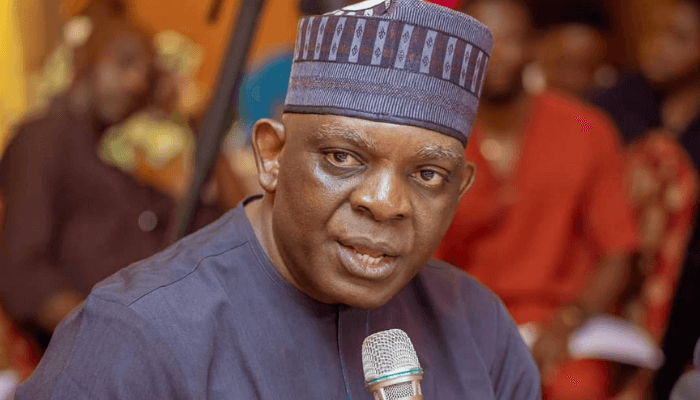
The Federal Government says plans are ongoing to begin manufacturing of boats in the country in a bid to phase out rickety vessels and curb the incidence of boat mishaps.
Pius Akutah, the Executive Secretary of the Nigeria Shippers Council (NSC), said this in an interview with the News Agency of Nigeria (NAN) in Abuja.
Akutah said that the Ministry of Marine and Blue Economy and the Nigerian Inland Waterways Authority (NIWA) were working tirelessly to minimise the level of accidents on the inland waterways.
According to him, the minister is looking at a new way of making boats in Nigeria so that we can phase out all these rickety wooden boats that are very easy to capsize.

“You see, the kinds of boats that are being put to use on our waters are not even boats that somebody should even put on the water.
“Because we have not properly professionalised boat making in Nigeria, that is why today we are still using wooden boats.
Read also: Boat mishap: FG donates 3,500 life jackets to Delta
“Other countries, even smaller neighbouring countries, have gone ahead to start fabricating boats and professionalising the act of fabricating boats.
“But all of these are in the master plan, the blueprint that the Minister of Marine and Blue Economy has just inaugurated recently, and plans are there to fabricate proper boats with the right specifications,” he said.

Akutah said that Adegboyega Oyetola, the minister, was leveraging the knowledge, experience and expertise of its members of staff to brainstorm on ideas to transform the marine sector and enhance safety.
He said that with the inauguration of the marine and blue economy policy, measurable development would be recorded within the next year, especially in terms of boat accident control.
Akutah lauded the government for the distribution of life jackets across states to save lives and urged boat users to ensure the usage of the jackets for their own safety.
He also called for the establishment of a coastal guard to support boat users with proper water navigation, especially at night.
Akutah said that aside from hipping safety, the council was working as a critical agency to promote and ensure safe and clear vehicle transit parks in hinterlands.
He noted that vehicle transit parks were part of the council’s mandates, and it was promoting the development of critical infrastructure in the hinterlands for vehicles.
“Vehicle transit parks are one of our mandates, and we are also promoting the development of inland dry ports to bring porting facilities or port facilities closer to the shippers at their doorstep in the hinterlands.
“The Nigerian Shippers Council undertook a study, which showed that most of the accidents we have on our roads today are a result of fatigued drivers.
Read also: FG creates safety committee to tackle frequent boat mishaps
“Drivers driving for several hours without stopping to rest because of the non-availability of parks along the way, and there’s an African Charter on the movement of vehicles on roads.
“It limits the time within which a driver can continuously be on the road, which is seven hours, but unfortunately, you will see that that has not been implemented over the years,” he said.
He said that the development of transit paths was not only to create critical transport infrastructure, but also to avoid accidents and create an environment for the security of cargoes.
He said that the vehicle transit parks would allow drivers to stop and rest in a much secure environment with other economic activities happening.
Akutah said that the council was also supporting the economic policies of the government to make an impact in the port sector.
He said that the council was in synergy with public and private stakeholders across the ports to improve and sustain development in the sector.