…Opportunities within the Green Transition Framework
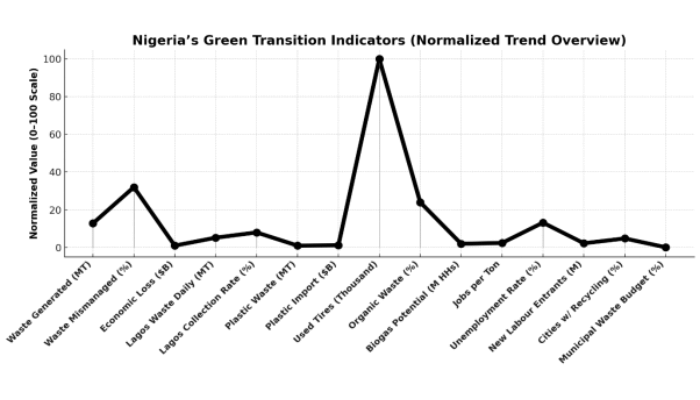
Nigeria stands at a critical moment in its developmental trajectory, where the convergence of environmental crises and economic potential demands urgent, innovative action. The nation generates 32 million tonnes of solid waste annually, with 80 percent mismanaged, a failure that costs the economy $2.5 billion annually in lost recyclable materials. This staggering waste crisis, exacerbated by rapid urbanisation and a population nearing 230 million, underscores the urgent need to abandon the unsustainable “take-make-dispose” model. Instead, Nigeria must embrace a circular economy that redefines waste as a resource, unlocking opportunities for job creation, climate resilience, and industrial innovation.
The scale and complexity of Nigeria’s waste challenge
Lagos, Africa’s most populous city, generates 13,000 metric tonnes of waste daily, yet only 20 percent is formally collected. The consequences are multifaceted: clogged drainage systems worsen seasonal flooding, unmanaged dumpsites emit methane equivalent to 21.6 million tonnes of CO₂ annually, and toxic leachates poison groundwater supplies. In northern states like Kano, agricultural waste burning contributes to air pollution levels exceeding the WHO threshold by 400 percent, while Port Harcourt’s electronic waste graveyards expose communities to carcinogenic heavy metals. Paradoxically, this waste represents a vast reservoir of untapped value. Nigeria imports $3 billion worth of plastic resins annually while discarding 2.5 million tonnes of recyclable plastics. Similarly, 250,000 used tyres dumped yearly could replace 15 percent of aggregate in road construction, and organic waste – accounting for 60 percent of municipal waste – holds the potential to produce biogas for 5 million households.

Trailblazers in waste valorisation: Case studies of success
A new generation of Nigerian entrepreneurs is proving that waste-to-wealth models are both viable and profitable. Kaltani, a Lagos-based recycling startup, combines AI-powered sorting systems with a network of 1,500 waste pickers to process 200 tonnes of plastic monthly into export-grade pellets. Their model demonstrates how technology can formalise informal sectors while meeting global demand for recycled materials. In Abuja, Chanja Datti has created a closed-loop system, partnering with more than 200 businesses to collect office waste, which is transformed into school chairs and construction materials. Their “Plastic-to-Desk” initiative has diverted 850 tonnes from landfills since 2022.
“As global circular economy markets approach $4.5 trillion, Nigeria’s transition from waste to worth is not merely an environmental obligation but an economic necessity.”
Perhaps most innovative is Free Recycle, which converts end-of-life tyres into rubber tiles priced at $45/m² – 30 percent cheaper than imported alternatives. Having processed 250,000 tyres since 2021, the company now supplies eco-friendly flooring for urban renewal projects across three states. These enterprises collectively highlight three critical opportunities: substituting imports with recycled materials, creating localised value chains, and addressing infrastructure deficits through circular design.


The triple dividend: Economic, environmental, and social gains
Transitioning to circular systems could yield transformative benefits across sectors. The recycling industry generates six times more jobs per tonne than traditional waste disposal, a crucial advantage for a country with 33 percent unemployment and 5.6 million new labour market entrants annually. For manufacturers, using recycled plastics slashes production costs by 30-50 percent, enhancing competitiveness in sectors like packaging and textiles. Environmentally, proper organic waste management could reduce Nigeria’s methane emissions by 40 percent by 2030, directly supporting its National Climate Change Commitments.
Socially, formalising waste management could improve conditions for 500,000 informal waste pickers, who currently earn less than $2 daily while facing severe health risks. Pilot programmes in Ibadan show that providing protective gear, fair pricing, and access to healthcare increases pickers’ incomes by 70 percent and collection rates by 45 percent.
Overcoming systemic barriers: Policy, infrastructure, and investment
Despite these opportunities, systemic obstacles persist. Only 12 percent of Nigerian cities have access to formal recycling facilities, and conflicting regulations hinder progress. While the 2022 National Waste Management Policy advocates extended producer responsibility (EPR), implementation remains fragmented. Municipalities allocate less than 0.3 percent of budgets to waste management, compared to 4-6 percent in middle-income nations like Morocco.
Read also: Climate gets higher allocation as DMO plans N50bn green bond issue
Four strategic interventions could accelerate progress:
1. Integrated Policy Frameworks: Harmonising federal and state regulations, enforcing EPR schemes, and mandating recycled content in public procurement (e.g., 30% in road construction).
2. Decentralised Infrastructure: Establishing 150 micro-recycling hubs near major markets by 2030, coupled with biogas plants at 50 percent of Nigeria’s 5,000 abattoirs.
3. Green Financing Mechanisms: Creating a $500 million Circular Economy Fund through carbon tax revenues and multilateral partnerships, offering low-interest loans to recyclers.
4. Skills Development: Launching vocational training programmes for 50,000 waste workers via NASENI and NITDA, focusing on safety protocols and digital inventory management.
Seizing the circular future
As global circular economy markets approach $4.5 trillion, Nigeria’s transition from waste to worth is not merely an environmental obligation but an economic necessity. The 2025 National Development Plan must prioritise circularity as a cross-sectoral strategy, aligning industrial, agricultural, and urban policies. International partners like the African Development Bank’s African Circular Economy Facility could provide technical assistance, while domestic investors must recognise recyclers as high-growth ventures.
Success hinges on reimagining waste as the foundation of new industries – turning food scraps into energy, plastics into textiles, and tyres into infrastructure. By doing so, Nigeria can convert its $2.5 billion annual waste loss into a $10 billion circular economy by 2035, creating 2 million green jobs and reducing greenhouse emissions by 25 per cent. The path forward demands bold leadership, innovative financing, and grassroots collaboration, but the rewards – a cleaner, wealthier, and more resilient Nigeria – are within reach.
Olajide Dahunsi is a Lecturer, Sustainability Advocate and Senior Fellow Higher Education Academy (SFHEA) in the UK. He specialises in accounting, finance, economics, entrepreneurship, and national development strategy.