|
Getting your Trinity Audio player ready...
|
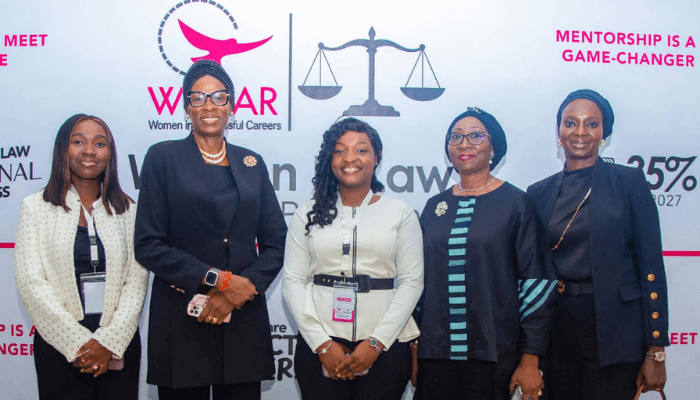
The Women in Successful Careers (WISCAR), has initiated the mentorship advancement for gender inclusion in the legal profession through the Women in Law Mentoring (WILM) Programme.
Amina Oyagbola, founder of WISCAR, in her address at the opening ceremony of WILMP, said, the organisation was founded on the conviction that empowering women and promoting gender equality are not only moral imperatives, but also critical drivers of social progress, institutional development, and national prosperity.
“Through programmes like the WISCAR-WILMP, we are creating the structures, systems, and support women need to advance, not in isolation, but as a collective force for good.
“While women have made remarkable strides in the legal profession, the leadership gap persists. From courtrooms to boardrooms, legislative halls to policy tables, too few women occupy positions of influence,” she said.

As of December 2024, women comprised only four percent of National Assembly members, 23 percent of Supreme Court justices, and four percent of Senior Advocates of Nigeria. Over half of those surveyed reported having limited or no access to mentorship and professional networks—essential resources for career advancement and leadership development.
Oyagbola emphasised that the statistics clearly highlight these systematic barriers, and points toward a path of meaningful change.
“WILMP was created to help bridge that gap. It is a structured, strategic programme designed to equip women in law with the mentorship, capacity, peer networks, and practical tools they need to rise, lead and thrive,” she stressed.
Kudirat Kekere-Ekun, Chief Justice of Nigeria commended WISCAR for the bold and timely step in nurturing the next generation of female lawyers and public servants.
She said the legal profession, and indeed the entire justice system, can only reach its full potential when the women are equally represented, equally empowered and equally heard.

Read also: Everything You Need to Know about the 2025 WISCAR Women in Law Mentoring Programme (WILMP)
“As the second female Chief Justice of Nigeria, I have witnessed firsthand the power of mentorship, of steadfast support and of doors opened by those who came before.
I urge every mentee in this programme to seize this opportunity with purpose and passion. You are not only beneficiaries, you are future leaders, judges, lawmakers, advocates and nation builders,” she said.
Kekere-Ekun highlighted the need to continue to foster a profession where excellence is not defined by gender but by character, competence and commitment to justice.
Oreoluwa Finnih-Awokoya, SA to the governor of Lagos State on sustainable development goals emphasised that mentorship paves the path for others to walk through in career and life.
“From what I have seen and heard, the WILMP is more than a mentorship programme. I believe it is a strategic investment in the future of Nigeria’s legal and governance basis.
“For one, it speaks directly to SDG 5, achieving gender equality, empowering all women and girls, it also strengthens SDG 16, building peaceful, just and inclusive institutions.
Because when women are present at the table, confident, competent and well-supported, every institution grows stronger,” she noted.
Speaking to the mentees, she said, “You are not just the future, you’re the now, the present; the work you do, the questions you ask, the boldness you bring on this journey, all of it matters. Let this programme be your safe space to learn, unlearn, grow and soar.”
Ayodele Atsenuwa, deputy vice-chancellor, development services at the University of Lagos said the importance of mentoring to society, especially in the legal profession cannot be over-emphasised, whether one is on the bench or as a practitioner at the back.
She stressed the fact that women’s access into and participation in the legal profession has been restricted through the structural and systemic exclusion of women from education, and cultural beliefs, among others.
However, Atsenuwa explained that the narrative is being changed by programme such as the WILMP put together by WISCAR and others.
“Today, we are in no way far from where we ought to stand, and so we should at least salute ourselves for that achievement, but I should also say that we are in no way far from where we should be, even if we are doing this to achieve the good of a more equitable and inclusive and just society,” she said.
Habiba Balogun, founder/director at Habiba Balogun Consulting presented the Needs Assessment report, conducted between March 15 and April 18, 2025.
She revealed that findings from the desk research, surveys, and key informant interviews, ensured the report is grounded in comprehensive insights from legal professionals across Nigeria.
This, she said, is critical for upholding justice, addressing societal inequalities, which is integral to achieving national development goals, and aligning with the National Policy on Women’s Economic Empowerment (WEE).