News publishers are facing a threat from Google’s Artificial Intelligence (AI) Overview feature, which is decreasing online traffic to their websites by 0ver 30 percent.
For many publishers, online traffic makes up a significant part of their income, mainly through page views and online adverts, which help to compensate for declining print sales and revenue from physical advertising.
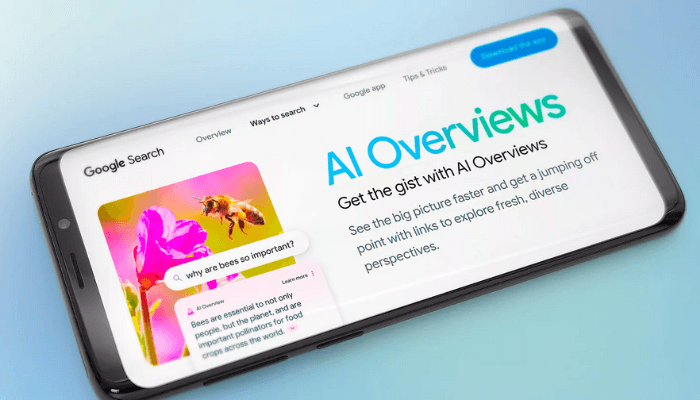
All this now faces risks due to Google’s AI Overviews, which summarise content on search results pages to enhance user experiences. AI summaries, powered by advanced algorithms, extract key points from stories and display summaries above search results. This reduces the need for users to click through to original websites, and news publishers are reportedly experiencing traffic drops of 30 percent to 80 percent or more.
Read also: Group unveils Artificial Intelligence to boost business data collection

“It is tough,” said an online editor at a major national paper. “We used to average around 1.5 million daily page views. Now, we are lucky to hit 800,000. The AI description is ensuring that people do not even bother clicking most of the links.”
Another editor at a niche publication confirmed the trend. “We were seeing some recovery in traffic earlier this year,” he said. “But then AI Overviews came in, and traffic dropped from about 100,000 to 60,000 per day.”
Matthew Prince, chief executive officer of Cloudflare, described the shift as an ‘existential threat’ to digital publishers. He told Axios that 10 years ago, Google crawled two web pages for every visitor it sent to a site. Six months ago, that number was 6:1. Today, it’s 18:1.
“People aren’t following the footnotes,” Prince said. “People trust the AI more over the last six months, which means they’re not reading original content… The future of the web is going to be more and more like AI, and that means that people are going to be reading the summaries of your content, not the original content.”
For news publishers, fewer clicks mean fewer ad impressions and less revenue. It also raises concerns about the future of original reporting, which is increasingly being summarised by AI tools.

Google launched AI Overviews in 2024. According to The Wall Street Journal, The New York Times’ share of traffic from organic search fell to 36.5 percent in April 2025, down from 44 percent three years earlier. Business Insider recently cut about 21 percent of its staff, in a move Barbara Peng, its chief executive, said was aimed at helping the publication “endure extreme traffic drops outside of our control.” Organic search traffic to its websites declined by 55 percent between April 2022 and April 2025.
Beyond news websites, other websites are experiencing this decline. A study by Ahrefs, a marketing intelligence platform, found that the presence of an AI Overview on a results page led to a 34.5 percent lower average clickthrough rate for top-ranking links compared to similar keywords without the AI feature.
After AI Overview launched, Sundar Pichai, CEO, Google, said, “In fact, if you put content and links within AI Overviews, they get higher clickthrough rates than if you put it outside of AI Overviews.”
However, Nicholas Thompson, CEO of The Atlantic, noted, “Google is shifting from being a search engine to an answer engine.”
Read also: Beyond oil: Charting Nigeria’s economic renaissance through artificial intelligence and broadband
Since the dawn of the internet, new publishers have always been on the receiving end of disruption. When social media platforms such as Facebook and Twitter began, they drove online traffic to publishers, until algorithm changes cut them off. Now it is Generative AI’s turn.
In response, some publishers are doubling down on direct engagement, such as email newsletters, video series, podcasts, and mobile apps, to reduce reliance on Google. Others are forming industry alliances to push for better deals with tech platforms. The New York Times now has a licensing agreement with Amazon, and News Corp, which owns The Wall Street Journal, recently signed a deal with OpenAI.
But as publishers attempt to adapt, Google is expected to continue launching more AI features in search, its flagship product, as increasing numbers of people rely on ChatGPT and other chatbots for research. Its new rollout of AI Mode, an effort to rival ChatGPT, is likely to present a stronger challenge as it responds to user queries in a chatbot-style conversation, with fewer links.