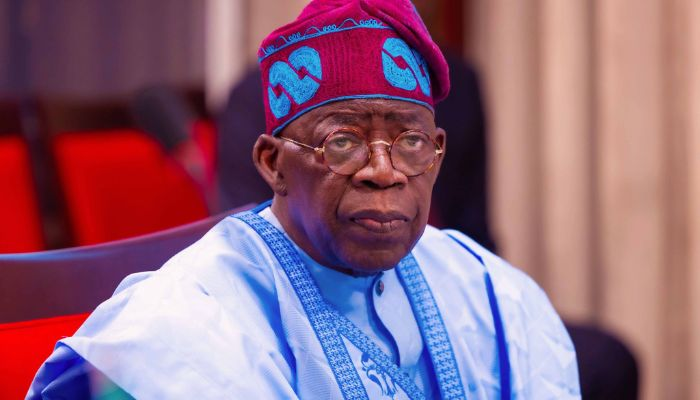
President Bola Tinubu has officially performed the groundbreaking ceremony for the new annex building of the Independent National Electoral Commission (INEC), marking a significant step toward resolving the longstanding infrastructure deficit faced by the electoral body.
At a brief but symbolic event held in Abuja, INEC Chairman Mahmood Yakubu welcomed the President and other dignitaries, expressing appreciation for Tinubu’s personal presence at the ceremony.
He described the moment as a milestone in the Commission’s quest to expand and modernize its operational infrastructure.
“For a long time, the Commission has been grappling with inadequate office accommodation. Our present national headquarters is severely congested,” Yakubu said.

“Commissioned in December 1997, it was originally planned to cater for eight Commission members, ten departments, and 500 staff.
Today, the number has more than doubled, 13 full-time Commissioners, 22 departments, and over 1,000 staff.”
According to the INEC Chairman, the strain has forced the Commission to rent two additional buildings in Wuse Zone II to accommodate staff and activities, including meetings of the Commission’s 15 standing committees and routine stakeholder engagements. General staff meetings, he noted, are often held outside the premises due to limited space.
He acknowledged the Ministry of the Federal Capital Territory (FCT) for coming to the Commission’s aid last year, highlighting that this is the third time the Federal Capital Development Authority (FCDA) would intervene in INEC’s infrastructure challenges since the Commission moved its headquarters from Lagos to Abuja in 1991.
“When the Commission first relocated to Abuja, the FCDA provided office space in Garki. When that became inadequate, they constructed the current national headquarters. Today’s groundbreaking event represents the third intervention in the last 34 years,” he said.

Read also: INEC as a kingmaker
Yakubu also explained that the concept and design of the new annex were developed by INEC’s technical department and submitted to the FCT Ministry. The building will house offices, meeting rooms, conference halls, a 1,000-seat auditorium, and specialized facilities such as the Election Monitoring and Support Centre (EMSC).
A notable feature of the annex is a proposed electoral museum aimed at documenting Nigeria’s electoral journey.
“This museum will serve as a repository for both the physical and digital history of elections in Nigeria. It will offer citizens, especially students who often visit on excursion, the opportunity to better understand the evolution of our electoral system, just as it is done in other parts of the world,” he added.
Yakubu emphasized that the new annex will complement the current headquarters, which will continue to serve as the Commission’s main administrative hub.
“For me personally, this is a special occasion. After almost ten years of persistent effort, the construction of the INEC Annex Building is finally a reality,” he said.
The event was attended by key national figures, including the Senate President, the Speaker of the House of Representatives, the Minister of the FCT, the leadership of the National Assembly’s Joint Committee on Electoral Matters, leaders of political parties, and other stakeholders.
Yakubu closed his address by thanking President Tinubu for “making it happen” and for demonstrating commitment to strengthening democratic institutions in Nigeria.
“May God continue to bless our efforts,” he added.