…As Port Harcourt investors join efforts to push Aba leather, textile works to global reckoning
For over 12 years, a group of investors in Port Harcourt has identified Ariara in Aba, Abia State, as the biggest market hub in the world, capable of growing into a global force.
The group known as the Rivers Entrepreneurs and Investment Forum (REIF), made up of local and foreign investors, began to probe the possibilities in Ariaria, to the point of bringing Chinese and European ambassadors to see the potentials in Aba.
Now, REIF, led by Ibifir Bobmanuel, an enthusiastic investor and tractor manufacturer, has perfected his plan of over one decade, which may lead to creation of a team that would solve the two key problems found to hold Aba down. This is expected to free the over 700,000 producers in Aba to produce globally approved standards and quality so as to compete globally.

According to Bobmanuel, who has many business partnerships with Chinese firms, if China will be scared if Aba is allowed to explode. Speaking with BusinessDay after the Aba meeting last week, the REIF president said by the time the government of Abia State promotes the kind of hubs found in Aba by giving them all what they need to grow, and they transition from one level to the other, he said, China will be scared. “What we have in Nigeria, if well harnessed, China will become scared; not to talk of Europe or America. China will become scared.”

He used the opportunity to reveal how China overtook the West. “There was a time when we would buy something from China and the West would brand them as fake or inferior. Today, which product is fake? The Chinese products are now the superior products. This is because they (China) believed in their hustle and their hand work.
“Their government supported them. Government would choose targeted brands and give them grants as well as yardsticks. They would obtain your bank transaction history, your business operations, your taxes, and calculate what you can do if you got a particular amount of grant. They would give it to you and give you target and time. They may not charge you interest but they will give you employment target. At the end, you would have grown well and they take the money and help another group. This way, you have expanded hugely and you would be paying income tax and PAYEE taxes. It’s a win-win.”
Bobmanuel, who now manufactures tractors in Nasarawa State to serve the north, said in most other countries, the government makes conscious effort to work with you, push you to larger success. In Nigeria on the other hand, what we do here is poverty economics. You look at the people and you call them ‘poorest of the poor’. You want to give them money instead of creating funds to support expansion of businesses to create wealth and jobs for the poor.
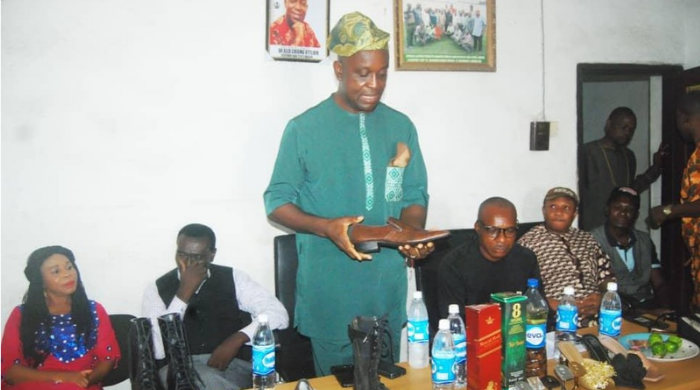
The CEO of Bobtrack Tractors Nigeria Limited, with top management of REIF, paid an investment visit to their affiliates; Leather Products Manufacturers Association of Abia State (LEPMAAS); and Association of Tailors and Fashion Designers Inc (ATFAD Inc) in Aba for a game-changing investment partnership that will redefine their sectors in what is termed REIF driving the local economy.

The challenge in Aba:
Explaining the challenge REIF found to hold Aba down, Bobmanuel pointed to access to standard raw materials to enable them produce standard products. “The next is lack of standards in the quality of products they churn out. It is difficult to produce many products of same quality and measurement.
“Simply put, there is no standard to measure what goes in to determine what comes out.
REIF has since decided to intervene in this matter. We found that Aba is the biggest incubator of fabricator-SMEs in the world. The Government of that state can easily can create one million entrepreneurs in one sector alone.”
He said REIF and the Aba traders have come up with a South-South/South-East Trade Exhibition within the year, 2025. “This is to show the world what is hidden in that city and the potentials of Aba that can beat most cities in the world. The traders were overjoyed when they heard the details of what REIF is bringing. Aba can scare China.”
He said the idea germinated about 15 years ago. “When we were about to implement it, Ebola scare came, and after that, the COVID-19 crisis emerged. We had foreign partners in the project, so such epidemics of international dimensions easily knocked off the project. Everything came to a pause.
“It took some time before a realignment took place to warrant resumption or resuscitation of the project.”
How the idea germinated:
He said: “The vision to support this sector (Aba leather works) germinated when I went to Dubai in the United Arab Emirates (UAE) and went to Bera town, their own Ariaria Market where they sell different things. In fact, that’s the market hub in Dubai. I was to buy something and I found that things made in Aba made their way there, but they had the branding of Made in Italy. It was when I realized this that I said, no, it can’t continue.
“As an investor, it will not be fair on our part to allow this potential to remain at this basement level where it is at the moment. The potential they have there in Ariaria is below basement.
“We said, look, what we could do is to help them provide quality raw materials. This is because we noticed that raw material supply is one of their challenges. The difference between ‘Made in Italy’ shoes and ‘Made in Aba’ shoes is basically raw materials used in making them. It is not about machines or tools used in making them.”
He said one would even see in those Italian shoes where they would boldly indicate ‘hand-made shoe’. He said these grades were more expensive than the machine-made ones or the mass-produced ones. “So, the Italians pride themselves with their hand-made shoes which are written ‘hand crafted shoes’. What they do in Aba is also hand-crafted shoes which are also meant to be expensive, but the only difference here is input; the quality of raw materials to make the hand-crafted shoes.
“Another challenge is that in Aba, the quality is not standardized. There is also no measurement for what goes in to determine what comes out.
“That is what we in the Rivers Entrepreneurs and Investors Forum (with me as President) want to help to solve. It is one of the areas we think we can intervene and make an impact. This is in keeping with our slogan and motto roll into a vision to support the local economy. We see that opportunity in pushing the raw materials to Aba and leveraging the knowledge-market sheer size to help in raw materials and maybe source profitable market for them.
“The person that opened my eye in Dubai got his shoes from Aba but packaged them and exported them to Dubai. He does what the craftsmen in Aba do not do: branding and packaging; Made in Italy. This way, he denies the Aba makers the credit they should get for making those shoes. But you don’t blame him. If he puts out the true source, most people around the world may not patronize him. He wants his goods to have a fair chance to compete through its quality instead of where it was made.”
Why Aba turned down 5000 shoes order from Poland
At this point, Bobmanuel revealed why Aba traders turned down an order for 5,000 shoes from a business man in Poland. “We were with the traders in Aba yesterday (May 29, 2025) and they gave an instance of when their governor travelled to Poland and took alone some video clips of their products. In the market there, one of the biggest dealers in Poland offered to buy as import their top-priced shoe. He offered them a contract to supply 5,000 pairs to be paid for in Dollars.
“The government delegation put a call back home to the leather works hub leaders. After all discussions, the hub leaders declined the offer. Reason, the deal looked good on the surface because even if at $50 a pair. The problem was, they were not sure they had the capacity to produce same type of shoes into 5,000 pieces same quality, same measurements, etc, that are associated with international standards. There would be issues because the manufacturing processes are not yet standardized. They needed to come up with mechanism for measurement, and mechanism to get the raw materials from one supplier, not different suppliers.
“They have a structured market that would measure all the shoes to be sure of same quality. So, they rejected that offer and lost the opportunity. They felt it was better for them to grow step by step than jumping into the trade and get their hands burnt.
“This, too, showed that the leaders of the traders have integrity, dignity, and honour. This is a plus at REIF, knowing that some of the KPIs (key performance index) we know will be met.”
REIF intervenes:
This is why REIF said they chose to intervene. “So, we intend to import those items into the country and provide them with basic but structured guidelines for them to work with.
“The textile/fashion group is another important group driving large-scale entrepreneurship incubation in Aba. There was an incident in Miami in the USA where my wife and I (on holiday) ran into a Nigerian fabric from afar. I wondered aloud what the fabric was doing there. I knew its origin to be Nigeria. I went very close to it wondering what this top-end designer cloth was doing there.
“When I looked through and found that it was actually a Nigerian designer dress. It was a female dress, and I looked at the cost, and it was above $1000. I was excited and picked up my phone and did a video and shared. The clip was later picked up by a popular television station in Nigeria. They showed it widely and even called and interviewed me over that matter.
“We have this kind of potentials. That cloth with everything, in Nigeria, won’t be more than $100, but when exported, it sold for over $1000. What else does a government need to do than encourage such businesses that can instantly create wealth. In doing that alone, you could make one million entrepreneurs in one aspect.”
Aba, biggest incubator of SMEs in the world?
The REIF boss said he had always known Ariaria Aba Market as the biggest incubator of SMEs in the world. “What they put together and what they put out can never be written in any book. You can only go and experience it to understand what is happening. I think the Government needs to take them seriously and not pay lip service.
“This is about the 4th time they have invited me as a guest in that market (Ariaria). In all of that, I could see the vision and potentials there. Not just for the sellers or crafters but I see it more in the people that go there, buy them and export them. All around Africa, you will see products from Ariaria Market. But we own this market and we do not celebrate it and expose it.”
The starting point, Bobmanuel said, is to mount a trade show for Aba products. They have put together a committee to come out with a south-south/south-east trade exhibition. “It will happen before end of this year (2025). The idea is to galvanize the true potential to the business community and exporters in and outside the country.”
What the UK and EU saw in Aba and marveled:
He said as far back as 12 years ago, I was invited by the Ariaria Traders Association. “I had two August visitors with me on that trip. They happened to be the British Ambassador to Nigeria and ECOWAS and the EU Ambassador to Nigeria that accompanied us (REIF) there. What they saw there left them with a different impression about, not just Aba and Nigeria, but about Africa and the potentials that are locked in Africa.
“So, we are trying to make that reality happen. We hope that in a short while we begin to reap the fruits of this enhancement discussion.”
Funding:
The REIF president made it clear that the organization was not getting any funding from government. “We are an amalgamation of seasoned investors, industrialists, and technocrats that came together. Giving back to the society in an organized way is the whole essence. The funding will come and we will do what we want to do to help the local economy.
“The second part is to help them standardize. We will get manufacturing and production outfits around the world to marry them with the Aba hub. We will either bring them to come to Aba or take the Aba people to go to them.”
Aba, a happy people:
The Aba traders and producers were said to be overjoyed over the help coming from Port Harcourt. “The traders were overjoyed. This was evident when we got there. We saw over 100 cluster heads. The hall was full. Each cluster head control between 5000 and 10,000 members. I was humbled by what I saw. I said, what other part of this country can do this level of incubation in such amazing numbers. In Aba, you have those doing different types of leather works, shoes, belts, bags, etc. It’s amazing.
“What this country needs to do is to promote incubation hubs such as this. If I was to be the governor of Abia State, I would not bother myself with other things than to help these hubs realise their dream and from there, I realise government’s own dream: jobs, revenue, wealth creation, etc.
“You know the nature of businesses. They are organisms in transit. A business you meet today by the side of your house, give it another six to 12 months, if it is run effectively, it would have moved from the side of your house to the front house. From there, it would take over your house, it may take the next house, and another house, and it will take over the street.”
The mood of the Aba traders was confirmed when the meeting was held. Confidence Nwaobilo, president of LEPMAAS, said: “We are very excited. Now, we are going to review the committee we have set sometime in the past so as to do these businesses comfortably. Any business we are going to do with REIF shall be open and transparent.
“On the raw materials we may need, we will look out for samples and some business opportunities. We will see how to engage in finished products for export. Our major problem is how to get raw materials and how to do export. So, we see two-way business in this programme: importation of raw materials, and export of finished products. We expect REIF President to tell us exactly what we should do and what they will do.”
This was supported by Mazi O.C Williams; President Emeritus of LEPMAAS, who said its up to REIF to now look at materials they like and decide the ones they can easily import.
A happy REIF boss told the traders that there is need for both parties to come together and see how REIF can help. “REIF is 100% not-for-profit organization. We are not funded by government. We contribute our funds and see how we can support hubs that do business.
“It’s to know what raw materials you people work with. We set up committee to manage the raw materials. What is happening now around the world is business-to-business (B2B). This is better because government people hardly understand our language. There is need for sincerity and we see how we work collectively.”
He made it clear that the biggest companies involved in leatherworks usually embark on outsourcing based on agreed quality.
Conclusion:
If the dreams of REIF and Aba hubs come true, Nigeria may become a force in leather works and textile/fashion matters in the world.