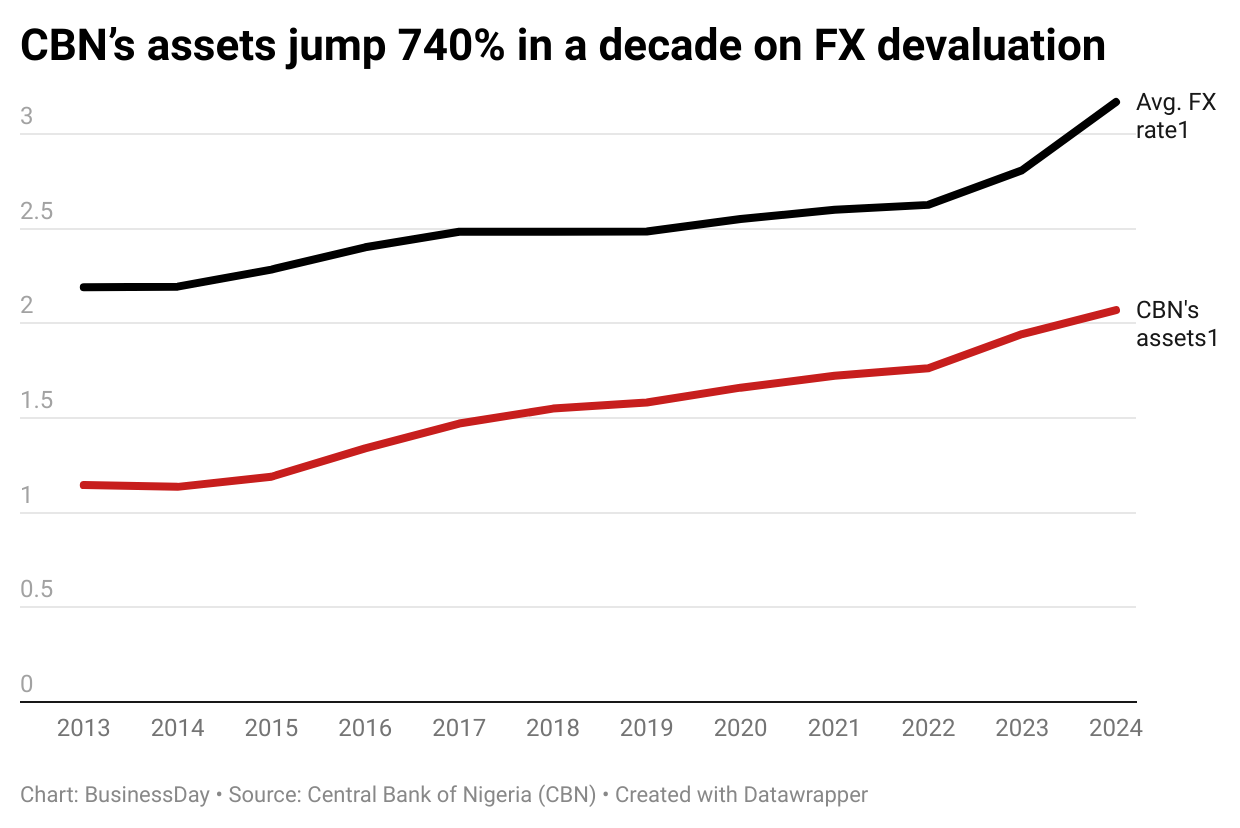
The Central Bank of Nigeria’s (CBN) total assets surged by 740 percent over the last decade, a spike closely linked to the persistent devaluation of the naira and the bank’s expanding role in managing the country’s foreign exchange crisis.
From N14 trillion in 2013, the apex bank’s total assets ballooned to N117.6 trillion in 2024, according to official financial statements. Over the same period, the average exchange rate moved from N157/$ to over N1,500/$, triggering significant revaluations of Nigeria’s foreign reserve assets held in foreign currency terms.
“The jump in both the assets and liabilities of the CBN was a result of the FX devaluation materialising, which you could also see in the income statement, about N11 trillion in net FX revaluation gains,” said Samuel Oyekanmi, research and insights associate at Abuja-based consultancy firm Norrenberger.
“The surge in both parts of tae balance sheet, pretty much evens themselves out, leaving equity at a dip, on the back of its recurrent accumulated losses and the erosion of its FX translation reserve.”

The strong correlation between asset growth and the weakening naira points to how FX devaluation, particularly after Nigeria’s multiple currency adjustments and the eventual unification of exchange rates in 2023, has amplified the naira value of the CBN’s foreign-denominated holdings.
“Much of the CBN’s asset growth is a reflection of naira depreciation rather than organic expansion,” said a Lagos-based economist. “When the naira weakens, the value of FX reserves and other dollar-linked items in naira terms rises sharply.”
CBN liabilities have also tracked this trend, rising from N13.5 trillion in 2013 to N116.6 trillion in 2024. That leaves a thin equity margin of just N1 trillion, or less than 1 percent of assets, raising questions about balance sheet resilience in the event of further currency or credit shocks.
The naira’s slide accelerated under a new FX regime launched in June 2023, which moved Nigeria toward a market-reflective rate after years of heavy-handed intervention and multiple official rates.
While the move helped attract some foreign inflows, it also exposed the structural fragility of the CBN’s balance sheet.

In particular, the revaluation of foreign assets—once shielded by artificially strong exchange rates—has now become a double-edged sword. It boosts the naira value of assets on paper but also inflates the liabilities side, as the CBN’s own FX-denominated obligations grow in parallel.
Analysts warn that unless monetary policy becomes more credible and FX inflows are strengthened, further devaluation could stretch the apex bank’s books even more, complicating inflation management and external debt servicing.
With naira volatility and inflation still elevated, the sustainability of the CBN’s swollen balance sheet, built in large part on paper gains from currency depreciation, remains uncertain.
Tides are turning
The Olayemi Cardoso-led central bank has restored confidence in the foreign exchange market after years of arbitrage that’s slowed down economic recovery. The lender has become more transparent and committed to enhancing liquidity through its various reforms.
“I believe what we see in its 2024 financials is a recovery period from a bad situation where the bank was printing ugly losses and external reserves were being eroded at a fast pace,” Oyekanmi said.
“In recent times both gross and net reserves have seen improvement compared to 2023 levels. That suggests some positives, and will be interesting to see how it pans out by the end of 2025.”
Nigeria recorded its highest net reserves in at least three years last year at $23 billion. Its gross reserves, which saw some declines at the beginning of the year, have begun to build up, hitting $38 billion as at the 10th of June 2025, according to CBN’s data.