Foreign exchange-induced costs have raised airlines’ operating costs, erasing gains from an earlier steep reduction in the price of aviation fuel.
The situation has seen airfares across local destinations in Nigeria remaining high or rising, shrinking passenger wallets.
Last year, BusinessDay reported that Dangote Refinery reduced the prices of diesel and aviation fuel to N940 and N1000 per litre, respectively, from a peak of N1,700 in 2023.
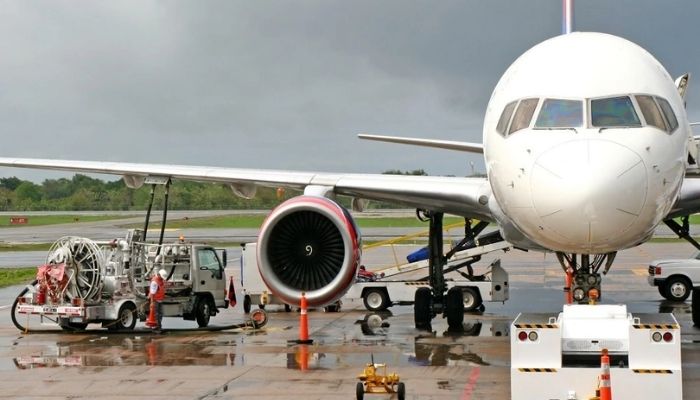
Staff at the aviation fuel depot told BusinessDay that marketers now buy aviation fuel at N1,000 to N1,100 in Lagos and sell to airlines between N1,170 to N1,192 per litre. But this has not reflected on airfares due to the rising cost of operations, induced by FX.

George Uriesi, chief operating officer, Ibom Air, said: “March 2024 was the height. Since then it’s been oscillating up and down on average, but the trend has been downwards.”
Read also: Nigeria leads regional push for sustainable aviation fuel financing
Cost of aviation fuel
A breakdown of the cost across states show that in Lagos, where over 70 percent of local airlines refuel, the product is bought at N1,170 per litre. It costs N1,202 per litre in Abuja; N1309 in Asaba; N1,265 in Port Harcourt; N1,210 in Kano; N1,245 in Enugu; N1,269 in Owerri; N1,290 in Anambra; N1,309 in Warri; N1317 in Calabar; N1260 in Maiduguri; and N1290 in Yola.
BusinessDay’s findings show that aviation fuel currently takes about 45 percent of operating cost; labour, 17 percent; aircraft rent and ownership, 8.5 percent; non-aircraft rents and ownership, 7 percent; professional services, 4.5 percent; landing fees, 2 percent; food and beverage, 1.5 percent; maintenance materials, 13 percent, and transport related, 1.5 percent.

FX-induced costs
Olumide Ohunayo, director of research at Zenith Travels, told BusinessDay that the reduction in the cost of aviation fuel has not impacted ticket prices positively due to the exchange rate and the taxes.
“The exchange rate has moved from N400/$ to N1,600/$ in the last two years. Hence it has knocked off whatever gains that have come from the stability in the fuel price.
“This is because they are all part of a total component,” Ohunayo explained.
He said as airlines collect money in naira but buy spares and many other things in dollars, the costs of operations would be high. He said there is a need for the government to work on policies that would reduce the exchange rate.
“Our currency can be stronger when we diversify our economy, encourage exports, and increase inbound tourism. This way, we would be able to create a new set of revenue from the FX market,” Ohunayo noted.
According to him, improving disposable income of the citizenry would see a boost in air travel.
High operating costs
John Ojikutu, CEO of Centurion Aviation Security and Safety Consult, told BusinessDay that the cost of air tickets have remained high despite a drop in aviation file price due to multiple charges paid by airlines.
“There are many tariffs in the tickets sales besides the fuel cost. There are landing/parking charges, navigational charges, among others. Landing charges depend on the aircraft weight and time of landings. Parking is also based on weight and time, especially day or night and the length of time for the parking,” Ojikutu said.
He suggested that airports should design slots for the airlines operating in the airports to reduce or remove delays.
He also said the meal service on board should be discouraged for flights that are less than one hour to reduce costs.
“All these costs put together can reduce airfares by an additional 30 percent, provided that the average load of seats for one hour flight is not more than 80 or 100.
“Fuel price can further go down if the transportation can return to the pipelines rather than bridged by tankers, which still attracts higher prices and subsidies,” Ojikutu further said.
Cost of tickets
A one-way economy class ticket from Lagos to Abuja has increased to N130,000 to N160,000 from N70,000 two years ago.
A one-way economy class ticket from Lagos to Port Harcourt, which cost about an average of N80,00 two years ago, is now priced between N120,000 to N180,000.
Also, a one-way economy class ticket from Lagos to Kano, which cost about an average of N80,00 two years ago, now goes between N120,000 to N180,000.
Read also: US reaches far to tap Dangote refinery for aviation fuel supplies
Aircraft scarcity
Last year, only few aircraft fed several passengers on domestic routes as Nigerian airlines struggled with fleet reduction as a result of high cost of maintenance.
Samuel Caulcrick, former rector of the Nigerian College of Aviation Technology (NCAT), Zaria, said the major obstacle to the immediate reduction in airfares – considering the reduced cost of JetA1 – is cost recovery.
“The cost of capital is the minimum rate of return that a company must earn to satisfy its investors and creditors. A high cost of capital, like the 36 percent in Nigeria, means airlines need to make higher profits to attract investors,” Caulcrick said.
He said that while lower fuel costs may not immediately dramatically lead to lower airfares, airlines could still choose to pass on some of the savings to passengers.
“They might also be able to absorb the savings and offer better services, or invest in other areas to improve their business.
“Even if airfares don’t change significantly, the reduced fuel costs will still lead to increased profitability and potentially greater investment in the airlines’ operations,” he said.