|
Getting your Trinity Audio player ready...
|
…as Foundation deepens outreach with ‘Clean Our World’ phase five
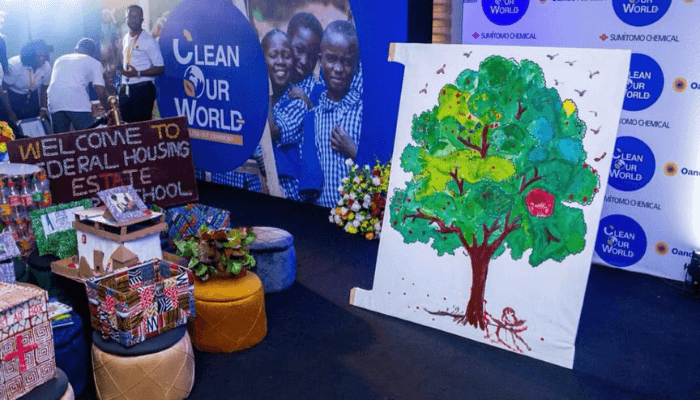
Oando Foundation has scaled up its commitment to environmental education initiative to 50 additional schools, with expansion into two new states, FCT Abuja and Delta State with the launch of phase five of its ‘Clean Our World’ (COW) project.

Tonia Uduimoh, head of Oando Foundation commenting on the launch said, “Implementation of the fifth phase of the COW initiative, in collaboration with our co-sponsor Sumitomo Chemical and government partners, marks a significant milestone in our journey towards embedding sustainability in education.
“By expanding into two new states, we are not only broadening our geographical reach but also deepening our impact in legacy states like Lagos and Plateau. Our goal is to instill a culture of sustainability from an early age, fostering responsible behaviours that extend beyond the classroom into the wider community.”
Uduimoh further explained that through strategic partnerships and active government involvement, the foundation aims to create a scalable model that can be replicated across the nation.
“This initiative is more than just an educational programme; it’s a movement towards a sustainable future. We believe that by equipping the younger generation with the necessary knowledge and skills, we are laying the groundwork for a cleaner, greener Nigeria,” she said.
Samuel Mariere, the executive chairman Delta State Universal Basic Education Board (SUBEB), commenting on the initiative, commended the foundation’s efforts.

“Oando Foundation’s COW V is a commendable programme that is broadening the knowledge and changing the attitudes of pupils, teachers, and stakeholders in our state towards understanding environmental education for a better healthier living,” Mariere said.
Read also: Oando Foundation to digitally empower one million children by 2027
The foundation is geared to supporting the Nigerian government in achieving its Universal Basic Education goal, hence the launch of phase five of its Clean Our World project; and expansion into two new states, while strengthening implementation in legacy states Lagos and Plateau to deepen impact and drive long-term sustainability.
According to a recent report by the United Nations Industrial Development Organization (UNIDO), an estimated 2.5 million tons of plastic waste is generated annually in Nigeria, with only 12 percent of that being recycled.
This underscores the urgent call for environmental education and action, especially amongst children and young people who are critical to shaping future sustainability practices.
Recognising the pressing need for systemic environmental literacy at the grassroots level, phase five of the Clean Our World project focuses on standardised lesson delivery through wide-scale capacity building for teachers, deployment of the climate action super-heroes (CASH) syllabus, and various in-school climate action activities, laying the foundation for a cleaner, greener future.
The foundation emphasised that with active government participation, its new phase of the project will ensure uniform, consistent, and high-quality delivery of environmental education in schools across Lagos, Plateau, Delta States and the FCT.
To date, the Clean Our World project has impacted over 95,500 beneficiaries, encouraging the adoption of eco-conscious lifestyles.
The Oando Foundation has also trained 939 education stakeholders, including teachers, Local Government Education Authority staff, and SUBEB officials, to ensure the effective delivery and utilisation of environmental education tools and practices.
This initiative also builds on the foundation’s current LEARNOVATE strategy, particularly its PLANET component, which promotes environmental education, green skills development, and waste management at the basic education level.
By fostering sustainability within the educational system, LEARNOVATE ensures that young learners are empowered to contribute to educational advancement, aligning the strategy with global goals such as SDG 4 (Quality Education) and SDG 13 (Climate Action).