…as Power Minister pleads with Tinubu for Gencos
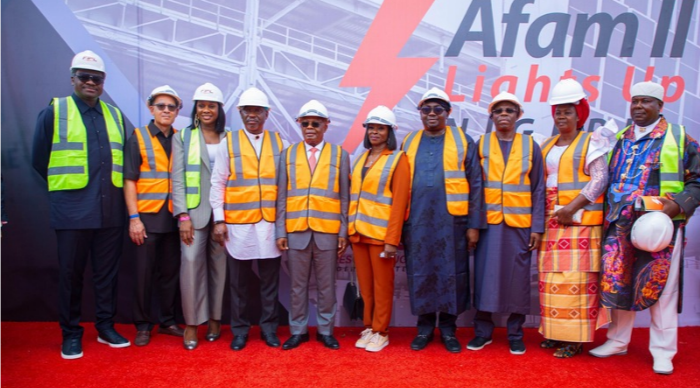
Nigeria’s big shots from investors (private sector) to regulators and public sector gathered on Wednesday, June 4, 2025, at Afam in Oyigbo near Port Harcourt to commission an additional 180mw power station known as Afam 2.
It however, ended up as not just a flag-off but the review of Nigeria’s power sector reforms in the past years intensified in the President Bola Ahmed Tinubu years and unveiling of a roadmap to where Nigeria should be in the immediate future.
The most significant ring-out from Afam could be the warning in the form of an appeal for President Tinubu to urgently roll out a priority plan to begin offsetting the N4trn said to be weighing as down the neck of the generating companies (GENCO) that feed the transmission company of Nigeria (TCN) and then to the 11 distributing companies (DISCOS).

Adebayo Adelabu, Minister of Power, said if the segment of the power value chain (GENCOs) that generate what is sent down the line is allowed to crumble, the system may suffer. The most likely sector that would fail is the manufacturing sector that is expected to support President Tinubu’s ‘Nigeria First’ scheme. It is regarded as a scheme that must succeed because Nigeria can no longer afford to import its consumables, usables, and other needs.
It was also an opportunity to review each major power policy reform so far, the huge gains, and areas needing some new touches.
Afam is known as a relatively small community but is a significant power generation hub, with four power plants which include: FIPL’s Afam Power Plant; Shell’s Afam VI Power Plant; Government’s Afam I-IV Power Plant; and currently on-going construction of the Fast Power Plant which has just been commissioned. In addition, Afam is also a host community to the Shell Okoloma gas plant. So, Afam is eminently qualified to host such a power sector review session.
Adelabu lays the power canvas:
Appeal: The Minister said at Afam: “Today, I respectfully appeal for your continued support to prioritize a sustainable mechanism for clearing GenCos debts and to back the establishment of a credible, bankable financial framework that ensures the entire electricity market can operate viably and transparently.”

The Minister cautioned very strongly, saying the debt threatens operations and future investments in the sector. “Without immediate attention, we risk a collapse of the sector, threatening the gains we have made thus far”.
The Minister admitted that in recent months, Nigeria has made significant progress with power sector reforms under the Tinubu administration but pointed to the urgent need to secure the financial health of the market.
Areas of joy so far:
Among the achievements, Adelabu cited the implementation of cost-reflective tariffs for a segment of consumers in early 2024—a policy shift that led to a ₦1.7 trillion market revenue, a 70% increase from 2023, and reduced the tariff shortfall by ₦1.1 trillion. “This is a demonstration that reform works,” he said, but stressed that it must now be reinforced by debt resolution and systemic financial clarity.
The Minister also hailed the Electricity Act 2023, signed by President Tinubu, which decentralised electricity regulation by transferring oversight to 11 state governments. BusinessDay had reported that this landmark reform is seen as critical in allowing subnational governments to attract investment and manage electricity development based on local needs.
Further, Adelabu mentioned the government’s performance on generation and grid reliability. He said on March 2, 2025, Nigeria achieved an all-time high energy generation of 5,801MW, and a record daily energy output of 128,370MWh, made possible by the commissioning of the 700MW Zungeru Hydropower Plant and other grid investments.
He credited this progress to increased national grid investments and the fast-tracking of the Presidential Power Initiative (PPI), following an agreement signed by Nigeria at the COP28 climate summit in Dubai. In 2025 so far, Nigeria has recorded zero grid collapses, a significant operational improvement over previous years. This seemed to turn eyes as many began calculating in their fingers when last there was a grid collapse.
The Minister also spotlighted a structural reform many administrations had failed to deliver: the unbundling of the Transmission Company of Nigeria. This led to the creation of the National Independent System Operator (NISO), a body designed to professionalise and bring efficiency to market and grid operations.
Pointing to the distribution side, Adelabu referenced the Presidential Metering Initiative, backed by ₦700 billion in FAAC allocations, which aims to deploy 1.1 million meters by the end of 2025, and 2 million annually over the next five years. Also, the World Bank’s DISREP programme is expected to provide 3.2 million additional meters by 2026 to improve billing accuracy and resolve estimated billing practices.
While these reforms mark significant progress, Adelabu stressed that without urgent action to clear GenCos’ debt and stabilize the market, the system remains vulnerable. “With your leadership, we have taken deliberate steps toward resolving some of these legacy issues,” he told President Tinubu. “But the challenge is enormous and requires urgent and sustained action.”
The Sahara Energy Afam plant, he said, stands as a testament to the administration’s reformist vision and the private sector’s willingness to invest—if the right market conditions exist. “Sahara Energy’s 180MW investment here in Afam is proof of that,” he said. “Let this project inspire others and reinforce our shared resolve to power every home, every business, and every hope in this great nation.”
Technical report on Afam 2:
Kola Adesina is the executive director, Sahara Group and Group Managing Director of Sahara Power Group. At the flag-off of Afam 2, he gave a technical report that show huge hope for Nigeria in the power sector.
After paying huge commendations to both the Rivers State government and the FG, in 2002, the Rivers State Government implemented a strategic plan to establish a network of state-owned power plants designed to cater to both commercial and residential electricity demands.
This led to the development of several power plants across the State, including the Rivers Independent Power Plant (|PP) where Afam 2 is. The Plant was initially designed to consist of two (2)180MW turbines, totalling 360MW and the first phase, which resulted in the installation of 180MW was commissioned in 2001.
In 2014, following the FG’s privatization initiative, the Rivers State Government privatized its four state-owned Power Plants – Rivers IPP, Omoku, Trans Amadi, and Eleme.
This led to the acquisition of a 70% stake in these assets by First Independent Power Limited (FIPL), a subsidiary of Sahara Power Group. Since then, FIPL has enmbarked on a
on an ambitious program to recover, optimize, and expand the capacity of this Plants through significant investments in repair, overhauls, infrastructure upgrades and human capital development.
As a result, FIPL’s operational capacity has grown remarkably from 60mw in 2014 to 392mw today.
Key Achievements are as follows:
Resolving the failed 132KV Bus Duct at Rivers IPP in 2017. Successful completion of a C-Inspection in 2018 resulting in consistent generation of up to 160MW.
Recovery of GI 2 at Omoku in 2016, Restoration of GT 3 in 2016 following top cylinder and Diesel start system repairs at Omoku, execution of a major overhaul for GT 4 and GT 3 major in Trans Amadi in 2019. Commissioning of GT 3 in Eleme in 2022.
On the corporate front, FIPL has demonstrated a strong commitment to inclusive development. A landmark memorandum of Understanding (MoU) was signed with host communities, creating skilled and unskilled jobs for local residents, among other initiatives. The host communities admitted seeing a difference in Sahara group.
Adesina went on: The company successfully integrated Ministry of Power staff into its workforce, renovated schools, organized quarterly health fair targeting vulnerable groups, and consistently invested in both local and international training for staff, among other initiatives.
In 2022 with the support of the Rivers State Government and in line with the Renewed Hope Agenda of President Bola Ahmed Tinubu, an investment was made by Crescendough Nigeria Limited (CNL) to complete the installation of the second phase, the 180MW Turbine in Afam Power Plant-referred to as the Afam Il Project.
This project was executed in collaboration with Sahara Power Group and FIPL, the operators of the existing Power Plantin Afam.
Work on Afam II commenced in Q3 2023 with China Machinery Engineering Corporation (CMEC) as the EPC contractor while the actual Project Management activities were handled by Nigerian resources.
Members of the Transmission Company of Nigeria (TCN) and the Rivers State Ministry of Power played an invaluable role throughout the installation and testing process. It is noteworthy to mention that a number of support services were provided by the Afam Community.
Afam ll was successfully connected to the National Grid on Friday, May 16, 2025, which meant that from start to finish, the Project was completed in 16 months, which is commendable for a project with this degree of complexity.
What is being celebrated today is the addition of 18OMW to the National Grid that will contribute to the growth of the National economy and ultimately improve the standard of living of the citizens of Nigeria.
Asiwaju hails Afam 2:
Describing the project as a “key achievement emanating from the enterprising Nigerian spirit”, President Tinubu, who commissioned the facility virtually, said the completion of the power plant reinforces the capacity we have to overcome our challenges – through collaboration, tenacity and renewed hope.
President Tinubu commended the Rivers State Government for envisioning and enabiling the project in pursuit energy sustainability in Nigeria. “I equally commend the private sector partners—Sahara Power Group, First Independent Power Limited, and Crescendough Nigeria Limited for their investments and expertise. You have transformed this great vision into reality. Nigeria salutes you,” he added.
President Tinubu further noted that the 180MW added to the national grid through will ignite and drive economic development. “Let me emphasize that under my administration, achieving stable power remains an unwavering goal. We will continue to enforce policies that protect investments and prioritize ease of doing business,” the President stated.
Kola Adesina, Group Managing Director, Sahara Power Group, said Sahara had for almost three decades, been a foremost stakeholder in Africa’s energy and infrastructure landscape, leveraging the power of collaboration and cohesion of shared aspirations to deliver sustainable energy solutions.
Describing electricity as the backbone of modern economies, he added: “Nothing will give Sahara Group more pleasure than its continuing leadership of efforts geared towards uninterrupted and reliable power supply through long-term strategic investments, operational excellence, and collaboration with like-minded stakeholders.”
Adesina stated that Sahara Power is the largest power business in Nigeria, contributing over 20 percent of the power generated in Nigeria through Egbin Power and First Independent Power Limited. “This translates to powering over 50 million homes, businesses, and industries, making a difference in spurring economic prosperity in the nation. However, this is only a fraction of our vision. Sahara has its sights on a Nigeria wholly transformed and globally competitive, enabled by the wings of sustainable power solutions,” he said.
Rivers State, a power state:
The investments by Rivers State administrations over the years seemed to get national recognition and acclaim at last on the day Afam 2 was unveiled to the world.
Rivers State began during Peter Odili days to invest in power generation through the gas turbine system. Odili built the Omoku and Trans-Amadi turbines but laws over power distribution caused ripples.
Chubuike Rotimi Amaechi who succeeded him built Afam power plant before Sahara Power Group that acquired it added Afam 2 to double the capacity to 360mw.
On Wednesday, June 4, 2025, Afam 2 was flagged off (virtually) by President Bola Ahmed Tinubu with Ibon-ete Ibas, the Rivers State Sole Administrator and a retired Vice Admiral, on hand to collect the glory on behalf of the state government.
Both Tinubu and Ibas described Afam II power plant commissioning as reinforcement of Nigeria’s sustainable electricity vision.
The President was very excited and declared that the completion and operationalization of the second power plant in Afam communities, Rivers State, marks a significant milestone in the Federal Government’s commitment to achieving sustainable electricity supply and industrial transformation.
The President commended the Rivers State Government for its pivotal role in fostering energy sustainability and lauded the investment partners—Sahara Power Group, First Independent Power Limited, and Crescendough Nigeria Limited—for delivering the project. He urged them to ensure optimal operation and expansion to meet Nigeria’s growing energy demands.
“We solicit the support of all Nigerians as we implement reforms and strategies to transform the power sector. Our administration will continue to enforce policies that attract investments—both local and foreign—to achieve this critical goal,” he affirmed.
In his remarks, Ibas, the Administrator of Rivers State, hailed the project as a product of visionary leadership and private sector empowerment. He noted that President Tinubu’s enabling policies have spurred bold investments across key sectors, including power, agriculture, oil and gas, education, and transportation.
“This power plant reflects the long-standing vision of successive Rivers State administrations to expand energy infrastructure beyond oil and gas, driving industrial growth,” Vice Admiral Ibas said.
“Beyond boosting electricity supply, this project has created jobs and skills development opportunities for youths in Afam. I commend the host community for their cooperation, proving that peace and development go hand in hand.”
Minister of Petroleum:
Similarly, Ekperikpe Ekpo, the Minister of State for Petroleum Resources (Gas), applauded Rivers State’s sustained investments in energy infrastructure since 2011, culminating in the Afam II Plant’s success.
He said the Afam II Power Plant stands as a beacon of progress, underscoring Nigeria’s resolve to achieve energy security, economic growth, and industrial transformation under the Renewed Hope Agenda.
Model community:
The role of the Afam community in creating peace and enabling environment was fully appreciated by all stakeholders that spoke at the event.
Speaking, the spokesman for paramount rulers of the three host communities, HRH, Chief Alex Dike, paramount ruler, Okoloma-Afam, commended Sahara Power Group, but requested for direct supply to Afam town to help boost industralisation in the area.