…Rainstorm destroys properties in some states
While the people of Niger State are writhing in pains over the heavy flood that left over 200 people dead and many properties destroyed, the Nigerian Meteorological Agency (NiMet) has warned other citizens living in coastal areas and erosion-prone areas to be cautious.
The agency had earlier warned Nigerians about a mix of sunny and cloudy weather conditions accompanied by thunderstorms across various parts of the country, and have not failed in giving early warnings about weather conditions.
However, for many of the flood victims in Niger State, the devastating effect is more than early warnings, as the area is flood-prone.

Nigeria’s history with devastating floods is not new. In 2012, many parts of the country got flooded.
In 2022, flooding impacted 34 of Nigeria’s 36 states. It killed hundreds and displaced more than 1.3 million.
In 2024, about 230 people were killed, with over 600,000 people were displaced, when floods swept through Borno state in eastern Nigeria.
“The news of the Mokwa flood disaster deeply grieves us all. Our thoughts and prayers are with everyone affected by this unfortunate incident,” Dikko Radda, Katsina state Governor, said.
Read also: The Mokwa flood: When nature went angry

According to him, the floods had brought immense pain and suffering to the affected communities in Niger State.
“Natural disasters are a reminder of our shared vulnerability and the importance of standing together during times of crisis.”
According to Radda, Katsina State stands in complete solidarity with her Niger State people during this difficult period.
However, Joseph Utsev, the minister of Water Resources and Sanitation, following the flooding incident in Niger State, reminded Nigerians that about 1,249 communities in 176 LGAs in 33 states and FCT were at risk.
The Nigeria Hydrological Services Agency (NIHSA), under the ministry of water resources, had warned of potential flooding in Mokwa Local Government Area as part of the 2025 Annual Flood Outlook (AFO) released on April 10.
”The AFO identified 1,249 communities across 176 local government areas in 33 states and the Federal Capital Territory (FCT) as high flood-risk zones. An additional 2,187 communities in 293 LGAs were listed as moderate risk.
”The high-risk states include Abia, Adamawa, Akwa Ibom, Anambra, Bauchi, Bayelsa, Benue, Borno, Cross River, Delta, Ebonyi, Edo, FCT, Gombe, Imo, Jigawa, Kebbi, Kogi, Kwara, Lagos, Nasarawa, Niger, Ogun, Ondo, Osun, Oyo, Rivers, Sokoto, Taraba, Yobe, and Zamfara,” Utsev said.
Moses Lawal, a concerned Lagos resident told BusinessDay that being apprehensive about flooding for a city like Lagos is valid.
“Regardless of the amount of preparation and mitigation contingencies put in place by the government, two sticky factors are recurrent – global warming triggering rising sea levels and our attitude towards our environment.”
He further said that as long as Nigeria remain largely dependent on fossil fuels to power her lives and the globe, the attendant greenhouse gases will continue to warm up the earth.
“Glacial ice melting and heavier rainfalls will inevitably make Lagos, and most coastal cities, extremely vulnerable to flooding.
“With Donald Trump not favourably disposed to cutting down on greenhouse gases emission, the outlook appears bleak,” Lawal said.
He questioned the attitude of many Nigerians, which he considered as a factor ravaging the country. He also questioned Nigerians reaction to early warning by NiMet.
“Do we heed to NiMet and other agencies warnings? How about clogging of drainages with refuse? People who build on drainage channels? Indiscriminate felling of trees?”
According to Lawal, Nigerians have a lot of reasons not just to be apprehensive, but also to remain vigilant, especially on the back of what happen in Mokwa, Niger State.
Lawal also urged the Lagos State government and the National Orientation Agency (NOA) to intensify its sensitization campaign as we gradually approach the peak of the rainy season for the year.
Read also: Mokwa floods: Residents recount losses as UNICEF, govt offer funds, relief materials to victims
Victims’ reaction and helplessness
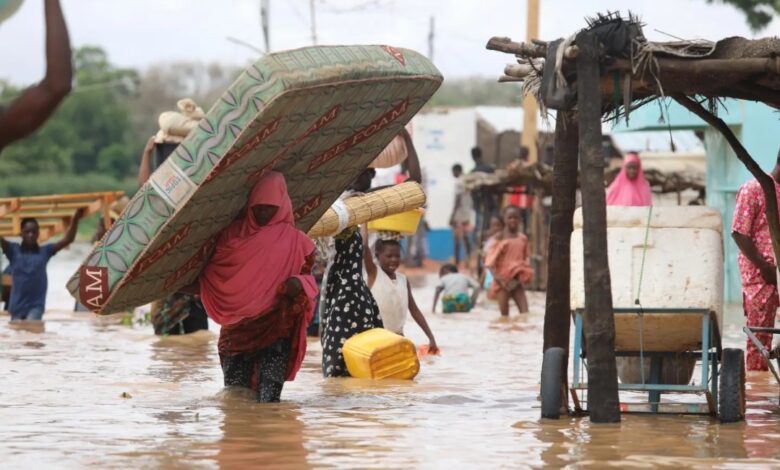
On May 29, while the governments, both at the federal and state levels were celebrating their second inauguration in office – flash floods swept through the trading hub of Mokwa in Niger State, wiping out everything in its path: homes, farmlands, human beings.
The United Nations says more than 3000 people have been displaced. However, the Nigerian government said 200 dead bodies were recovered, with about 500 others still missing.
The Niger State chapter of the Christian Association of Nigeria (CAN) extended words of sympathy to the people of Mokwa Local Government Area over the devastation wrought by the floods.
“On behalf of the entire Christendom in the state, I extend our heartfelt condolences to the families who have lost their loved ones, and we stand with everyone who has suffered in this disaster,” said Bulus Yohanna, the CAN chairman.
The Christian community in Niger State were directly affected, following the death of James Omeh, the parish priest of Saint Anthony’s Catholic Church in Gulu in Niger State.
His vehicle was believed to have been swept away by floodwaters along the Lapai-Gulu Road near Duma village on May 25, days before the Mokwa devastation.
The demise of the Catholic priest was not to be an isolated incident. Just four days after his death, Nigeria faced the most devastating floods in over 60 years.
“Rev. Father Omeh, who was driving a white Hilux, was swept away by the flood into a deep, water-filled ditch. With assistance from the Sarkin Ruwa, local volunteers later recovered the vehicle. Sadly, the lifeless bodies of Rev. Father Omeh and a woman were recovered at the scene,” Wasiu Abiodun, a police spokesperson, said.
Similarly, women within the Mokwa community are still counting their loses days after the devastating flood that swept away their homes and source of livelihood.
Among them were Fatima, 26, who lost four children, and Habiba, 27, who lost six children. Both women are married to the same husband.
They have been spending their nights helplessly since the flood wiped out their entire livelihood, including other other wives of their husband, and 16 children.
But of the 18 people believed to have died from the flood in the family, only four bodies have been recovered.
Similar story is now common across Mokwa, in Niger state, north-central Nigeria.
“We’ve been sleeping outside under the mango tree with mat and mosquito net. Even food to eat, we don’t have any,” Fatima told AFP.
Their husband, an Islamic school teacher, has been going out daily since the flood flattened more than 250 houses in the community, searching for the remaining 14 bodies.
Read also: 200 dead, 500 missing in Mokwa flooding – BBC
States’ capacity to handle flooding
Since 1999, state governments across the country have been collecting billions of Naira in ecological funds.
However, the reality on ground raised more questions than answers on the capacity of the states to handle ecological challenges that open their states to devastating incidents like the Mokwa flooding.
“Generally, I will say yes. However, if we localize the issue to the different states, capacity varies. In Lagos for instance, no matter how heavy the rain is, once it subsides you will observe a rapid drop in the volume of flood (at least in most places),” Lawal said.
He added that some states have not shown the needed capacity to manage state-wide disaster, as seen in Mokwa, Niger State. “Same cannot be said of some other states where the floodwaters might take over a week to recede.”
Nkem Victor, a resident of Owerri, the Imo State capital, told BusinessDay that residents of the state are more apprehensive about the bad state of the road in the state.
According to her, many roads across the state are in very bad shape and could pose danger to residents whenever there is an heavy rainfall.
Govt reaction to Mokwa flood
The Federal Government reacted to the Niger State incident by refuting claims that the devastating flood in Mokwa, was caused by the release or failure of water from nearby dams.
”It is important to clarify that the flooding in Mokwa was not the result of any water release from the Kainji or Jebba dams.
”Both facilities are intact and pose no risk to surrounding communities,” Joseph Utsev, the minister of Water Resources and Sanitation, said during a press briefing in Abuja on Tuesday, June 3, 2025.
According to him, the flooding was largely due to heavy rainfall associated with extreme weather conditions driven by climate change, which overwhelmed the town’s drainage infrastructure.
Utsev explained that unregulated building activities and encroachments blocked a seasonal tributary of River Dingi, which normally remained dry except during periods of heavy rainfall.
According to the minister, the absence of efficient alternative drainage channels worsened the situation.