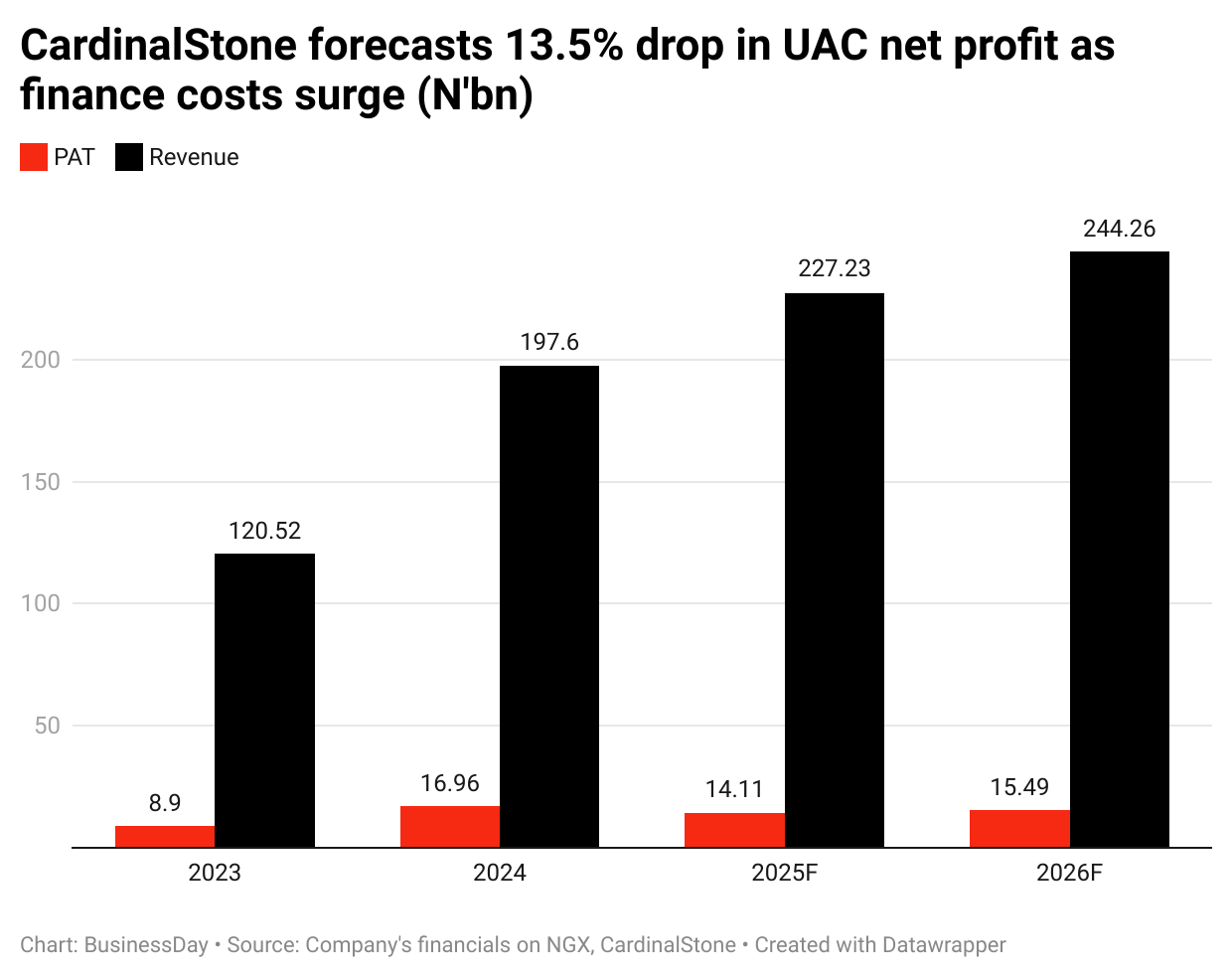
UACN Plc is expected to record a decline in full-year profit for 2025 as rising interest expenses continue to weigh on earnings, according to a new report by CardinalStone Research.
The company’s net finance cost is projected to hit N8.1 billion this year, up significantly from previous levels, as short-term borrowings and elevated interest rates take a toll on its bottom line.
“In Q1 2025, UACN experienced a 133.4 percent year-on-year increase in interest expense, driven by a rise in short-term borrowings,” the report said. The average interest rate on the company’s total borrowings rose to 24 percent, compared to 17 percent in the same period of 2024.
The majority of these borrowings are expected to mature in the second half of the year, amplifying the pressure on the company’s cash flow and profit margins.

CardinalStone forecasts that net profit will fall by 13.5 percent to N14.1 billion in FY 2025, with the profit-after-tax margin shrinking to 6.2 percent from 8.3 percent in the previous year.
Despite this potential fall in profit, the conglomerate is projected to see a 15.4 percent growth in revenue to N227.2 billion in 2025 buoyed by price increases and product innovations that spurred volume expansion.
Driving the growth from a product segment perspective is Packaged Food and Beverages, especially with the launch of new products like the 120g ‘Odogwu’ Gala.
The report also noted that foreign exchange gains which previously helped cushion finance costs may be minimal this year due to the relative stability of the naira. UACN holds a net long dollar position, but the subdued FX environment limits the scope for significant revaluation gains.
“With limited room for FX gains and continued pressure from interest expenses, UACN’s finance income growth will likely remain muted,” the analysts said.

UACN has embarked on deliberate and aggressive cost management initiatives, an effort that has slowed down the company’s cost-to-sales ratio over the past two years, moderating to 74.5 percent, down from 77.6 percent in Q1’24.
“This improvement has been largely attributed to operational efficiencies—particularly in energy usage—through initiatives such as monitoring energy consumption per unit of output and adopting more sustainable, cost-effective energy sources.”
In the first quarter of this year UAC’s revenue jumped by 63.4 percent year-on-year to N197.9 billion, driven by strong performance across all its major business segments — including food, paints, and real estate.
This helped the company nearly double its operating profit to N18.9 billion, while after-tax profit surged to N17 billion, up 90.4 percent from 2023.
Industry experts attributed the turnaround into profitability to the change in leadership structure that has now made the conglomerate reshaped from a sprawling holding company into a leaner, performance-focused enterprise.
The company sold off underperforming assets, refocused on its core consumer goods businesses, and instilled a culture of accountability and operational efficiency.
But like many of its peers, the group is navigating high inflation, currency volatility, and elevated monetary policy rates.
The Central Bank of Nigeria has kept interest rates high to tame inflation and stabilise the naira, creating a challenging borrowing environment for corporates.
The authorities maintained a hawkish stance in 2024, raising benchmark interest rates all through the year to anchor inflationary pressures that peaked above 33 percent. It has however held rates twice this year, leaving borrowing costs at 27.5 percent with focus on likely tightening to rein in rising prices.