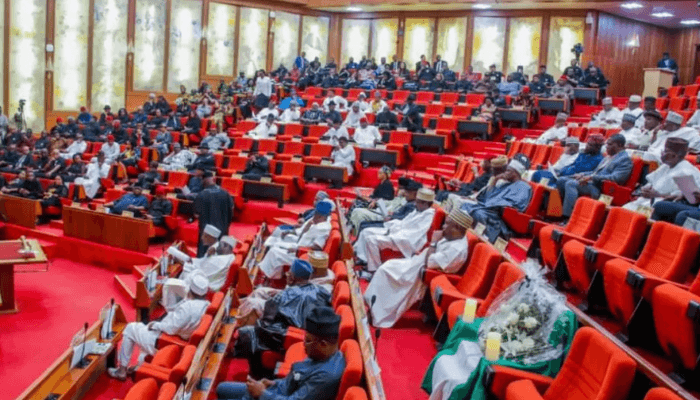
…Reps forge ahead with bold reforms
More than a year and three months after the 10th Senate inaugurated its Constitution Review Committee, all the constitution amendment bills have remained stuck at the first reading, raising concerns over yet another failed constitutional reform cycle.
The Senate’s slow pace sharply contrasts with that of the House of Representatives, which has already passed over 50 amendment bills through the second reading.
These include critical proposals on judicial and electoral reforms, inclusive governance, legislative reforms, and devolution of powers, among others.

Constitutional amendment exercises in Nigeria have historically been arduous. The Senate initiated comprehensive constitutional review bills but transmitted them to the 36 state houses of Assembly late.
Read also: As 7 constitutional amendment bills drown in Reps voice votes, ‘Tomorrow is here’ rings in Enugu
As a result, many states never even debated the bills before the legislative session ended, rendering the effort fruitless.
Experts and civil society groups fear a repeat of past failures unless the Senate significantly speeds up its engagement.
On February 14, 2024, the Senate constituted a 47-member Committee on the Review of the 1999 Constitution. At the inauguration, Senate President Godswill Akpabio stressed the need to address ‘numerous outdated or defective sections’ in the constitution.

Barau Jibrin, deputy Senate president, was named chairman, with Senate leader Opeyemi Bamidele serving as his deputy.
The committee met a week later and set a 24-month timeline to conclude the exercise by February 2026.
At that meeting, Senator Sani Musa (APC, Niger East) called for the prioritization of bills on state police, devolution of powers, and other directly impactful areas.
Yet, since that inaugural meeting and the Senate retreat in Kano, no formal activities have been publicly announced.
Repeated efforts to get comments directly from Barau or his media aide, Ismail Mudashir, yielded no response.
A committee member, who asked for anonymity, told BusinessDay that the Senate is ‘working behind the scenes’ to avoid the mistakes of past assemblies.
“We are in consultations with governors, traditional rulers, and the Conference of State Speakers. We know that bills passed by the National Assembly can only succeed if they’re approved by two-thirds of state assemblies,” the senator said.
House of Reps’ speedy passage
In contrast, the House of Representatives Committee on Constitutional Review, chaired by Deputy Speaker Benjamin Kalu, has held multiple public hearings, issued open calls for memoranda and maintains a visible public engagement strategy.
Some prominent bills passed through second reading in the House include: Creation of 37 special seats for women in the National Assembly; establishment of state police; financial and administrative autonomy for local governments; independent candidacy; diaspora voting rights; removal of immunity from criminal prosecution for public office holders; and recognition of traditional institutions, among many others.
Pressure on the Senate
As the constitutional reform process gains momentum in the House, domestic and international actors have added pressure on the Senate to act.
A few months ago, a delegation from the UK branch of the Commonwealth Parliamentary Association (CPA-UK), led by British MP Kate Osamor, paid a courtesy visit to Akpabio.
“We call on you to support the special seats for women in parliament by ensuring that the bills already sponsored for this purpose are considered and passed,” Osamor said.
The bill to create special seats for women was first introduced in the Ninth Assembly and has been re-sponsored in the 10th Assembly. It proposes to amend Sections 77(1) and 117(1) of the 1999 Constitution to establish 37 new Senate seats—one per state and the FCT—exclusively for women.
Former Vice-President Atiku Abubakar weighed in on the reform process with a memorandum to the Senate Committee.
Read also: Reps’ constitutional amendment bills erode federalism
In it, he proposed a six-year single term for the presidency and rotational leadership between North and South to reduce political tension and promote national unity.
Stakeholders are now worried that the Senate’s delay might lead to another fruitless constitutional reform effort.
Timing remains a challenge
Jide Ojo, a political analyst, told BusinessDay that timing remains a critical challenge.
“We are looking at a 24-month cycle, but if the Senate spends the first year consulting without legislative progress, there will be insufficient time to pass the bills and transmit them to state houses of assembly,” he warned.
He added, “What we are seeing is a lack of political will. The House is showing that reforms are possible. The Senate’s opacity undermines public trust in the process.”
The Civil Society Legislative Advocacy Centre (CISLAC), in response, expressed deep concern over the Nigerian Senate’s delay in considering and passing the constitutional amendment bills, warning that the inaction could threaten the nation’s democratic development and electoral reforms ahead of the 2027 general elections.
Auwal Musa Rafsanjani, executive director of CISLAC, in a statement issued on Wednesday, described the Senate’s inaction as ‘deeply concerning and regrettable,’ particularly in light of the commendable progress already made by the House of Representatives, which has passed nearly 100 of the proposed amendments.
“It sends the wrong signal about the urgency of much-needed constitutional reforms in Nigeria, especially at these critical moments when Nigerians are yearning for better governance and stronger institutions,” Rafsanjani said.
Read also: Reps’ constitutional amendment gambit, Senate’s house of horror’ and Jandor’s volte face
He stressed that the constitution forms the bedrock of Nigeria’s democracy, governance, and development. Delaying critical amendments—many of which focus on electoral reforms, equitable representation, judicial efficiency, and restructuring of the federal system—risks eroding public confidence in the legislative process, he warned.
“At a time when Nigerians are grappling with uncertainties and demand transparency, inclusion, and credible elections, this delay hampers the deepening of our democratic disposition,” Rafsanjani stated.
The CISLAC director also raised the alarm that 2026, a pre-election year, is fast approaching, and failure to pass the reform bills in good time could mean entering the next electoral cycle with the same institutional gaps that have long marred Nigeria’s elections.
“These amendments are not mere legislative routines; they are tools to enhance inclusivity, transparency, and the integrity of our democratic institutions,” he said.