



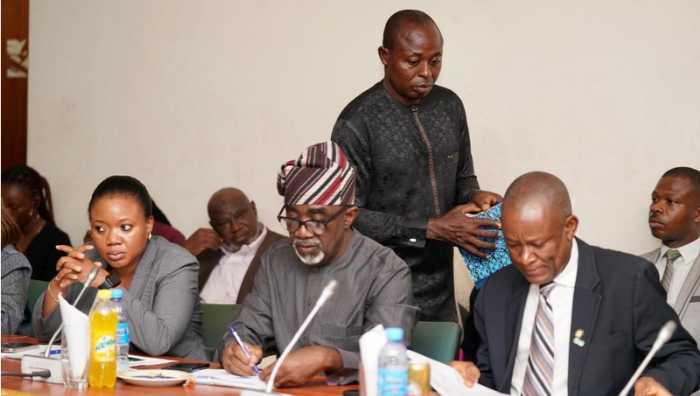
The Minister of State for Industry, Senator John Owan Enoh, has emphasised sugar sector’s strategic importance in driving President Bola Tinubu’s vision of a $1 trillion economy.
Speaking at the public hearing organised by the House of Representatives Committee on Industry as part of the amendment process of the Establishment Act of the National Sugar Development Council (NSDC), the Minister informed the gathering that President Bola Tinubu spoke glowingly about the sector’s potential in a recent meeting of the Federal Executive Council (FEC).
“About two weeks ago, the President spoke about sugar at the Federal Executive Council (FEC) meeting. That in itself is a reflection of the importance of sugar as a product. Sugar is such a strategic industrial and domestic product that no country must joke with and Nigeria should not.
“The sugar sector has a huge role to play in the President’s commitment to having a 1 trillion dollar economy. Our attitude towards it must ensure it plays that role adequately in terms of facilitating job creation and development of the rural economy,” he said.

Read also: Nigeria’s sugar crisis is a myth, and our economy may pay the price for believing it
Also speaking in the same vein, Kamar Bakrin, Executive Secretary of NSDC reiterated that a full implementation of the Nigeria Sugar Master Plan (NSMP) could save Nigeria over $1 billion in foreign exchange annually, while also creating jobs, attracting massive investments, and spurring rural development.
The proposed legislation aims to redefine the council’s powers and functions, and to align its financial operations with the 1999 Constitution.
Bakrin highlighted the immense potential of Nigeria’s sugar industry if the NSMP is properly implemented, noting that the plan is designed to stimulate domestic production and reduce reliance on imports.
“We need about $4.5 billion in investments to fully realise the vision of the NSMP,” he said.

“Investor confidence is therefore crucial, and that can only be achieved through transparent and rule-based policies,” he added.
He raised concerns over a recent government directive mandating that 50 percent of the sugar levy be paid into the Consolidated Revenue Fund (CRF), arguing that such a move could derail progress.
“The sugar levy was not meant as a general revenue-generating mechanism but as a dedicated fund to support the sector’s growth. Redirecting it threatens to undermine the very purpose for which it was created,” he noted.
The public hearing attracted major stakeholders, including representatives from the Nigeria Customs Service (NCS), National Agency for Food and Drug Administration and Control (NAFDAC), BUA Group, Flour Mills of Nigeria, and the Abuja-based consultancy NINA-JOJER.
NAFDAC, represented by Iba Edward, acknowledged the intent of the bill but warned against overlaps with the agency’s regulatory mandate.
“Some proposed provisions encroach on NAFDAC’s core responsibilities under Section 5 of our Act. We urge the lawmakers to clearly define roles to avoid duplication,” she said.
Aliyu Idi Hong, a former minister now representing BUA Group, said the company has invested in a 50,000-hectare sugar plantation, with 20,000 hectares already under cultivation.
He stressed the importance of stable policies for investor confidence.
“We are not there yet, but we are making progress. Regulatory certainty is key,” he said.
Similarly, Onome Okurah, Head of Government and Community Relations at Flour Mills of Nigeria (FMN), owners of the Golden Sugar Company (GSC) in Sunti, Niger State, spoke about the company’s ongoing efforts.
“We’re cultivating over 6,000 hectares and currently run sugar production for up to four months annually. With stronger partnerships, we expect tangible results in the coming years,” he said.
Chairman of the House Committee, Enitan Dolapo Badru, assured stakeholders that the legislative amendment would be inclusive as it is aimed at strengthening NSDC’s capacity to deliver on its mandate.





