



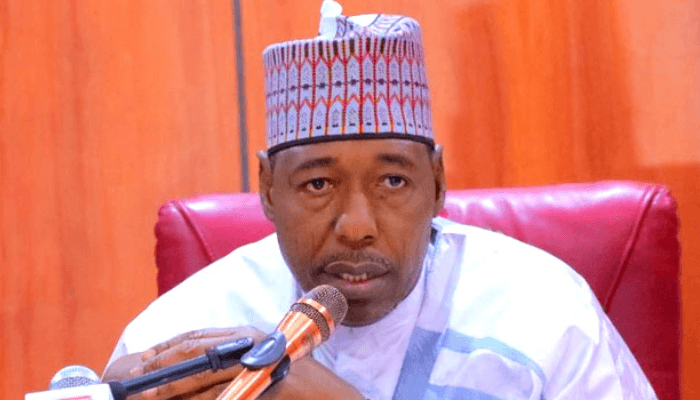
Babagana Zulum, governor of Borno State, has raised the alarm over internal sabotage hampering Nigeria’s fight against Boko Haram, alleging that some members of the Nigerian military and political class are serving as informants and collaborators to the insurgents.
The governor made the explosive revelation during a live interview on News Central’s Breakfast Central programme on Wednesday, where he warned that the Borno State government would take decisive action to strengthen intelligence networks and deal severely with saboteurs.
“We have informants and collaborators within the Nigerian armed forces, within the politicians, and within the communities. What we shall do is to strengthen our intelligence and to deal with them ruthlessly,” Zulum stated.
Read also: Insecurity: Obi applauds Zulum’s bold, courageous act in Marte

Decrying what he described as ‘contractocracy,’ a system where insecurity is prolonged due to vested contractual interests, the governor urged political leaders to move beyond politicisation and face the crisis head-on.
“In six months, we can put an end to this madness. We need not politicise insecurity,” he noted.
Responding to questions on the controversial reintegration of surrendered insurgents, Zulum acknowledged that while not all have fully reformed, the vast majority have turned away from violence and are contributing positively to the community.
“I cannot completely say that 100 percent of those people who have surrendered are doing the right thing, but I want to assure you that over 99 percent are doing well and are not participating in the ongoing terrorism,” he said.
Read also: Don’t allow Marte, other Borno’s towns captured, Zulum begs FG

He noted that although there remains a risk that a small number may relapse and return to the bush, the deradicalisation and reintegration efforts, backed by the military and civil society, are largely effective.
“Yes, I believe among the 500,000 or more that have repented, I cannot rule out the possibility of a few going back to the bush,” he said.
Zulum also raised the alarm over what he called ‘a significant equipment gap facing Nigerian troops on the frontlines,’ alleging that Boko Haram insurgents may even have the upper hand in terms of technology and resources.
“The army doesn’t have the necessary equipment on ground to fight the insurgency,” he said, noting that without adequate hardware, soldiers are left vulnerable despite their bravery and commitment.
Insisting that military action alone will not bring a sustainable end to the insurgency, Zulum advocated a holistic approach that combines both kinetic (military) and non-kinetic (socioeconomic and political) measures.
“Insurgency will never be ended by kinetic measures alone. We must ensure that the non-kinetic measures are also properly put in place,” he explained.
According to him, the ongoing non-kinetic strategies including community engagement, education, economic empowerment, and political reconciliation are already yielding tangible results, thanks in part to the cooperation of the armed forces.
“I want to commend the Nigerian armed forces for the support that they have been rendering to our non-kinetic measures,” Zulum noted.
In a direct appeal to President Bola Tinubu, Zulum urged the nation’s leader to take intelligence from military professionals seriously and avoid being misled by political considerations.
“The President of Nigeria needs to listen to those who can differentiate their left from their right.
“We should not politicise insecurity. The President needs to listen to the people who can tell him the right thing. The President should listen to the army,” the governor said pointedly.
He also revealed that plans are underway to deploy a dedicated forest guard to enhance surveillance and intelligence gathering in remote areas, a move he said would further tighten the security architecture across the state.





