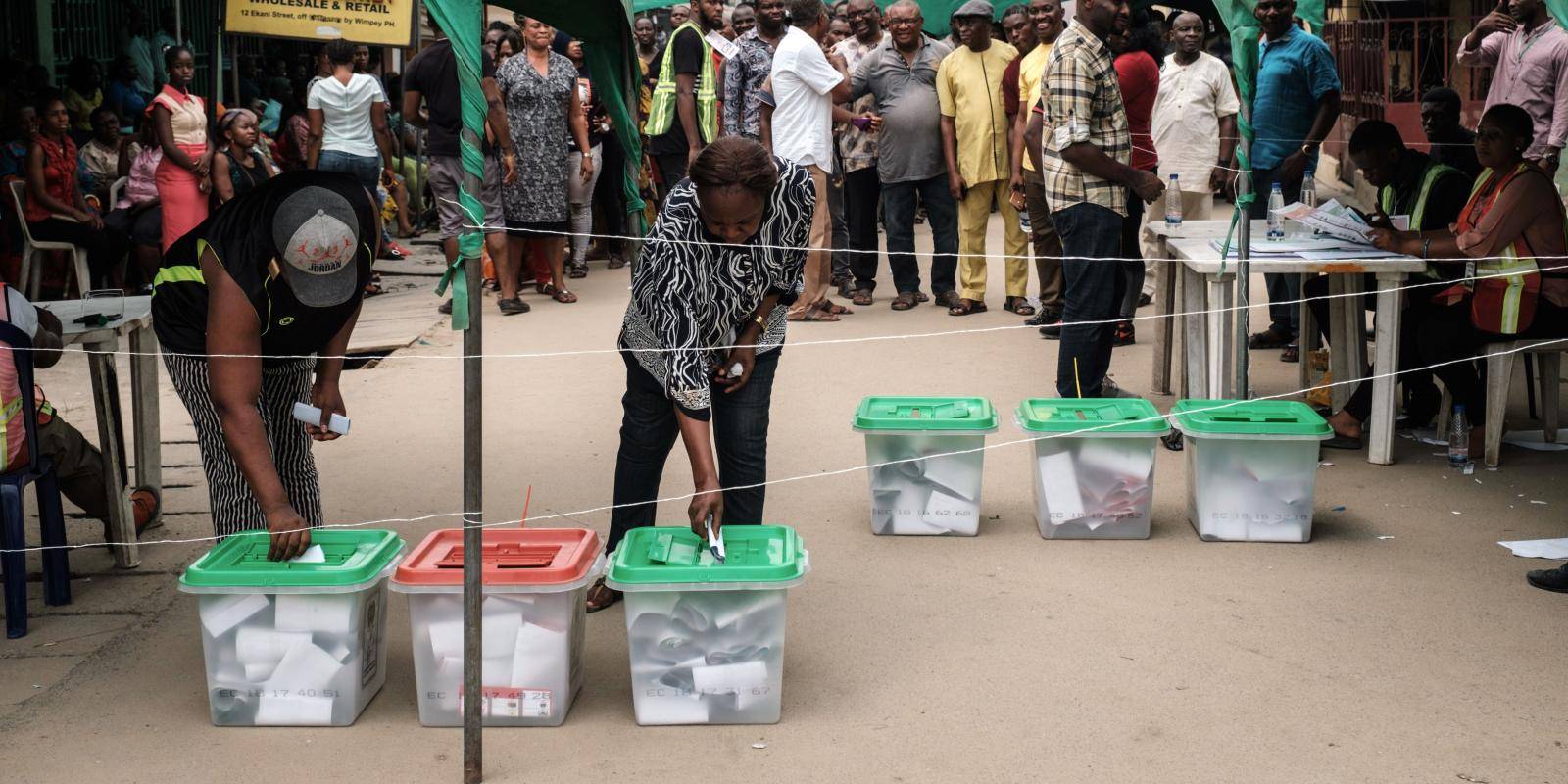
Nigeria’s politicians know the problem, and it’s not the voter
By Oluwole Crowther
A bill jointly sponsored by Tajudeen Abbas, the current Speaker of the House of Representatives from Kaduna, and Daniel Ago, who represents Bassa/Jos North Federal Constituency of Plateau State, proposes to make voting compulsory for all Nigerian citizens. While this may appear to be a step toward civic responsibility, it is a misdirected effort that ignores the core issues affecting Nigeria’s democracy.
The bill prescribes a six-month jail term or a N100,000 fine for eligible voters who fail to vote. However, Femi Falana SAN, a respected legal practitioner, has rightly described the bill as “constitutionally invalid”.

In a political economy analysis titled “Weak incentives could be holding back Nigeria’s productivity”, published by BusinessDay on 5 March 2025, the paper warned that “Nigeria risks repeating the cycle of near-reform success syndrome if it does not reform its political institutions, starting with the Independent National Electoral Commission (INEC).”
This insight aligns with the position of Mark Esset, who represents Uyo/Uruan in Akwa Ibom. During plenary, Esset advised the House to first fix INEC before making voting mandatory: “We are trying to put something on nothing,” he said.
Rebuilding trust before mandating participation
This dilemma is reminiscent of the age-old question: which comes first, the chicken or the egg? Political reform came first for countries that have historically achieved shared prosperity, as noted by economists Daron Acemoglu and James Robinson, authors of Why Nations Fail.
Esset clarified, “There is no problem making it compulsory for citizens to vote. But in a situation where citizens have lost confidence in their votes, it becomes a very serious problem. And as such, Mr Speaker, while we are making a law to make voting compulsory, we should also make a law that will make the votes of citizens count.”
Esset’s remarks hit at the heart of the matter. Yet, instead of engagement, his fellow lawmakers interrupted him with uproar, effectively silencing what was arguably the most thoughtful comment during the plenary.

“The last election, Mr Speaker, we can all say without shying from the truth, INEC chairman and all the INEC officers went around the country carrying out campaigns that their votes would count, making all sorts of promises. And at the end, we saw something else,” Esset continued before being abruptly shut down.
Citizens must demand real political reform
Now is the time for Nigerian citizens to pay closer attention and demand genuine political reform, starting with INEC. The small political elite understands precisely what the problems are. They simply choose not to solve them. These same elites travel frequently to the United Kingdom and other developed nations for medical check-ups and holidays, yet ignore the political mechanisms that made those societies functional.
A lesson from England’s parliament
Consider the story recounted by Acemoglu and Robinson. In 1583, William Lee, a Cambridge graduate turned clergyman, sought to mechanise the process of knitting after observing the laborious efforts of his mother and sisters. Remember that knitting became necessary because Elizabeth I (1558–1603) had recently issued a ruling that her people should always wear a knitted cap. By 1589, Lee invented the stocking frame knitting machine—a breakthrough in textile production.
With great hope, Lee travelled to London to seek a patent from Queen Elizabeth I. But the Queen, fearing the disruptive potential of his innovation, refused him.
“Thou aimest high, Master Lee. Consider thou what the invention could do to my poor subjects. It would assuredly bring to them ruin by depriving them of employment, thus making them beggars,” Elizabeth told Lee.
Her response mirrors the posture of many Nigerian politicians today, opposed to creative destruction. They prefer a stagnant status quo that keeps the populace poor and controllable. Even James I, Elizabeth’s successor, refused Lee a patent for the same reason: innovation threatened royal control.
Innovation threatens the status quo
As Acemoglu and Robinson observe, the stocking frame offered enormous productivity gains, but it also disrupted entrenched interests. Similarly, electoral reforms that ensure votes truly count threaten the political class, which is why many resist them.
What ultimately made the difference in England was not the monarchy but parliament, equivalent to Nigeria’s legislature. Parliament fought to dismantle domestic monopolies, restrict royal authority, and promote broad-based participation. This laid the foundation for the Industrial Revolution—an era of sustained economic prosperity.
Without political reform, economic progress is hollow
Nigerians must understand that economic reform without political reform is unsustainable. It will only deepen inequality and leave the majority behind, just as we are witnessing today.
A concerned citizen, Adebisi Ismail, summarises this point eloquently: “Any electoral reform that does not limit the responsibility of INEC, as a federal body, to only supervisory and funding roles will not yield positive results for our polity.” He further argues that “Each State Electoral Commission should be fully independent from state control and free from the influence of governors in terms of appointments. These commissions should be responsible for conducting state, local, and federal elections.”
According to him, INEC’s real job should be to guarantee electoral fairness through security deployment, real-time vote uploads, and the eradication of vote buying and thuggery.
“Any electoral reform that fails to take these considerations seriously will only worsen the state of our democratic process, polity, and democracy,” he warns.
He concludes with a compelling call to lawmakers that INEC should be made fully independent, free from presidential control and political appointments. Its role should shift to supervising, monitoring, funding, and ensuring transparency in all elections—federal, state, and local. At the same time, State Electoral Commissions must also be protected from interference by state governors and allowed to operate independently.
A final word to the House of Representatives
The Nigerian House of Representatives, under the leadership of Tajudeen Abbas, must embrace these recommendations, not silence them. Political courage lies not in proposing punitive measures against voters, but in building systems that inspire confidence. If the people’s votes count, they won’t need coercion—they will show up on their own.
The time for superficial reforms is over. Nigeria’s political reform must begin with fixing INEC, not criminalising the frustrated voter.