



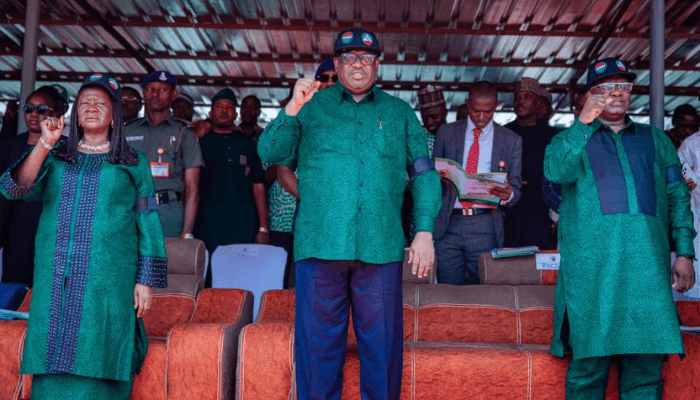
In a display of solidarity and mutual respect, Governor Caleb Manasseh Mutfwang of Plateau State joined thousands of workers in Jos to celebrate the 2025 May Day, reaffirming his administration’s commitment to the welfare, dignity, and prosperity of the state’s workforce.
The celebration, held at the historic Jos Polo Field, was more than a ceremonial gathering it was a reaffirmation of trust between a government determined to rebuild a resilient workforce ready to be partners in progress.
Accompanied by Ngo Josephine Piyo, his deputy and other top government officials, including Gabriel Dewan, the Speaker of the Plateau State House of Assembly, Governor Mutfwang was welcomed with chants and cheers from jubilant workers who gathered in unity to mark the international workers’ celebration.
Read also: Troops neutralise two bandits, recover rifle in Plateau ambush

In his keynote address, the Governor described the day’s theme, “Reclaiming the Civic Space in the Midst of Economic Hardship,” as a bold reflection of the nation’s current socioeconomic realities and a testament to the unbreakable spirit of Nigerian workers.
“We gather today not just to celebrate workers but to honour the courage, endurance, and unwavering dedication of Plateau workers, who continue to power our administration’s vision for a new Plateau,” Governor Mutfwang stated to thunderous applause.
Since taking office, the Governor said, his administration has focused on correcting the deep-rooted issues that plagued the civil service from irregular salaries and stalled promotions to unpaid pensions and infrastructural neglect.
Mutfwang recalled the difficult state of affairs he inherited delayed wages, broken morale, abandoned pensioners, and a climate of distrust between labour and government. But he also highlighted how these challenges became a call to action rather than a cause for despair.
He used the occasion to reassure Local Government workers, often overlooked in state-wide reforms, that their welfare remains a core priority of his administration’s inclusive governance model.

“The civil service was in distress, but we choose not to point fingers. We rolled up our sleeves and went to work. And today, the story has changed and changed for the better.
“Workers’ dignity begins with timely remuneration and ends with meaningful rewards for service. We are rebuilding that ladder of progress step by step.
“Together, we are not just surviving the times we are rebuilding our state,” the Governor concluded, leaving the podium to a rousing standing ovation.
True to his words, the administration has since implemented the N70,000 minimum wage, cleared salary arrears, and restarted the payment of pensions and gratuities policies that have brought renewed confidence among Plateau’s workforce.
The Governor also unveiled a range of pro-worker initiatives, including the reduction of transport fares through the Plateau Express Services and the signing of a Memorandum of Understanding to establish a Workers’ Housing Scheme, offering civil servants a path to affordable homeownership.
Read also: Plateau Mutfwang receives IDP land report, vows their return to ancestral homes
One of the most transformative actions was the resumption of long delayed promotions, ensuring that merit and hard work are once again recognized and rewarded within the Plateau civil service structure.
Beyond financial reforms, the administration has launched capacity-building programs and modernized workplace tools, showing a clear commitment to long-term productivity and innovation in the public sector.
Renovation of public offices across the state is also ongoing, aimed at creating a more dignified and conducive working atmosphere. This is a step workers say has boosted morale significantly.
At the heart of these reforms is a transformation in the relationship between government and labour unions. Where there was once friction, there is now respect, dialogue, and a shared vision for the state’s future.
Eugene Manji, the Chairman of the Nigeria Labour Congress (NLC) Plateau State Chapter, lauded Governor Mutfwang’s hands on leadership and transparency, describing the government-labour collaboration as “the most functional in the last decade.”
He praised the Governor’s timely response to not only worker-related issues but also the broader security challenges facing Plateau communities, noting that this dual commitment has strengthened public trust in the administration.
“Under this administration, salaries are paid on time, retirees are no longer abandoned, and peace is being restored. We see the efforts, and we stand with the Governor,” Manji said.
He also acknowledged the administration’s unique ability to blend empathy with action listening to workers’ concerns while implementing practical solutions to longstanding issues.
The Governor’s engagement with workers on his second May Day, since he assumed office was both symbolic and strategic. It reaffirmed his government’s promise to remain worker-centered and responsive to the evolving needs of civil servants across all tiers.
The celebration ended on a high note, with workers singing solidarity songs and expressing optimism that Plateau is entering a new era of harmony, prosperity, and accountable governance.
In a time when public trust is fragile and economic hardships weigh heavily, the unity between Governor Mutfwang and Plateau workers stands as a beacon of what can be achieved when leadership is rooted in empathy and guided by purpose.
Read also: May Day: We refused to be overwhelmed by the challenges we inherited, Mutfwang tells Plateau workers
At the Jos Polo field, the shared energy of hope, trust, and commitment lingered a clear signal that Plateau State is on the rise, and its workers are at the heart of its transformation.
For many, this May Day was more than a celebration. It was a turning point in the journey towards a new Plateau stronger, united, and driven by people who believe in the power of purposeful governance.
From the handshake of solidarity to the roll call of reforms, one truth emerged: the bond between Mutfwang and Plateau workers is not just political, it is a partnership born of shared struggles and a common dream. And that bond, strengthened by mutual respect and sustained by action, may well be the catalyst for Plateau’s long awaited renaissance.





