



… IEPL may be Africa’s greenest production plant
Most Nigerians already know that the fast growing petrochemicals outfit known as the Indorama Eleme Petrochemicals and Fertilizer complex may by end of 2025 attract up to $4.6bn in Foreign Direct Investment (FDI) in Nigeria, and may be contributing $2.9bn to Nigeria’s gross domestic product (GDP) annually. What many may not know yet is that the petrochemical and fertilizer plant in Eleme Nigeria may be the greenest plant complex in Africa.
The plant, the size of a normal village in Nigeria, yields trucks loaded with resins and pellets that serve as raw materials for various plastic materials on one hand, and on the other hand two major fertilizer products in the ammonia and urea. These products either go to the various locations in Nigeria for local consumption or to the nearby jetty at Onne for export via ships.


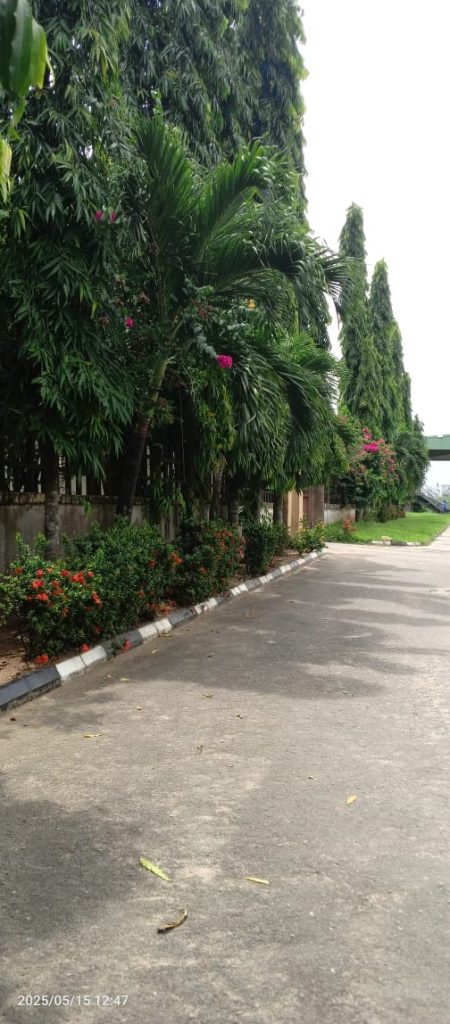
A tour of the all-green plant in Eleme:
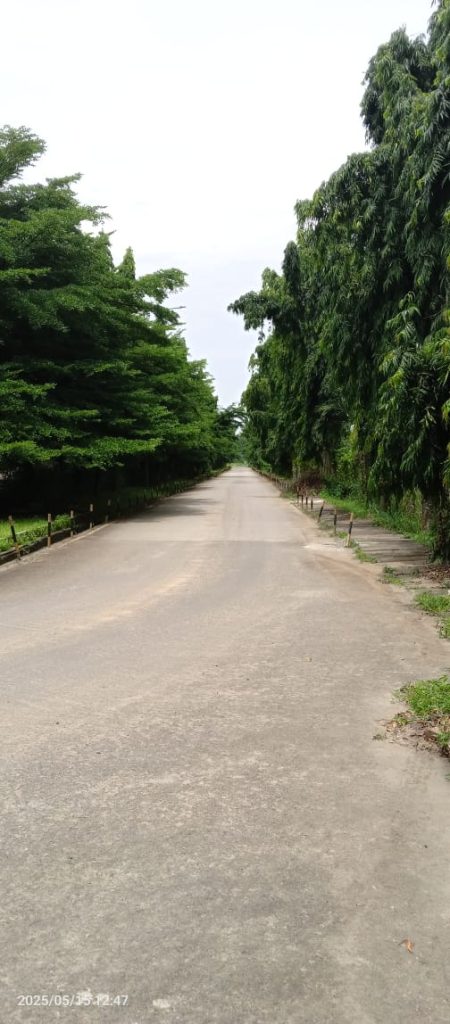
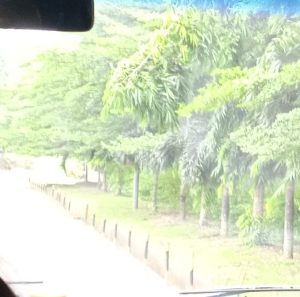
The world may be going green but a trip round the complex in Eleme shows that Indorama Eleme Petrochemicals & Fertilizer complex is already green. From the gate to the extremes of the large compound indicate that industrial plants and natural plants can grow together. At some points, the visitor may not even see the sky anymore, looking like the enviable woodlands of Kenya in East Africa.
Each time Indorama-Eleme is accused of pollution or any untoward activity against the environment or health of man, some company officials not only point to the array of certifications on their walls but they take visitors and regulators to the greens of the plant complex and the river that flows through the complex where birds flock and ducks swim happily.
They seem to ask you to decide if a zone where birds live and chirp happy and flower trees abound is likely to be pollution zone or be harmful to humans.
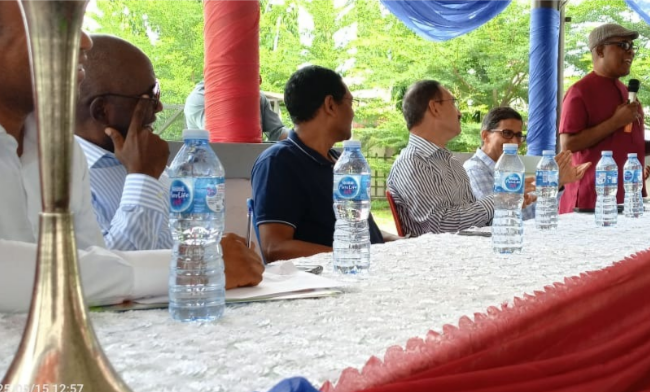
The company made a very important personnel change and this warranted the presence of over 100 top journalists in the complex close to Port Harcourt on the East-West Road on the way to the Port Harcourt Refinery.

A tour was arranged for all the journalists and top officials of the company in four buses, each bus with a tour guide who is a well-grounded manager.
Read also: At Indorama, Jossy Nkwocha hands over to Justice Bibiye
The tour began from the restaurant located at the southernmost part of the complex, next to their football field. Soon, the trip snailed into a green hallway, a road framed both sides by tall tree-flowers that cast the look of passing through the woods.
The tour guide reminded the journalists that in most industrial locations, grasses die, showing that the place is not very conducive for life but that in this plant complex, plants blossom.
The team drove past the Recreational Club complex where construction is ongoing; then came on sight Union secretariats on the right for the various unions that operate in the place. The next is the Police station next, then the car park, all adorned by trees of different species.
At this point, the petrochemicals plants begin to emerge after the car park on the right. One of the most sensitive requirements in the petrochemicals industry is environment, which is part of HSE (health, safety and environment). In this case, what happens to the water that comes from the processing mechanism is very important and creates the basis for which most inspectors flood such plants.
In Indorama-Eleme, the effluent water treatment plant is by the right side as the plant area begins. Yet, trees upon trees line up the place and provides a very lush and green pathway. Some of the plants such as coconuts were seen heavy with fruits, evidence of healthy life around.
Next is the Environment, Fire, Safety Department by the left. The officials say this department is as efficiently run as the plants. Its fire station is said to operate at topnotch, an is linked to the state fire service system. This means that once there is fire in the Garden City and some other areas, their station joins the effort and can go as Borokiri in the Old Port Harcourt City to intervene.
Next is the Olefin Plant. This is said to produce Ethylene and Propylene; key raw materials to produce polypropylene which end up as some of the most exotic and cherished plastic products that rule the world, some in airplanes and ships. This is the power of Polypheme and polyethylene.
The road opens into what looks like the floral beauty zone up to the plant zone toward the power plant zone.
Indorama said they met four gas turbines when they acquired the place in 2006 to restart the plant. Now, the plants are six. One is always on standby, and the 7th plant is coming. This is said to be evidence of the vision that operates in Indorama group that has transformed the petrochemicals and fertilizer plants.
He is generated in the plant and this is transferred underground to a place it is treated and separated and returned to the plant. Everything seems carefully handled and treated.
At this point, officials noted that everything on the right side is new investment. There are arrays of fertilizer plants; thus Fertilizer Line one; Line two. Line three is under construction; while line four is now at design stage.
Thus, the Ammonia plant (liquid ammonia) and the Urea Plant (urea fertilizer) for local and for export use. Each plant has a control room and these form series of control rooms where experts see everything happening in each section of the plants and control everything. Yet, there are field persons in the plants seeing with the eye to agree with what is being seen remotely through instrumentation system.
Officials like to call their facility an all-green plant in Eleme, to them it is one of the cleanest plants in the world.
The raw material for all this is natural gas which they feed into a conditioning unit: Ammonia needs lighter version; heavier one goes to other plants.
Now, they say Plant three will be ready by April 2026; Fertilizer Plant Four is on the drawing board. Everything is said to be planned and timed. Things work in the plant, yet it is Nigeria.
The tour gets to the Warehouse zone, large vats that once showed the pains of failure. It was like an industrial museum to study how to fail because it was lying empty and fallow for years, entering bad decay stage, because Indorama acquired the plant.
Now, it has the bulk loading zone where products go straight to the jetty, no bagging, to overseas for export. Next is a lab which obtains soil samples from each part of Nigeria to know what suits them and advise them and supply them. The journey ends at the Haulage zone for bagged products that move off to the local market, all in quiet and orderly manner.
Outcome:
Recently, managing director of Indorama-Nigeria, Manish Mundra, gave hints of how FDI to Nigeria through Indorama would hit $4.6bn by 2025.
It has been reported recently that Indorama Eleme Petrochemicals Limited (IEPL) has emerged as a major value creator in the Nigerian economy. “It is responsible for the survival, growth and sustenance of many manufacturing companies in Nigeria today. A large number of plastic and allied firms depend on the Eleme-based company for petrochemical resins (or polymer resins) which serve as their raw materials.
“The petrochemical company is just one of the several subsidiaries of Indorama-Nigeria Group, which also comprises Indorama Eleme Fertilizer & Chemicals Limited (IEFCL), Indorama PET Nigeria Limited, and Indorama Port Operations.
“Since Indorama Corporation of Indonesia became core investor in the old Eleme Petrochemicals Company Limited (EPCL) in 2006 through privatisation programme of the Federal Government, the group has become a game changer in the Nigerian economy.
“The petrochemical company has solved the major challenge facing a number of manufacturers— poor access to raw materials. Rather than scramble for foreign exchange to import inputs, the company ensures that manufacturers have access to their critical raw materials, enabling them to save costs and improve margins.
“The major resins used by plastic and allied companies are polyethylene and polypropylene. Indorama produces about 45 grades of these products for various industries. About 600 of such companies in Nigeria depend on IEPL for their survival.” Before Indorama, plastics companies were less than 15, suffering under importation of resins. Now, they are estimated to have over 90,000 workers.
Recently, it has been reported, IEPL completed its 4th Turn-Around Maintenance (TAM), which it completed in record 24 days. This is the 4th since 2006 when it took over EPCL. This is remarkable considering the fact that in Nigeria, TAM is regarded as almost impossible in the refineries and other sectors.
Another subsidiary, Indorama Eleme Fertilizer & Chemicals Limited (IEFCL), has a Train-1 world-class fertilizer plant in Port Harcourt, funded majorly by the International Finance Corporation (IFC). The plant produces 1.5 million metric tons of urea fertilizer, which has revolutionalised farming, boosted food production, helped to ensure food security and propriety for farmers.
Reports say: “Indorama sells about half of the urea production to Nigerian farmers and exports the rest to South America, Brazil, West Africa, Central Africa and other parts of the world, thereby earning foreign exchange which is badly needed by the Nigerian economy. The fertilizer company is one of the biggest non-oil exporters in Nigeria, according to the export records of the Nigerian Export Promotion Council (NEPC).”
Key contributions and templates:
Some of the business journalists that visited the plant observed that Indorama-Eleme Petrochemicals & Fertilizer Company can be credited with some innovations and breakthroughs that seem worthy of emulation in finding a way forward for industries in Nigeria.
They mentioned the success of turn around maintenance (TAM) schemes which seemed a dread in Nigeria for decades, and which were blamed for failure of most production facilities in Nigeria including the refineries.
Another success story seems to be how to manage the host communities. The host communities hold 7.5% equity in Indorama-Eleme which at one point fetched accumulated N14bn. If there is any fight, it is within the communities trying to decide how to share their booty. Workers also have 7.5% share capital. Yet, there is a heavy Corporate Social Responsibility (CSR) activity to complement the equity.
Indorama Eleme seems to breed modesty and show Nigerians how well to do companies still lie low with the lowest profile: modest cars, simple dress, etc.
Other intangibles that the company seems to excel in include how to make smooth changes without rancour; perfect planning, etc. Above all, they seem to teach the rest how best to pick their media managers. They pick from the beloved members of the pen fraternity especially from the local (Port Harcourt) zone despite the candidates being some of the very best in the industry. The result seems to be the winning formula that rules the place, and strategic communication policy of Indorama.
Indorama pours encomiums on Jossy Nkwocha:
It was thus a perfect way to conclude the day with the management pouring encomiums on Jossy Nkwocha, the outgoing head of corporate communications department. He is a veteran journalist and Public Relations expert.
Read also: Dangote Fertiliser, Indorama led non-oil exports in October – CBN
He handed over to Justice Bibiye, who has been an ace broadcaster in the African Independent Television (AIT).
It was thus a solemn moment Thursday, May 15, 2025, when Sivadas Deepu, the Chief Technical Officer (CTO), eulogized the Nkwocha for his meritorious services for 18 years.
He said Nkwocha is a thoroughbred Communications professional who has contributed immensely to the growth of the group.
Deepu who represented the Managing Director, Mundra, said it is rare to find a head of department in any organization that turned his department to his image, saying Nkwocha, reputation capital expert, achieved the feat. He also admitted that Nkwocha left big shoes to be filled.
He advised Nkwocha, a UNN Ph.D holder in Public Relations, one of first two in Africa, never to retire from his profession, rather “to re-tyre” his professionalism and move on to higher heights.
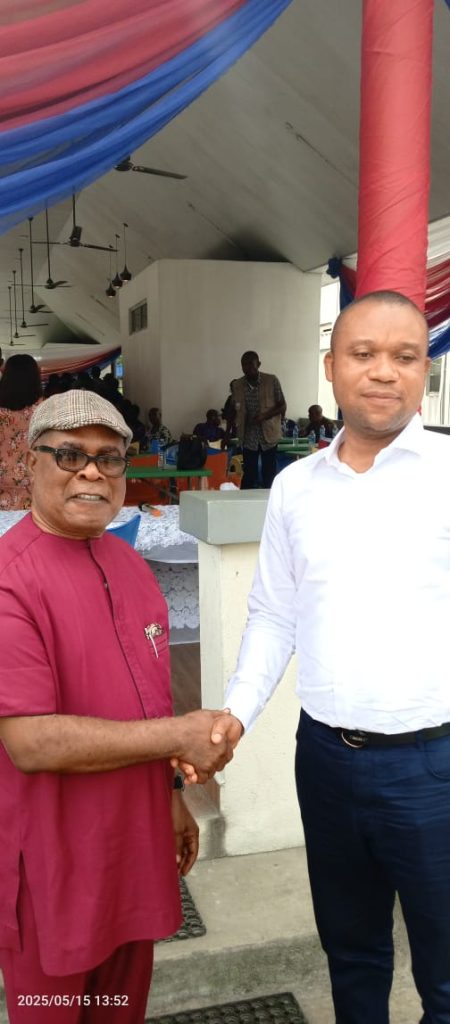
Nkwocha had earlier introduced his successor, Bibiye, whom he said would step into his shoes after he formally steps aside on 31st May 2025.
Deepu advised Bibiye to work hard to fit into the big shoes being left by Nkwocha. “He may not be tall but his shoes are quite big” he joked.
The event tagged “Happy Hour” for journalists in Rivers State attracted over 100 journalists and also featured a facility tour of the Petrochemicals and Fertilizer plants full of greenery.
Nkwocha said the objective of the event was to thank the media for supporting him in the past 18 years and asked them to extend the same support to his successor Bibiye.
In his remarks to welcome the Journalists, Biriye appealed for support, reminding the media men that he was part of the Port Harcourt media family. He described Indorama facilities and plants in Eleme, near Port Harcourt as a critical national asset.
,





