|
Getting your Trinity Audio player ready...
|
…And the many fruits and outcomes of a new vision
Many have come to hear that the Niger Delta Development Commission (NDDC) is now operating a transformation system instead of transactional leadership system. Explaining the difference between transactional leadership of old and transformational leadership of the present, an insider said: “Money is involved in transaction, while transformation represents change.”
Whatever be the difference, the task of developing the Niger Delta region cannot be taken lightly and this may have informed the NDDC’s policy of transitioning from transaction to transformation to ensure effective service delivery to the people.
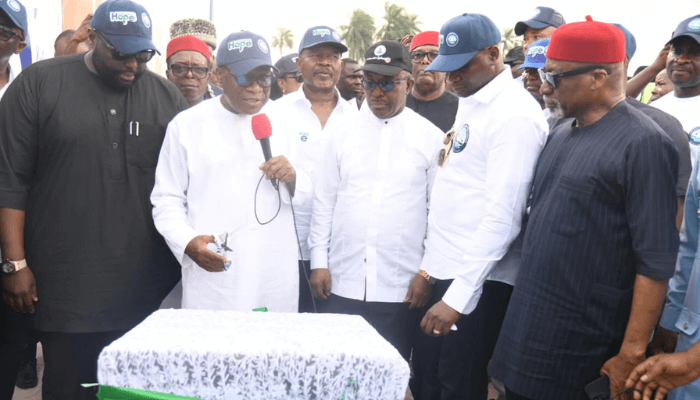
Recently, the Commission’s development and transformation programmes have been given impetus with the inauguration of completed projects across the nine Niger Delta states.

Read also: NDDC launches ‘Mission to Heal’ with Nigeria’s First Lady
Some landmark projects were inaugurated in Delta, Rivers, Imo and Abia States. They included the Abraka-Oben Road in Ethiope East Local Government Area of Delta State and the Obunku-Umuosi Road in Oyibo Local Government Area of Rivers State.
Others are the 7.8-km Eziama-Abba-Owerre Nkworji Road, which links Isiala Mbano Local Government Area to Nwangele Local Government Area of Imo State, and the reconstructed Isi-Court Olokoro-Amaoba Oboro Road in Umuahia South LGA of Abia State.
Today, there are testaments from people satisfied by the performance of the NDDC in recent times, in the quest to improve the living conditions of Niger Deltans. Observers say there now refreshing stories of success after many years of unfulfilled expectations.
These projects also seem to testify to the positive impact of transitioning from transaction to transformation.

The NDDC is also seen to demonstrate determined to make the Renewed Hope Agenda of the Federal Government a reality in the Niger Delta region.
In 2024, between May 18 and May 28, the NDDC commissioned the 27.5-kilometre Ogbia-Nembe Road constructed in partnership with Shell Petroleum Development Company, SPDC. The N24 billion flagship project illustrates the kind of challenges confronting the Niger Delta. It cuts through the mangrove swamps with many bridges and 99 culverts, opening up 14 communities along its stretch to economic activities and modern development.
Similarly, the Commission inaugurated the 6km Iko-Atabrikang-Akata-Opulom-Ikot Inwang-Okoroutip-Iwochang Road and 600m Ibeno Bridge in the Ibeno Local Government Area of Akwa Ibom State, as well as the 9km Obehie-Oke-Ikpe Road in the Ukwa West LGA of Abia State.
For the people living in over 2,000 communities spread across five local government areas of Ondo State, NDDC has given them light after many years in darkness. The Commission has completed and commissioned the 132/33 kv substation in Okitipupa.
Read also: NDDC resumes support to universities in oil region with Uniport in focus
An elated Governor of Ondo State, Hon. Lucky Ayedetiwa, thanked the NDDC for completing and commissioning the record-breaking project.
Indeed, the governor is not alone in eulogising the NDDC. In all its engagements around the region, there is a groundswell of support from stakeholders long desirous of an NDDC that works towards facilitating regional sustainable development.
The 45-km double-circuit 33kv feeder line from Omotosho Power Station to Okitipupa has supplied light to 25 local governments in the dark for 15 years. The NDDC also inaugurated the 1×15MVA 33/11KV electricity injection substation in Amufi, Ikpoba-Okha Local Government Area in Benin City, Edo State.
The achievements of the NDDC have also attracted testimonials from eminent Niger Delta stakeholders. From Ijaw leaders, Timi Alaibe, to Akwa Ibom State Governor, Eno Umo and Rivers State Governor, Similaye Fubara, the stakeholders lined up behind the NDDC to strengthen its hands in the arduous task of fast-tracking the development of Nigeria’s oil-rich region.
The Akwa Ibom State Governor noted that partnership between the NDDC and the state governments in the region was necessary, adding, “We need to collaborate and not compete.
“I am glad that you have started a stakeholders’ engagement, and I urge you to meet all the governors of the nine Niger Delta states.”
The commendations come against the background of a 25-year-old NDDC contending with varied challenges. Since its inception, the NDDC has struggled with faithfully delivering on its mandate as envisioned by the region’s stakeholders: to be an interventionist agency that brings about the desired peace and development through the accountable and equitable allocation of resources for infrastructural development and empowerment.
As promised by the current NDDC board and Management, things are now said to be done differently to drive sustainable regional development effectively. Part of the strategy was the adoption of the Public-Private Partnership (PPP) model to provide alternative funding sources for key development projects and programmes.
What has been achieved so far, shows that the PPP initiative has strengthened the hands of the NDDC in using partnerships to drive its vision of fast-tracking the development of the Niger Delta region.
To further leverage the benefits of the new trajectory, the NDDC organised a PPP summit in Lagos to explore the possibilities presented by a PPP model. This is part of the Commission’s strategy to reduce its reliance on International Oil Companies to raise funds for development projects.
One positive outcome of the PPP initiative is signing a Memorandum of Understanding (MOU) between the NDDC and the Nigeria Liquified Natural Gas Limited (NLNG). They agreed to collaborate on diverse fronts to deliver sustainable development projects.
Insiders say the MOU will enable the two organisations to collaborate to empower communities in the region, promote local content and capacity development, and work with stakeholders along the value chain to deliver sustainable development projects effectively.
The gains of the emerging collaborations are said to confirm that the NDDC is indeed charting a different course with new strategies anchored on transparency and accountability.
The new approach is said to take into account the vision of the NDDC, which is to create an enabling environment for the sustainable development of the Niger Delta region. In practical terms the Commission’s leadership could be said to be focused on the mission “to facilitate the sustainable, even and rapid development of the Niger Delta, into a region that is socially stable, politically peaceful, economically prosperous and ecologically regenerative.” Evidence could be sited when the nation was on fire for fuel price hike but it was mild in the Niger Delta region.
A new NDDC is gradually emerging, and the plan so far has been to improve project and service delivery by enthroning and strengthening the transparency of the commission’s processes to ensure accountability and efficiency.
Internally, the NDDC restructured its administrative system by returning to the 13 Directorates recognised in the NDDC Act. The Commission also introduced measures to build confidence and trust among all partners and stakeholders.
It set up a system to establish a robust Corporate Governance structure that fosters accountability and transparency, and to develop clear and measurable Key Performance Indicators (KPIs) to track progress towards goals.
Efforts were made to ensure that NDDC has a seamless system that enables it to operate according to global best practices.
To ensure that a new institutional culture anchored on sound ethics and good corporate governance is in place, the Commission engaged KPMG, a reputable global business consultancy, to review and strengthen its corporate governance system and improve its internal processes and institutional protocols. This is said to be paying off.