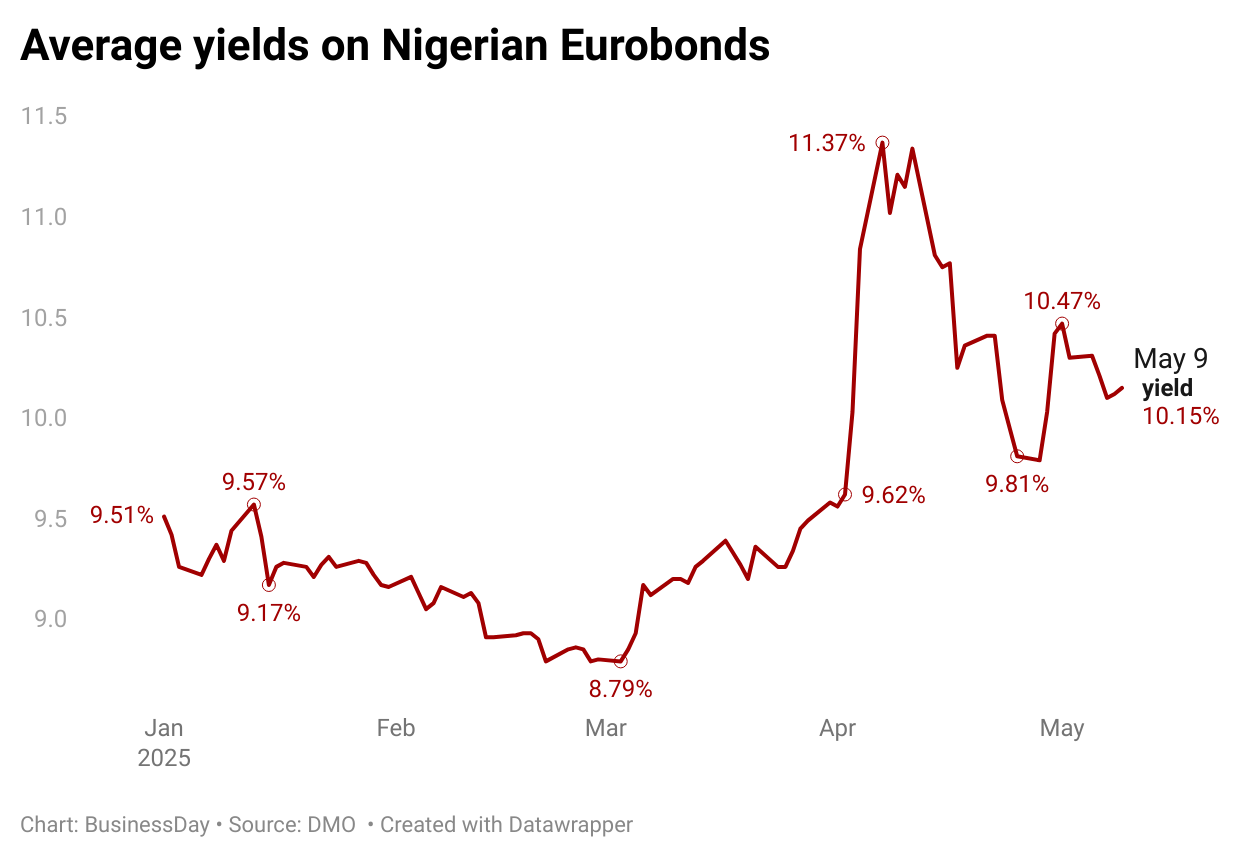
Nigerian Eurobonds rallied last week, buoyed by a rebound in global oil prices and easing trade tensions, offering investors renewed confidence in the country’s external debt amid improving risk sentiment.
The Eurobond market turned bullish during the week, with buying interest dominating across nearly all maturities.
The only exception was the NOV-27 paper, which saw a modest three basis point uptick in yield.
As a result, the average Eurobond yield fell to 10.15 percent, compared to 10.30 percent in the previous week, according to data from the Debt Management Office (DMO).

The most notable yield declines were observed on the NOV-25 (-43bps), MAR-29 (-30bps), and JUN-31 (-27bps) instruments.
Nigerian Eurobonds recovered some of their recent losses, with prices rising 0.8 percent over the period.
The average price of the papers rose to $88.25 on friday last week from $87.55 the previous week.
Analysts say that offshore sentiment has improved alongside a rebound in oil prices, which had previously slipped below $60/bbl.
For Nigeria, its premium crude oil grades are trading above $65 per barrel as global oil prices hold steady. Industry reports indicate that Nigeria’s crude oil grades are currently fetching between $65 to $68 per barrel, supported by steady buying interest from European and Asian refiners.

Similar bullish sentiment was seen across the Sub-Saharan African Sovereign Eurobonds market, leading to an 11bps decline in average yield to 9.5 percent.
“ We attribute this broad-based momentum to attractive valuations, following weeks of risk-off sentiment occasioned by the disruptive effects of the initial worldwide tariff impositions by President Trump,” analysts at Afrinvest said in irts weekly report.
Last week, the US and China struck a new trade agreement after two days of talks in Switzerland, bringing an end to the trade wars that caused global uncertainty and flight to safety.
According to a White House statement released Yesterday, the United States will cut the low-value “de minimis” tariff on Chinese shipments to 54 percent from 120 percent, while maintaining a flat fee of $100, effective from May 14, according to a White House executive order issued on Monday.
China has agreed to reduce its 125 percent duties on US goods to 10 percent and remove other countermeasures taken against the US since April 2. It also removed its month-long ban on airlines taking delivery of Boeing Co. planes.
This week, analysts expect relative stability in the Eurobond market.
“For the SSA and Corporate Eurobond markets, we expect stability in the market as investors continue to hunt for decent bargains in high-yielding instruments,” analysts at Afrinvest said.