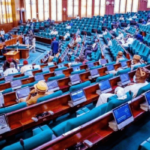
For any outsider visiting the National Assembly for the first time, especially during plenary hours without making it into the main chambers, the experience might leave more than just a little dent in their perception of Nigeria.
Whatever form of admiration or respect they came in with is likely to drop, perhaps not entirely, but significantly.
At first glance, the grandeur of the complex may deceive you. From the gates, there’s an air of authority and power.
The security protocols, the marble floors, and the bureaucratic bustle suggest a place where big decisions are made.

But walk a little further into the office wings and reality sets in, hot, sweaty, and humbling. The scene inside is nothing short of chaotic: people fanning themselves like it’s a traditional wedding in the peak of dry season, some clutching old newspaper pages in desperation, others with colorful, locally made hand fans, trying to battle the unrelenting heat that pours in like a punishment from the sun.
It’s a heat that tells its own story, a tale not of total darkness, but of a frustrating power shortfall.
According to some staff members, the problem isn’t that electricity is absent, but that it’s simply not enough.
“PHCN gives us power, yes,” said a maintenance worker who asked not to be named, “but the current they supply is often below 200 kilowatts. What we need is 230 kilowatts to power all the offices and the cooling systems.”

Because of this shortfall, the National Assembly has adopted a now-ritualised power strategy.
During plenary sessions, the generators are switched on to provide a stable current to the chambers alone, ensuring smooth broadcast, lighting, and comfort for lawmakers inside.
But while senators debate bills and address the nation’s future, their offices, just a throwaway, are sweltering in silence.
“No AC, no fan, just heat,” lamented a legislative aide.
“Even opening the window doesn’t help because there’s barely cross ventilation. Sometimes, we sit outside under the tree just to breathe.”
This isn’t just about inconvenience; it’s now affecting productivity.
After the plenary, power is partially restored, but only to priority zones. The senators’ offices and a few corridor chillers are cooled again.
The rest of the building remains unbearably hot, particularly the wings where civil servants, committee secretaries, support staff, and journalists work.
“It feels like we’re being punished,” said another staffer. “We serve the same country. Why are only a few rooms cooled while the rest of us sweat and struggle?”
In the iconic White House section of the Assembly, the story is worse.
The area, notorious for poor ventilation, becomes almost uninhabitable by mid-afternoon. Not even the corridor chillers in the White House are turned on.
Read also: FG approves National Integrated Electricity Policy to transform power sector
Some departments now unofficially close early, staff quietly packing up by 2 or 3 p.m., unable to bear the heat any longer.
“It’s not just a matter of discomfort,” said a female staff member who works with one of the ranking committee chairmen. “This heat affects your mood, your energy, and your work. How do you focus on policy memos when your clothes are drenched and your system is overheating?”
Interestingly, lawmakers are not oblivious to the conditions, even if many remain insulated from the worst of it. “We know,” one senator admitted off-record. “The air conditioning doesn’t run during plenary in our offices, and sometimes you return and it’s like walking into an oven.”
“It’s why many of us now deliberately wait in the tea room for a longer time, so that the offices can start cooling before we go there.”
But beyond the heat lies a more symbolic crisis. In a country that’s battling energy reform, where power generation and distribution continue to plague homes and industries, the very seat of legislation appears unable to maintain consistent cooling and basic work conditions.
If the National Assembly, a place where energy policy is debated and passed, can’t get stable power for its own operations, what hope does the average Nigerian citizen have?
Some aides joke that the building is a “perfect metaphor for the country,” impressive from the outside, but struggling with internal dysfunction.
“You come into this big, beautiful structure,” one journalist covering the Senate said, “and you’d expect efficiency, order, and at least air conditioning. But after 30 minutes of running around for interviews, you’re sweating through your shirt.”
Not everyone is complaining, though. Some have adapted in creative ways.
Local hand fans are back in fashion. Small rechargeable fans have become statement pieces.
And then there are the few lucky ones, mostly women who have adapted stylishly, clutching their mini rechargeable fans like essential gadgets.
These little fans, often hung around the neck or held close to the face, have now become part of the unofficial dress code for survival at the National Assembly.
Read also: How Enugu is transforming the electricity market
In the age of climate change and digital policy, the irony is biting. The building that ought to represent the future, one where technology, renewable energy, and digital governance are being actively pursued, is still battling with how to share 230 kilowatts of current equitably.
Staff say they’ve raised the issue through internal channels, but little has changed. “The response is always the same,” one said with a shrug. “Blame PHCN, blame the load. Meanwhile, we are the ones roasting.”
The National Assembly, a microcosm of Nigeria’s broader infrastructural challenges, is struggling to power itself.
If nothing else, it’s a sweaty reminder that governance is not just about passing bills but also about setting examples, even if it’s just by turning on the lights and keeping the fans running.
As plenary season intensifies and more bills are tabled, from tax reforms to constitutional amendments, one can only hope that someone in the Assembly will make room on the agenda for internal welfare and basic infrastructure.
While the National Assembly debates how to fix Nigeria, the power to fix itself seems to remain just out of reach.