Since the 2023 presidential election in Nigeria, many supporters of Bola Tinubu—Nigeria’s president and former governor of Lagos—have attributed the development of Lagos to his leadership. Often, these supporters say, “He built Lagos,” without acknowledging the natural advantages Lagos holds over other states.
Throughout history, nations situated along the sea have accumulated tremendous wealth due to maritime trade. Countries like Venice, England, China, and South Africa leveraged their access to the sea to prosper. When such countries cut themselves off from international trade, like China and Venice once did, their economies faltered.
Lessons from history: The power of maritime trade
Daron Acemoglu and James Robinson, in Why Nations Fail, explain how England’s monarchs monopolised international trade to enrich the government and their allies. During the English Civil War, Parliament challenged these monopolies and eventually won. Domestic monopolies were abolished, though the monarchy retained control over overseas trade.

One notable example was the Royal African Company, granted a monopoly charter by Charles II in 1660. His brother, James (later James II), was both the governor and a major shareholder. The company controlled the lucrative African slave trade, highlighting the strategic importance of overseas commerce to the English crown.
In Venice, Italy, maritime trade once fueled widespread prosperity. Situated in the north of the Adriatic Sea, the city was possibly the richest in the world during the Middle Ages. Its inclusive economic system encouraged political participation and innovation. A key invention was the “commenda”, a rudimentary joint-stock company formed for single trading missions. This contract enabled young entrepreneurs without capital to partner with sedentary investors and participate in long-distance trade. These partnerships fostered upward mobility and inclusive prosperity.
The commenda system was a powerful vehicle for social mobility. Official records show a high percentage of new names entering the Venetian elite in the 10th century. The wealth it generated was made possible because of Venice’s location and the maritime trade that followed.
But when the elite began to feel threatened by new wealth and rising competition, they dismantled these institutions. By banning the commenda and introducing high taxes on trade in 1324, Venice shifted from inclusive to extractive institutions. Long-distance trade became reserved for the nobility. As Acemoglu and Robinson note, “This was the beginning of the end of Venetian prosperity.” Today, Venice’s economy relies mainly on tourism.
China’s experience was similar. During the Song dynasty (960–1279), China led the world in technology—clocks, compasses, gunpowder, and paper were all Chinese innovations. In 1500, its standard of living rivalled Europe’s. However, China’s government monopolised overseas trade and later banned it entirely. Emperor Yongle reinitiated oceangoing tribute missions in 1402, but by 1436, all overseas trade was banned, and shipbuilding was made illegal. The ban remained until 1567.

This policy had long-lasting consequences. China remained economically stagnant while other regions industrialised. By the time Mao Zedong took power in 1949, China was one of the poorest countries in the world. These cases demonstrate how international trade, when coupled with inclusive institutions, can elevate nations—and how its restriction can result in decline.
Lagos’s strategic advantage
In Nigeria, several states—Lagos, Rivers, Akwa Ibom, Bayelsa, Cross River, Delta, Ogun, and Ondo—are bordered by the Atlantic Ocean. Yet, only Lagos has a fully functional port. Apapa and Tin Can ports dominate trade, while the Onne Port in Rivers State is limited to oil and gas. Calabar Port, according to its manager Olumati Festus, has not seen a container vessel in 25 years.
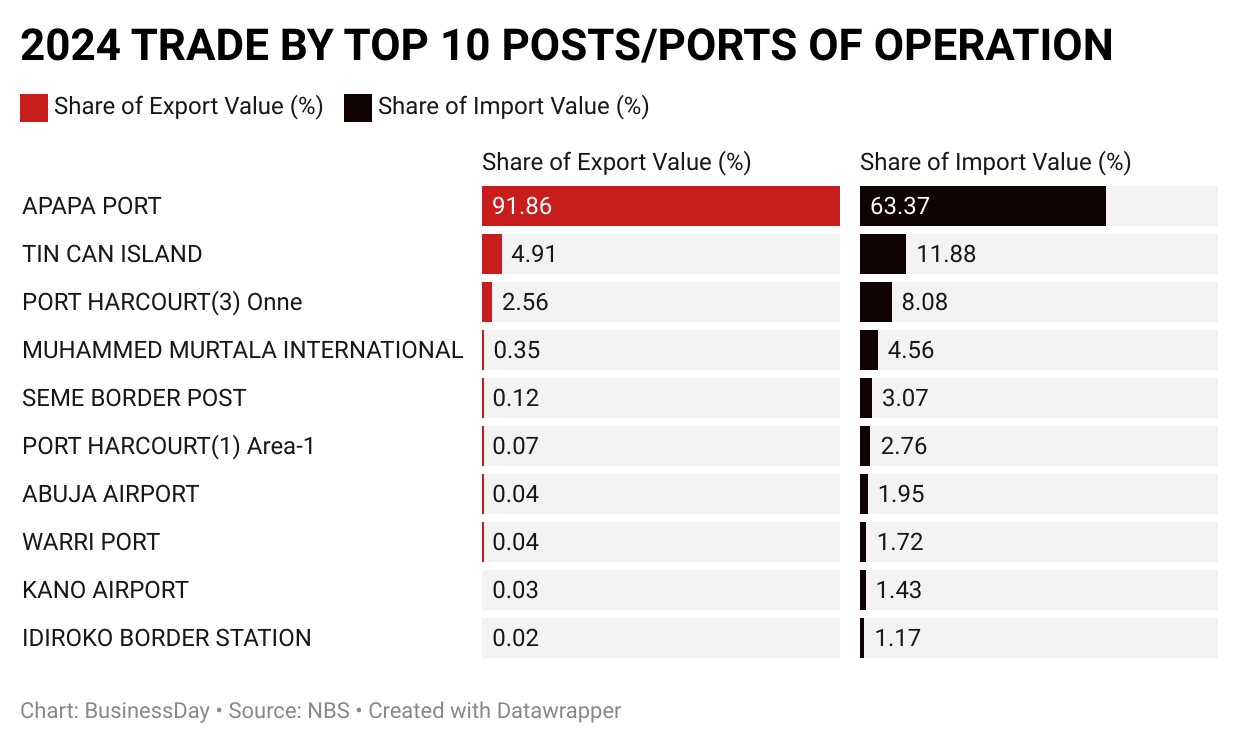
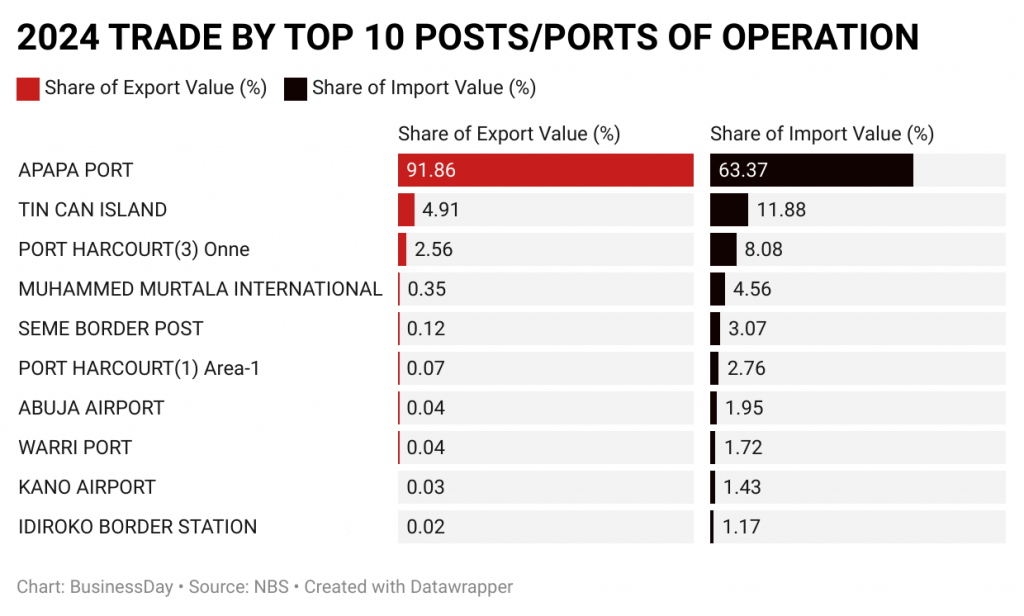
Recent data from the National Bureau of Statistics (NBS) in 2024 show that 91.86 percent of Nigeria’s total exports passed through Apapa Port, and 4.91 percent through Tin Can, leaving a meagre 3.23 percent to all other ports combined. Imports follow a similar pattern: 63.37 percent through Apapa, 11.88 percent via Tin Can, with the rest accounting for 24.75 percent.
The pull of ports: Industry and innovation in Lagos
Since the federal government controls all functioning ports and they are in Lagos, it is natural for firms to site their operations there. Paul Krugman’s New Economic Geography explains how industries cluster based on economies of scale, transport costs, and access to inputs. In Nigeria’s context—where logistics are expensive and infrastructure is weak, it makes economic sense to locate industries near ports.
Until recently, most industrial inputs were imported, further strengthening Lagos’s logistical advantage. In contrast, Kano, once a thriving industrial hub, has declined due to decaying infrastructure, long distances to seaports, and the collapse of railway systems. BusinessDay’s investigations cite erratic power supply and poor transport networks as additional factors.
This explains why Lagos dominates Nigeria’s economy. According to BudgIT, Lagos contributes 25.05 percent of Nigeria’s GDP, followed by Rivers State at 4.84 percent.
Lagos: A story written by the sea
Lagos’s rise as a commercial hub began with its coastline. Before bridges, roads, or railways, the sea was its primary link to the outside world. The Portuguese first made contact in the late 15th century via the Atlantic. Later, the British formalised their presence through trade and colonial conquest, facilitated by Lagos’s strategic location on the Gulf of Guinea.
By 1861, Lagos had become a British Crown Colony following a naval blockade and political pressure. Its natural harbour made it an essential point of entry—first for merchant ships, then for military forces. This geographic advantage laid the groundwork for modern Lagos.
Building on legacy: Rail, telecom, and industry
Lagos continued to evolve with innovation. In 1898, the colonial government opened the first railway line in Nigeria, connecting Lagos to the interior. Though documentation on Lagos Railways Limited is incomplete, the impact is clear: agriculture, trade, and urbanisation flourished.
By the mid-20th century, Lagos was undergoing infrastructural upgrades. As reported by the Daily Times in its March 17, 1949 edition, the project was part of a broader plan to modernise Lagos’s communication infrastructure. A major development came in 1953, when the city inaugurated its largest automatic telephone exchange. This upgrade, built by the UK’s General Electric Company, replaced the manual system introduced in 1933. The new exchange served Lagos, Ikeja, Ebute Metta, and Apapa, and included features like metered calling, trunk dialling, and a “speaking clock.” It was scalable to accommodate more users as the city grew.
Lagos’s growth is no accident
Lagos’s dominance is no accident—it is the result of geographic luck, early infrastructural investments, federal port control, and the agglomeration effects described by economic theory. From its role as the colonial and post-independence capital, to hosting all federal ministries, international organisations, and key infrastructure like three federal ports, a major international airport, and the national railway terminus, Lagos benefited immensely from early concentration of state resources. Julius Berger’s construction of roads and bridges, including the Second Marina Bridge in 1965 and the ring road in 1975, laid a modern foundation long before many current Nigerian states were even created. As Kalu Aja, US-based Financial Expert, notes, “Lagos should be benchmarking itself against global peers like Cairo, Johannesburg, Nairobi, and Rio, not caught in arguments with states still playing catch-up”.
As Nigeria looks to diversify its growth across other regions, the Lagos model offers both inspiration and a cautionary tale: without infrastructure, trade access, and institutional support, no amount of political goodwill alone can replicate such success.