…why Nigeria’s business reforms must include the informal sector to unlock true economic growth.
Nigeria’s economic potential is vast, yet it remains largely unrealised, trapped between two contrasting realities. On one side lies a formal sector that benefits from targeted reforms and policy attention; on the other, an expansive informal economy that fuels livelihoods but remains excluded from the formal policy framework.
The ease or difficulty of doing business in Nigeria is not a singular experience. It is bifurcated, shaped by whether an enterprise is registered or not and, by extension, whether it can access finance, infrastructure, or legal protections. Until Nigeria confronts this duality head-on, reforms will only scratch the surface of its development aspirations.
Read also: 10 steps to starting a business in the US as an African immigrant

Ease of doing business is critical to Nigeria’s ambition for sustainable economic growth and private-sector-led development. Historically, Nigeria has grappled with a complex business environment characterised by bureaucratic inefficiencies, infrastructure deficits, regulatory opacity, and insecurity.
Nonetheless, between 2018 and 2020, the country made measurable progress, moving up 15 places on the World Bank’s now-defunct Doing Business rankings to reach 131st out of 190 economies. This improvement was largely attributed to reforms in business registration, credit access, and cross-border trade.
Yet beneath these headline figures lies a structural divide. Nigeria’s economy is dualistic. The formal sector, comprising registered corporations, banks, industries, and SMEs, accounts for approximately 55 percent of national GDP (National Bureau of Statistics, 2024) and drives tax revenue, exports, and large-scale employment.
It benefits from government initiatives such as the Presidential Enabling Business Environment Council (PEBEC), which introduced National Action Plans (NAPs) to streamline regulations, digitise company registrations through the Corporate Affairs Commission, and improve port logistics.
“Dominating sectors such as agriculture, retail, transportation, and construction, the informal economy operates outside the reach of traditional regulatory frameworks.”

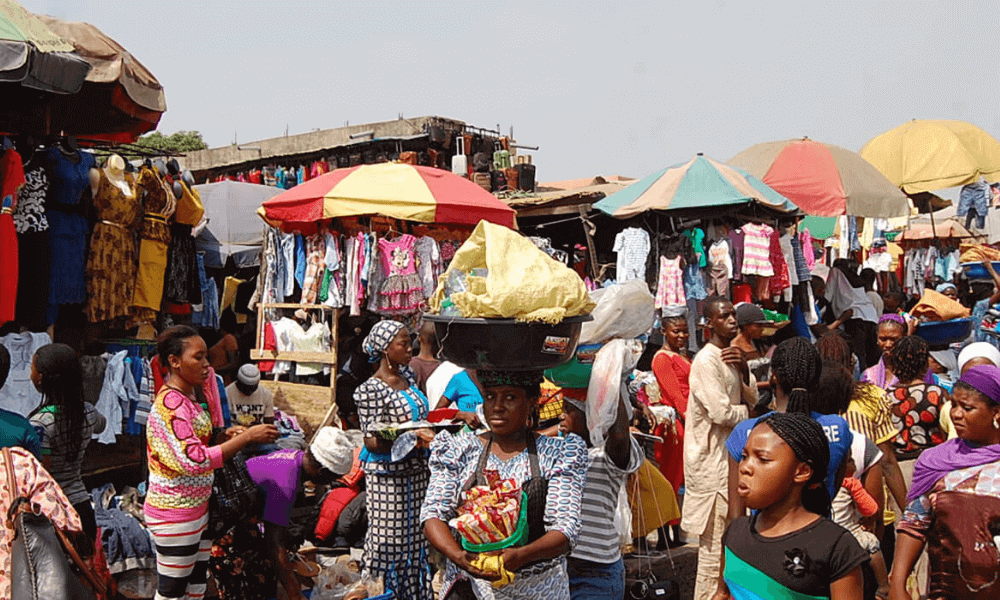
In contrast, the informal sector, consisting of unregistered microenterprises, artisans, market traders, and smallholder farmers, contributes an impressive 45 percent of Nigeria’s GDP and employs an estimated 80–85 percent of the workforce (International Labour Organisation, 2024; IMF Country Report, 2024).
Figure 1: Comparative Analysis of Formal and Informal Sector Contributions to GDP, Employment, and Productivity in Nigeria (2024)

Dominating sectors such as agriculture, retail, transportation, and construction, the informal economy operates outside the reach of traditional regulatory frameworks. According to Enhancing Financial Innovation & Access (EFInA, 2024), only about 40 percent of informal operators use formal financial services; more than 60 percent rely on informal savings groups, reflecting persistent financial exclusion.
Read also: Firms see employment rise as business activities reach 15-month high
Productivity within this sector remains low. World Bank data (2024) indicates that informal enterprises in Nigeria are on average 4–7 times less productive than formal ones, a gap considerably wider than in peer economies like Vietnam or Kenya. Without structured support, innovation incentives, or access to affordable credit, many informal businesses remain locked in low-margin, subsistence-level operations.
Formalisation continues to prove elusive. Despite multiple reforms, only 9 percent of informal enterprises attempted registration over the past five years, citing high costs, tax burdens, and distrust of regulatory institutions (Corporate Affairs Commission, 2024).
This underscores a central policy failure: ease of doing business reforms have not yet bridged the divide between formal and informal sectors. Addressing this imbalance is essential if Nigeria is to harness its full economic potential.
Policy implications for economic reform
First, Nigeria must pursue a dual-track reform agenda enhancing the formal sector while enabling the informal one. This could include mobile-first registration platforms with zero upfront costs, deferred tax registration, and simplified compliance pathways.
Second, financial inclusion should be aggressively expanded. Microfinance institutions, digital banks, and fintech platforms must be empowered to reach informal entrepreneurs. Kenya’s mobile money model, led by M-Pesa, which lifted financial inclusion from 26 percent to over 82 percent in a decade, offers a compelling case study for Nigeria.
Third, infrastructure investments must target informal economy hubs: markets, transit corridors, and agro-processing zones. Productivity will remain stunted without roads, electricity, logistics, and digital access in these spaces.
Fourth, property rights reform is imperative. A vast portion of the informal economy operates without recognised land titles, especially in peri-urban and rural areas. This limits access to credit and formal growth. Legal recognition of land ownership, particularly for women and youth, could unlock latent capital.
Fifth, tax policy must evolve. Instead of punitive compliance requirements, presumptive tax models such as small flat taxes based on estimated turnover could incentivise registration. Rwanda’s simplified tax framework offers a useful reference point.
Finally, skills and entrepreneurship training should be embedded into national and subnational strategies. Informal sector actors need accessible training in business management, digital literacy, and value-chain upgrading to scale beyond subsistence.
Conclusion
Bridging the gap between Nigeria’s formal and informal economies is no longer optional. It is the only viable route to inclusive growth, job creation, and economic resilience. Policymakers must recognise that the informal economy is not a footnote to development; it is central to it.
Olajide Dahunsi, Lecturer/Sustainability Advocate. United Kingdom