Imagine you’re an investor willing to commit between N30 million and N500 million into Nigeria’s agriculture and food sector. Nigeria is planning a tax incentive where such an investment would earn you tax relief for up to 15 years—or even more.
Here’s how it works: for every N30 million invested, which is a minimum fund for Agric investment, the government offers a 5 percent tax credit, equivalent to N1.5 million. If your tax liability in a given year is N1 million, for instance, this credit will fully offset it, leaving you with a balance of N500,000 in tax credits. That unused credit can be carried forward and applied to future tax liabilities for up to five years.
The incentive gets even more attractive if your investments are spread. Suppose you invest N30 million in the first year—you earn N1.5 million in tax credit, valid for five years. If you invest another N30 million in the second year, you receive an additional N1.5 million credit. This new investment begins its investment cycle, which can be used over another five years separately. This cycle can continue, extending your tax relief across 15 to 20 years, depending on how your investments grow. The maximum investment that earns you tax credit for the Agriculture and food sector is N500 million for up to 20 years. This procedure applies to all the listed priority sectors in the table.
According to Oyedele, “the priority sector incentive is not about giving tax breaks without limits; it’s about rewarding real, productive investments in sectors that matter most to Nigeria’s future.” He explained that the scheme focuses on verified capital investments, ensuring investors not only enjoy long-term tax credits but also help scale critical industries like agriculture, manufacturing, and energy. “We believe that moving forward, we can do much better than we’ve done in the past and truly set our country on the path to irreversible progress,” Oyedele added.

As Nigeria pushes ahead with its sweeping fiscal reform agenda, one of the most promising developments for the investment community is the launch of the Economic Development Incentive Scheme (EDIS). This initiative, a centrepiece of the country’s proposed tax bill, replaces the Pioneer Status Incentive with a smarter, performance-based structure designed to catalyse growth in priority sectors.
This guide outlines how investors can navigate and maximise tax credit opportunities in the new system, with practical insights drawn from the national policy rollout and reform presentations.
Economic Development Incentive Scheme (EDIS): What’s in it for you?
The EDIS is targeted at sectors deemed most critical for Nigeria’s economic resurgence. These include manufacturing, agriculture, energy, mining, health, logistics, and creative industries. What sets this scheme apart is its data-based, asset-linked tax credit model.
Key features:
-
5 percent annual tax credit for verified capital assets (up to 5 years, extendable to 10 years).
-
Credits are cumulative and offset income tax liabilities.
-
Capital allowances remain intact—a rare double tax advantage.
-
Sector-specific thresholds and sunset clauses prevent abuse and ensure strategic alignment.
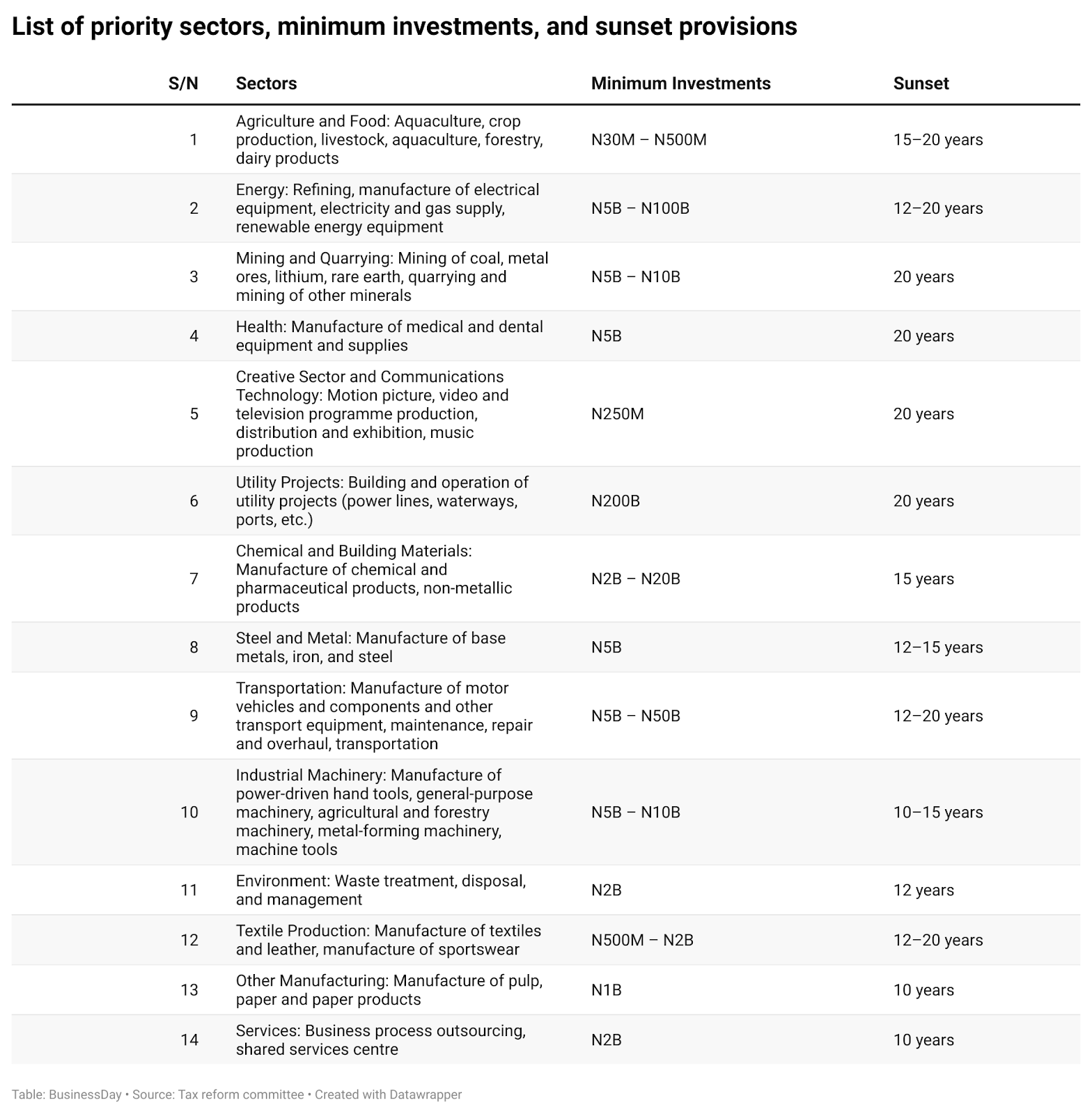
List of priority sectors, minimum investments and sunset provisions
For example:

-
Agriculture & Food: N100M–N500M minimum investment; 15–20 year sunset.
-
Utility Projects: N200B minimum; 20-year sunset.
-
Creative Sector: N100M–N1B minimum; 10-year sunset.
The rest of the sectors are in the table below.

What Businesses stand to gain
The reform expects to reduce risks, ease compliance, and boost competitiveness:
What we expect from the reforms
For Businesses:
-
Lower tax burden (via credits and reduced rates).
-
Elimination of minimum tax on capital.
-
Faster refunds, better planning with clearer rules.
-
Encouragement to formalise operations with 0% CIT for small businesses under N100M turnover.
For Government:
-
Increased tax-to-GDP ratio (from 10% to a target of 18% by 2027).
-
Fiscal sustainability via responsible borrowing and non-oil revenue growth.
How to maximise the incentive
-
Choose your sector strategically — Confirm eligibility and minimum investment thresholds.
-
Phase your capital investments to extend the tax credit lifecycle (credits apply per asset, per year).
-
Maintain verifiable documentation — Credits require validation by the Industrial Inspectorate Division.
-
Stay compliant — File incentive reports annually to remain eligible.
-
Use the credit smartly — Offset annual income tax without affecting your capital allowance claims.
-
Partnership: Investors can pull resources together and invest in the choice of their sector/sectors.
A Smarter incentive for smarter investors
Oyedele cautions investors to prepare ahead, noting that the countdown on incentives begins immediately the law is signed. “If the laws are passed today and they take effect on a particular day, these sunsets begin to count from that day,” he explained. “For example, if the incentive for agriculture and food is 15 to 20 years, the 20 years start counting from the day the law commences. If you get the approval one day before the 20 years expire, you can still enjoy the incentive, but after that, no new approvals will be granted.”
This means strategic investors must move quickly to position themselves and meet the conditions early enough to maximise the full benefits of the scheme.
For savvy investors, this is a unique window to enter or expand in Nigeria’s emerging sectors with a guaranteed return in tax savings and an opportunity to contribute to national development while building sustainable businesses.