…700 million dollars waiting disbursement by FG
As environmental experts predicted that some coastal communities in the Niger Delta and other African communities will be submerged by 2030-2050 due to the hard climatic conditions from climate change, some community stakeholders and Civil Society Organisations are seeking ways to combat the menace.
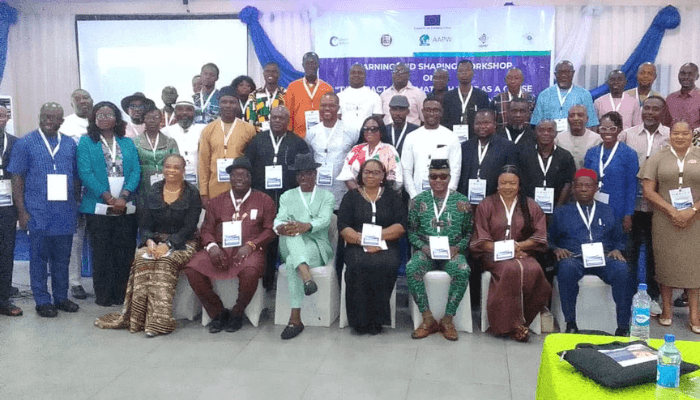
The issue was a major part of the discussion at a two-day ‘Learning and Sharing Workshop on Impact of Climate Change As a Cause of Conflict in Coastal Communities’ in Port Harcourt, the Rivers State capital, recently.
In her welcome address, the Executive Director, Academic Associates Peace Works, Judith Burdin Asuni explained that the idea of doing a project on the intersection of climate change and sharing workshop on impact of climate change as a cause of conflict in coastal communities was to seek possible ways communities can avoid conflict caused by climate change, especially in the Niger Delta.

Read also: Climate change and Nigeria’s growing food crisis
Asuni maintained that their work with the militants then prepared them for the peace process of 2016 which eventually led to the creation of the Niger Delta Dialogue.
“This was sponsored by the European Union, chaired by HRM King Alfred Diete Spiff, and facilitated by Amb Nkoyo Toyo, Amb Godknows Igali and myself,” she stated.
The Executive Director further explained that their good track record with the European Union ( EU) led them to being recommended to other organisations working on piracy in the Gulf of Guinea, while also working with the Italian shipping academy, where they brainstormed on how to address climate change in West Africa.
She stated that her organisation, the Academic Associates Peace Works, used its decades of experience in community conflict to see how climate change can impact community dynamics as reports and Handbook have been produced, saying that the workshop attendants comprised journalists, academicians, community leaders and Civil Society Organisations that are qualified enough to amplify and escalate the issues relating to climate change and how scare resources can lead to conflict between communities if not properly handled, while urging the participants to use their wealth of knowledge to seek ways communities can overcome climate change without generating conflict.
In his Presentation on ‘Overview of Climate Change Impact on Coastal Communities’, Raynus Ebiegeri who is the Coordinator of Community Network in Akasa Bayelsa State said that climate change has impacted many people negatively and that if the people did not seek solution by 2030-2050 many coastal communities would be wiped away by the negative effects of climate change.
” Many communities will vanish due to flooding arising from climate change, due to deforestation, constant decrease in mangrove vegetation and sand mining,” he said.

He told participants that it was the carbon emissions and the fossil fuel that were the major contributors to climate change, saying that homegrown solutions can help mitigate the impact, since there is an increase in global warming.
Read also: Climate activists renew call for climate reparations for Africa
In his contributions, Isu Menidin, Project Manager of AAPW, said climate change has caused many conflicts in coastal communities and that if not properly managed, it could lead to loss of lives and property. He explained that 10 communities were selected with the aim of enhancing the resilience of coastal communities.
According to Menidin, it was discovered that most rivers, creeks are drying up due to climate change and that the livelihood of the local people is gradually being eroded as climate change is playing a big role in the coastal community crisis, with only scarce resources.
He stressed that over 100 persons have been trained on climate change in 10 communities, especially on waste management and waste selection, with the formation of Community Stakeholders Network( CSN).
In his submission, Asụ Beks, the Chief Executive Officer of Maritime Media Limited, tasked the federal government under President Bola Tinubu to disburse the over 700 million dollars as a revolving loan for ship owners in Nigeria. He said that such fund will create employment opportunities in the blue economy while putting Nigeria on the global map for maritime business.
In an interview with journalists shortly after the event, Amb. Nkoyo Toyo, the facilitator and the assistant director of AAPW, said that part of the discussion was the protection of the endangered species of the coastal communities.
“We are asking that more engagement should be done in respect of the coastal communities’ protection and preservation of resources. The communities also mentioned how, through tradition, their resources can be preserved.
Read also: Climate change undermining efforts to reduce poverty, inequality – WorldBank
Toyo also said that historically, there are things that can raise conflict within the coastal communities, and such should be avoided since the people are vulnerable when strangers invade their communities to collect their resources, and that this can cause conflict, but they can rise up and ensure that they are protected by the government.
The former National lawmaker emphasised the need for the protection and the security of the coastal communities so that conflict will not arise since they are fragile to climate change and they need to be protected by the government at all times.
Some key recommendations were made from the workshop, including that there must be community ownership of issues affecting them, policies and development concerning them must be specific, PIA issues should begin to address climate change condition in their communities, climate change should be in the school curriculum, capacity of the communities should be built, communities should form forest protection law as the formation of Coastal Community Advocacy Network was also made.